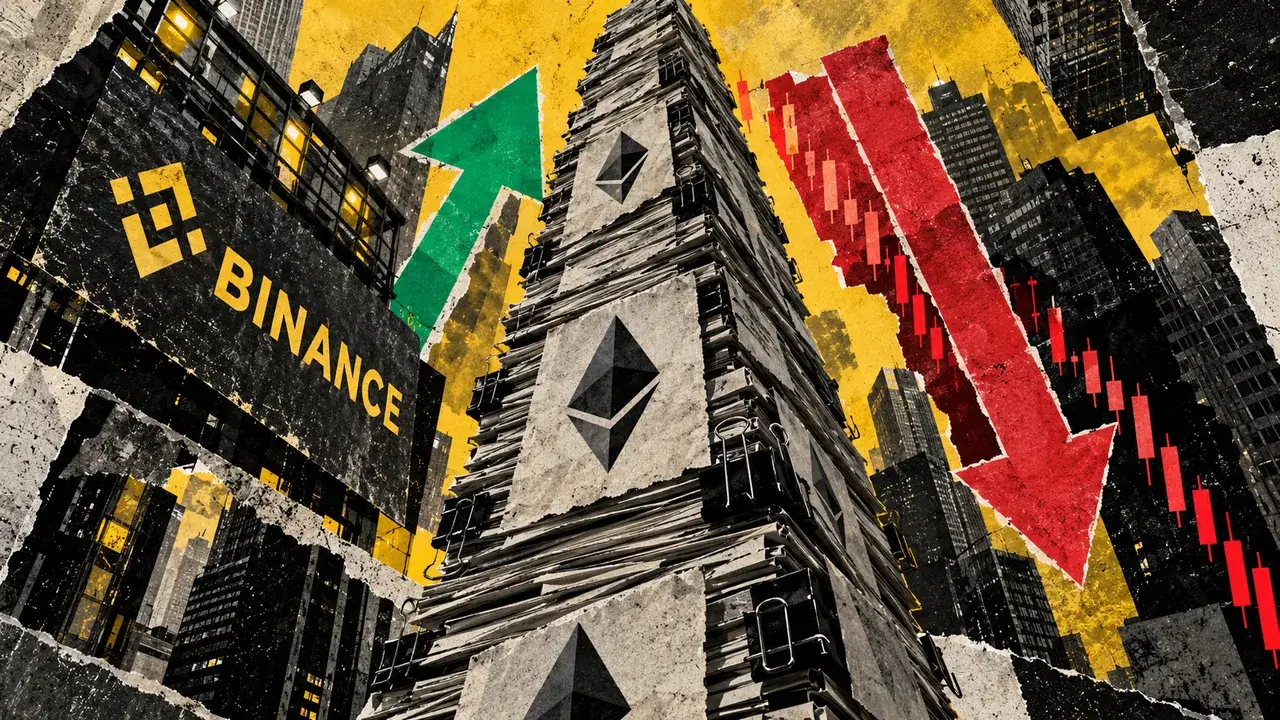
If you only look at dollar values in crypto, you are missing half the story. Most people see a red candle and assume everyone is packing their bags and leaving. They see a 6.6% drop in the dollar value of open interest and assume the market is deleveraging. But if you look under the hood at the actual asset quantity, the reality is often the opposite.
Between October 6 and October 8, something interesting happened on Binance. While the total USD value of Ethereum futures contracts slid by over six percent, the actual number of ETH tokens locked in those contracts grew by 2.3%. This is a classic case of the numerator and the denominator telling different stories, and for founders building in this space, it highlights a crucial distinction between price action and participation.
The Illusion of Deleveraging
In a standard bull market, dollar-denominated open interest and asset-denominated open interest usually move in the same direction. When the price goes up, the value of the contracts goes up, and more people jump in. When the price drops, liquidations usually flush out the system, causing both the dollar value and the token count to plummet.
What we are seeing now is a divergence. Traders aren't necessarily running for the exits; they are actually increasing their exposure. The dollar value is falling simply because the underlying asset is worth less, but the number of contracts being opened is increasing. This suggests that despite the short-term price weakness, there is a persistent appetite for ETH volatility or hedging.
For a builder, this matters because it shows that liquidity isn't drying up just because the price is choppy. The market is getting deeper, even if it is getting cheaper. It is a sign of a maturing derivatives market where participants are staying the course rather than panic-selling every time the chart turns red for forty-eight hours.
Why This Divergence Happens
There are a few reasons why we see a 2.3% increase in ETH-denominated interest during a price dip. First, you have the dip-buyers. These are the traders who see a five or six percent drop and decide it is a good time to go long. They add more units to their position to lower their average entry price. This increases the total token count in the books even if the aggregate dollar value stays flat or slightly down.
Second, you have the hedgers. If you are a developer or a treasury manager holding a large amount of ETH, a price drop makes you nervous. You might go to Binance and open a short position to protect your downside. You aren't selling your ETH; you are adding a contract to offset the risk. This, again, increases the amount of ETH tied up in the futures market.
Finally, there is the possibility of increased volatility seeking. When the price moves quickly, day traders flock to the platforms to capture the swings. They don't care about the long-term dollar value as much as they care about the number of units they can flip for a profit. This activity keeps the engine running even when the external valuation looks bleak.
The Founder Perspective: Signal vs. Noise
As founders, we are often told to ignore the price. That is easier said than done when your runway is in ETH or your user base fluctuates based on market sentiment. However, metrics like asset-denominated open interest are a better health check for the ecosystem than the spot price on a Tuesday afternoon.
If the dollar value drops but the token count stays high, it means the infrastructure is being used. It means people are still engaging with the asset. The real danger for a builder isn't a lower price; it is a lack of interest. A market where nobody wants to trade or hedge is a dead market. A market where people are actively increasing their positions during a drawdown is a market with a pulse.
We have to look at these numbers as a measure of utility. If Binance is seeing more ETH flowing into its derivatives books, it means the exchange remains the primary venue for price discovery and risk management. For those building DeFi protocols or layer-2 solutions, this should be a signal that the demand for sophisticated financial tools is not going away.
The Risk of Over-Leverage
We shouldn't paint this as entirely bullish, though. An increase in token-denominated open interest while prices fall can also be a warning sign. It creates a coiled spring effect. If the price continues to slide, all those new contracts—many of them likely long positions—are at risk of liquidation. When you have more "units" at stake, the eventual flush-out can be even more violent.
I have seen this cycle repeat dozens of times. The market builds up open interest, the price hits a pain point, and a cascade of liquidations wipes out the books in minutes. The fact that the ETH count grew by 2.3% means there is more fuel for a potential move in either direction. It is a sign of tension, not necessarily a sign of a bottom.
The market is getting deeper, even if it is getting cheaper. This is a sign of a maturing derivatives market where participants are staying the course.
Looking Ahead
What does this mean for the next few weeks? It means the market is currently in a tug-of-war. The dollar valuation is reflecting broader macro concerns or perhaps a temporary rotation out of ETH. But the internal mechanics of the Binance order book show that traders are not ready to give up on the asset just yet.
For those of us building in the trenches, the takeaway is simple: don't let the headlines about "billions wiped off the market" distract you. Look at the actual participation. If the number of units being traded and held in contracts is growing, the ecosystem is still growing. The dollar signs will eventually catch up, one way or the other.
We are seeing a market that is becoming more resilient to price swings. Traders are using these dips to reposition rather than just fleeing to cash. As long as the ETH-denominated interest stays high, the liquidity remains available for the next leg of whatever the market decides to do. Keep your head down, keep building, and watch the tokens, not just the dollars.
Read the original at CryptoSlate →