Ethereum Name Service, or ENS, is arguably the most successful utility project in the history of decentralized apps. It turned unreadable wallet strings into human identities. But for years, it has suffered from the same bottleneck as every other high-profile Ethereum project: the cost of doing business on the mainnet.
The Migration to Layer 2
The ENS team is finally moving forward with a major architectural overhaul. The goal is simple: move the naming service to a Layer 2 environment to make registration, renewals, and record updates actually affordable for the average person. Currently, renewing a domain for five dollars can cost fifty dollars in gas. It is a broken user experience that has stunted the growth of decentralized identity.
This shift to L2 is not just a patch; it is a fundamental rebuild of how the registry functions. For builders, this means better integration possibilities and a lower barrier to entry for users who want to claim their digital footprint without paying a premium to miners.
The One-Way Ticket
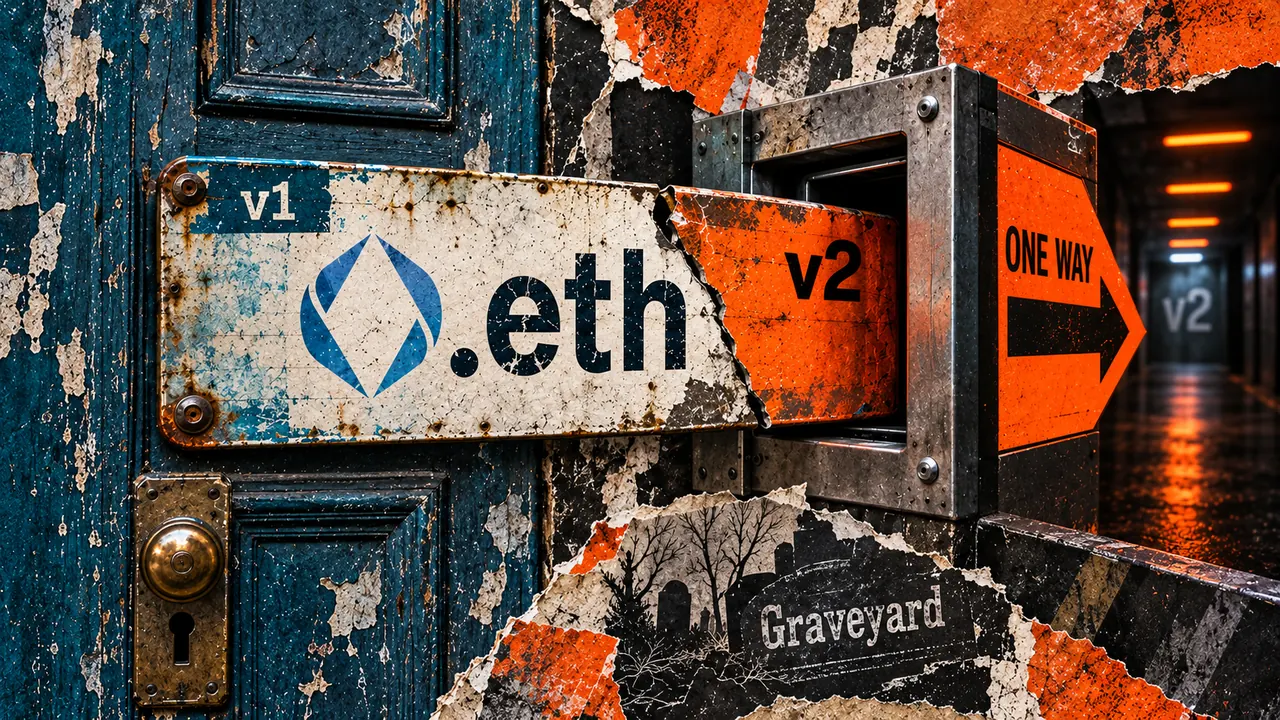
However, there is a catch that every domain holder needs to understand. The migration process is designed to be a permanent, one-way bridge. Once you move a .eth name from the V1 contract on the Ethereum mainnet to the new V2 infrastructure, there is no going back. You are essentially burning the management rights on the old system to claim them on the new one.
This is a bold technical choice. Most protocols try to build in escape hatches or backward compatibility. By making this irreversible, ENS is forcing a consensus on where the future of the protocol lies. It prevents a fragmented ecosystem where some names live on L1 and others on L2, which would create a nightmare for developers trying to resolve names across different layers.
What Founders Need to Know
If you are building an app that relies on ENS, you need to be looking at the draft specifications now. This is not just a cosmetic change. The way your smart contracts interact with the registry will change. You have to account for the fact that a user's domain might exist in a completely different execution environment than their wallet or their assets.
- No Forced Deadline: The current draft does not set a hard expiration date for V1. You are not going to lose your domain tomorrow if you do not migrate.
- Management Lock: Once you migrate, you lose the ability to manage that name on the mainnet. Any legacy tools that haven't updated to support the L2 bridge will break for that specific domain.
- Gas Optimization: The long-term benefit is a massive reduction in operational overhead. For founders managing hundreds of subdomains or corporate identities, this is the scaling solution we have been waiting for.
The Skeptics View on Layer 2 Fragmentation
While the move to L2 is necessary, it does introduce a layer of complexity regarding decentralization and security. By moving the registry away from the core Ethereum security model—even if it is to a rollup—we are trusting a new set of validators and sequencers. For a protocol that aims to be the backbone of the internet's identity layer, that is a significant trade-off.
We also have to consider the "irreversible" nature of the migration. If the chosen L2 experiences a catastrophic failure or a governance deadlock, those migrated names are stuck. It is a high-stakes bet on the stability of Ethereum's scaling roadmap.
The Bottom Line for Builders
Don't rush into the migration the second it goes live. Let the early adopters find the bugs. Because this is a one-way street, you want to ensure the destination is stable before you move your most valuable digital assets over.
For those building new products, start designing with a multi-chain resolution mindset. The era of assuming everything happens on the Ethereum mainnet is officially over. ENS moving to L2 is the final signal that the hub-and-spoke model of blockchain development is the new standard.
The shift to L2 is the only way for ENS to survive as a retail product, but the permanent nature of the migration means founders must treat the transition with the same caution as a major smart contract deployment.
We are watching a legacy protocol attempt to reinvent itself in real-time. It is a necessary evolution, but it comes with risks that should not be ignored for the sake of lower gas fees.
Read the original at CryptoSlate →