The Cost of Complexity
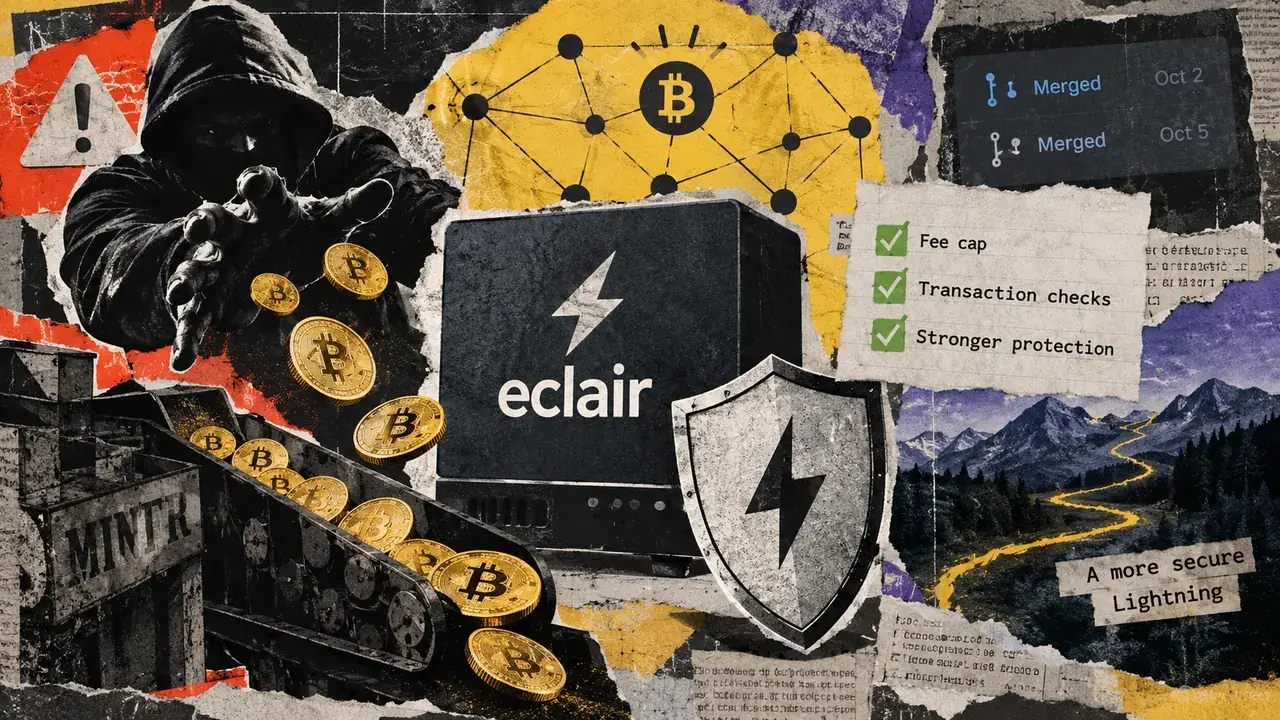
Building on top of Bitcoin is a constant battle between security and usability. We want faster transactions and lower fees, but every time we add a layer of abstraction, we open up a new door for someone to walk through. Recently, the team behind Eclair, one of the primary implementations of the Lightning Network, started merging fixes for flaws that were effectively turning node operators into unintended sponsors for their peers' transaction costs.
This isn't your standard "someone stole my keys" hack. This was a structural vulnerability where an attacker could force a node to pay excessive on-chain fees during channel funding or splicing operations. It is a subtle, technical drain that highlights why building in the Lightning ecosystem remains one of the most difficult engineering challenges in the crypto space today.
Understanding the Fee Burn
In the Lightning Network, opening a channel or resizing it via splicing requires an on-chain Bitcoin transaction. Usually, the two parties involved agree on what the fee should be. However, the Eclair developers discovered scenarios where a malicious peer could manipulate the process. By tricking the backend into overpaying for transaction fees, an attacker could essentially burn a victim's capital on the base layer.
For founders and builders, the takeaway here is that you don't need to lose your private keys to lose your money. If your protocol logic allows an external party to influence how your node interacts with the Bitcoin blockchain, you have a financial leak. These updates to Eclair are designed to put a hard ceiling on what a peer can demand in fees and to ensure that the backend is actually verifying the transaction details before signing off on them.
The Splicing Problem
Much of the recent work centers around splicing. For those who aren't in the weeds of Lightning development, splicing is a way to add or remove funds from an existing channel without having to close it and open a new one. It is a massive UX improvement, but it introduces a lot of moving parts. Because splicing involves touching the main Bitcoin chain, it creates a point of friction where fee estimation becomes critical.
The vulnerability allowed for a situation where a peer could propose a fee that was significantly higher than necessary. Without the proper sanity checks now being implemented in Eclair, a node might blindly accept these terms to keep the channel active. In the worst-case scenario, an automated node could be drained of its entire liquidity just by trying to keep up with these fake fee requirements. It is a reminder that in the world of decentralized finance, "automatic" is often synonymous with "vulnerable."
Why This Matters for Builders
If you are building an application that relies on Lightning, you need to understand that the protocol is still in its "move fast and break things" phase, even if Bitcoin itself is not. We often talk about Bitcoin as this static, unchangeable rock. But the layers we build on top of it are fluid. When you use an implementation like Eclair, you are trusting the logic of that specific development team to protect your capital.
- Fee Sanity Checks: Always implement hard limits on what your software will pay for an on-chain transaction, regardless of what a peer or a fee estimator says.
- Verification Over Trust: Never assume the data coming from a peer about a shared transaction is honest. The latest Eclair fixes focus on verifying the backend state before committing funds.
- Minimalist Logic: Every new feature like splicing adds a new attack vector. If your app doesn't need it, don't enable it until the implementation is battle-tested.
The Development Gap
It is worth noting that while these fixes have been merged into the codebase, the public releases often lag behind the actual development. As of this analysis, the latest official release is still from September, while these critical fee-burning fixes were merged in October. This creates a dangerous window for node operators who aren't paying attention to the GitHub commits.
This is the reality of being a founder in the Bitcoin space. You cannot just wait for the update notification to pop up. You have to be aware of the underlying protocol changes. If you are running a high-volume routing node, you are effectively a target. These fee-burning exploits are particularly nasty because they don't even benefit the attacker directly—they just hurt the victim. It is a form of griefing that can bankrupt a small business.
Looking Ahead
We are seeing a trend where Lightning development is moving toward more robust safety rails. The early days of "just get it working" are over. Now, we are in the phase of "make it impossible to break." The Eclair team is doing the right thing by hardening these processes, but it serves as a wake-up call for the rest of the industry.
As we integrate more AI-driven automation into these financial systems, the stakes get even higher. An AI bot managing a Lightning node could be tricked by these fee-burning exploits much faster than a human operator could intervene. We need to be building these defensive measures into the core logic now, before we hand the keys over to the algorithms.
The biggest threat to a builder isn't a market crash; it's a logic error that you didn't see coming because you trusted the protocol too much.
The lesson here is simple: verify every outgoing satoshi. If your node is willing to pay any price to stay connected, eventually someone will make you pay the ultimate price. Stay skeptical, keep your fee limits tight, and don't let the convenience of layer-two scaling blind you to the risks of the base layer.
Read the original at CryptoSlate →