We have a tendency to take data at face value. In the tech world, especially within the high-stakes environments of AI and decentralized infrastructure, we often assume that what we see on a dashboard or a ledger is a direct reflection of reality. But as the latest imagery from the James Webb Space Telescope demonstrates, even the universe likes to play tricks with the light.
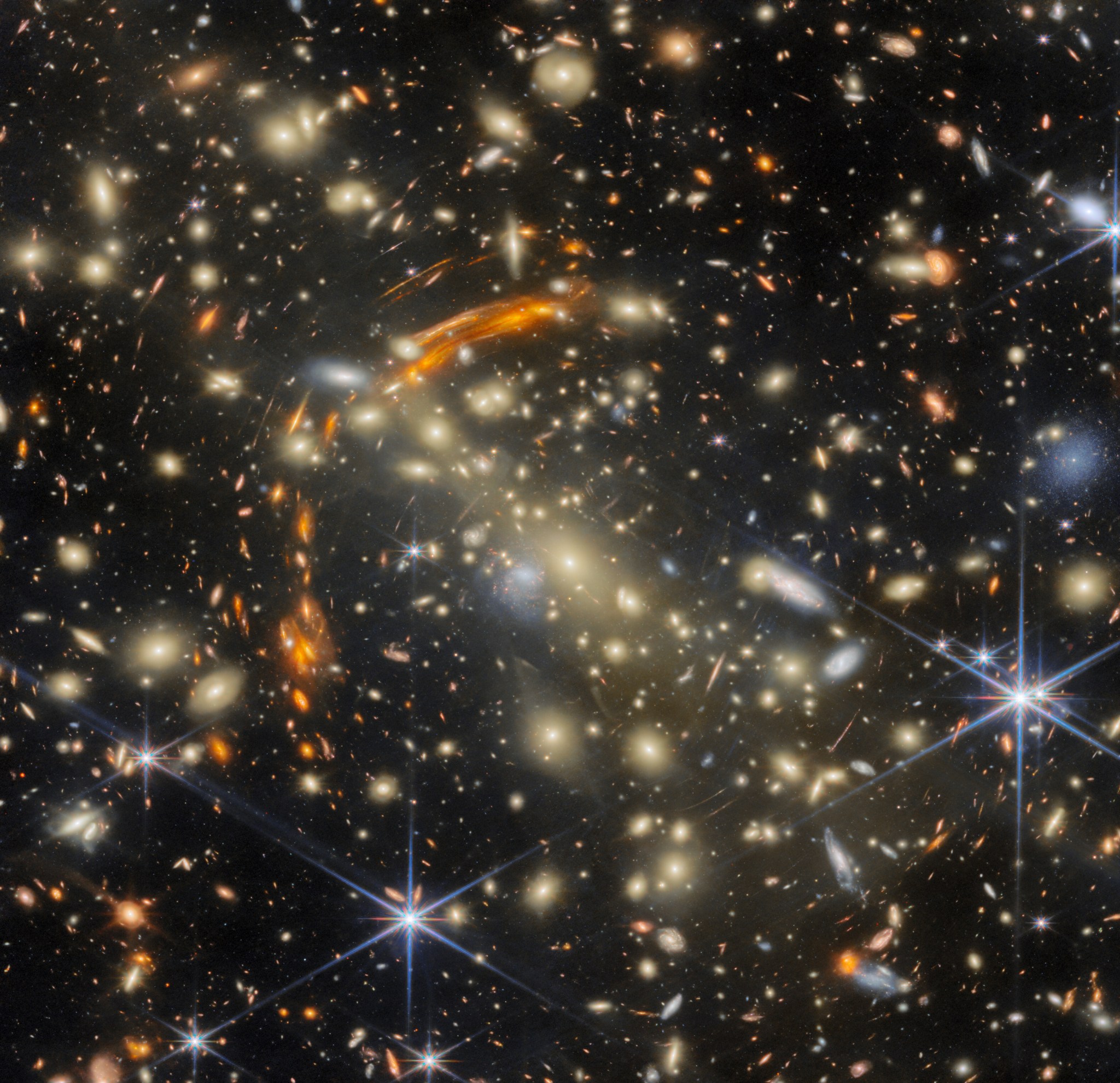
NASA recently released a visual of a galaxy cluster known as MACS J0454.1-0300. To the untrained eye, it looks like a collection of brilliant golden galaxies scattered across the void. However, the image is a masterclass in distortion. It is a cosmic house of mirrors where what you see is rarely what is actually there. For founders and builders, this isn't just a cool space photo. It is a lesson in gravitational lensing, data integrity, and the danger of building on top of distorted signals.
The Optics of Distortion
The science here is straightforward but profound. The mass of this galaxy cluster is so immense that it physically warps the fabric of space-time. When light from even more distant galaxies passes through this region, it doesn't travel in a straight line. It bends. This creates a magnifying glass effect, but it is one that comes with a heavy price: duplication and warping.
In the Webb image, you can see orange galaxies that appear to be bunched together. In reality, these are not distinct entities. They are multiple images of the same distant objects, stretched and repeated by the gravity of the cluster in the foreground. If you were building a map of the universe based solely on this visual output without understanding the underlying physics, your map would be fundamentally broken. You would be counting the same assets twice, thrice, or more.
This is the exact trap many crypto founders fall into during a bull market. We see a spike in total value locked or a surge in unique active wallets, and we assume we are seeing genuine growth. In reality, we are often looking at a house of mirrors created by sybil attacks, wash trading, or recursive lending loops. The signal is being warped by the gravitational pull of incentives, and the resulting data is a distorted duplication of a much smaller reality.
Building Through the Noise
When you are building in AI, you deal with a similar phenomenon called hallucinations. An LLM might provide a confident answer that looks like a galaxy, but it is actually just light bending around the limitations of its training data. The challenge for a builder is not to ignore the image, but to build the tools necessary to de-warp it.
Astronomers don't just look at these photos and guess. They use complex mathematical models to work backward from the distortion to find the original source. They acknowledge that the medium—space-time itself—is not neutral. As a founder, you have to treat your data providers, your oracles, and your analytics platforms with the same level of skepticism. You have to assume the medium is bending the light.
- Verify the source: Are you looking at a primary signal or a reflection?
- Account for gravity: What incentives are currently warping the data you are relying on?
- Map the duplicates: In a world of automated agents and bot-driven volume, how much of your growth is just the same orange galaxy appearing in four different places?
The builders who survive the next decade won't be the ones who chased the brightest lights in the cluster. They will be the ones who spent the time building the math to see through the distortion. They will be the ones who understood that the most impressive-looking data sets are often the ones most heavily warped by external forces.
The Founder Perspective
I have seen dozens of projects launch based on a misinterpreted signal. They see a trend, they see a cluster of activity, and they dive in headfirst without realizing they are looking at a mirage. They build infrastructure for a user base that doesn't exist, or they train models on data that has already been poisoned by previous iterations of AI-generated content.
This cosmic house of mirrors is a reminder that the more massive a system becomes, the more it distorts the truth around it. The larger a network gets, the more gravity it exerts, and the harder it becomes to see the distant, original signals. We have to be disciplined enough to look past the golden glow of the foreground and account for the physics of the market.
The goal is not to see the most light; it is to see the most truth.
We are entering an era where reality is increasingly difficult to pin down. Between deepfakes, synthetic data, and manipulated markets, the house of mirrors is getting larger. But there is an opportunity here for builders who prioritize clarity over optics. If you can be the one who provides the de-warping lens, you become the most valuable player in the ecosystem.
The Takeaway
Don't trust the first iteration of the data you receive. Whether it is a telescope image or a quarterly growth report, understand that mass creates distortion. Your job as a builder is to find the original source of the light, no matter how many mirrors are standing in your way. If the data looks too perfect, or too repeated, it probably is.
Read the original at NASA Breaking News →