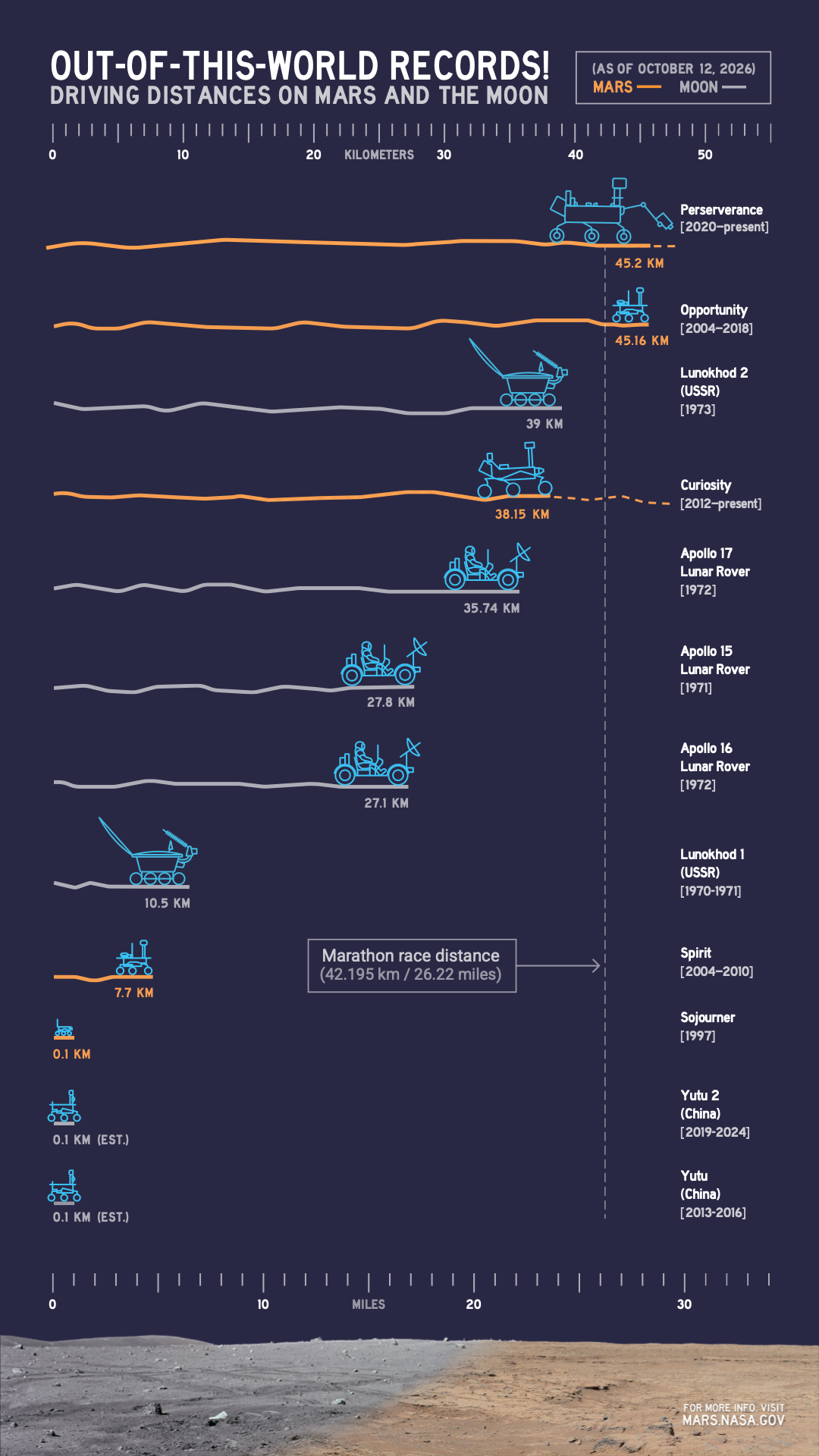
We talk a lot about speed in the software world. Move fast and break things, right? But when your hardware is sitting on the surface of a planet 140 million miles away, breaking things isn't an option. NASA recently updated their off-world driving leaderboard, and for those of us building in the crypto and AI space, there is a massive lesson here about what actual progress looks like.
The data released covers the total distance traveled by every significant rover we've sent to the Moon and Mars. While the headline numbers look like a simple race, the real story is about engineering longevity and the sheer difficulty of maintaining momentum in a hostile environment. As of late 2026, the Perseverance and Curiosity rovers are still adding to their totals, proving that the best systems are the ones that can survive their own success.
The Long Game of Hardware Iteration
Looking at the breakdown, you see a clear evolution. The early Soviet Lunokhod rovers and the Apollo-era Lunar Roving Vehicles put up respectable numbers, but they were short-lived. They were sprints. Compare that to the Opportunity rover, which covered over 28 miles during its decade-plus lifespan on Mars. It wasn't the fastest machine ever built, but it was the most resilient.
For builders, this is the ultimate case study in technical debt. If NASA had taken shortcuts on the chassis or the power management systems for Opportunity, it would have died in a dust storm three months in. Instead, it lasted years past its expiration date. In our world, we often launch products with the hope that we can fix the core architecture later. NASA doesn't have that luxury, and honestly, neither do we if we want to build things that last longer than a market cycle.
Why Perseverance is Winning
Perseverance is currently the gold standard. It’s not just driving; it’s collecting samples and laying the groundwork for future missions. This is the difference between a proof-of-concept and a platform. A lot of AI startups right now are building "rovers" that can drive ten feet and take a nice picture, but they don't have the infrastructure to sustain a mission for five years.
The current stats show that Curiosity and Perseverance are still operational as of October 2026. That’s years of continuous uptime in an environment where the temperature swings are lethal and there is no tech support. When you look at their mileage, don't just see numbers on a map. See a thousands-of-hours-long stress test of their underlying code and mechanical integrity.
The Distance Gap
One thing that jumps out from the NASA data is the disparity between the Moon and Mars missions. The Moon is closer, but the rovers there were often limited by the lunar night or the lack of sophisticated autonomous navigation. The Mars rovers, particularly the newer ones, are using significantly more advanced AI to navigate hazards without waiting for a signal from Earth.
This is where the AI builders should be paying attention. The latency between Earth and Mars can be up to 20 minutes one way. You cannot drive a rover in real-time. The machine has to make decisions. The mileage these rovers are clocking is a direct result of their autonomy. The less they have to rely on a central command, the further they go. There is a direct parallel here to decentralized systems and edge computing. If your project relies on you manually fixing every bug, you aren't going to get very far from the landing site.
Founders Need a Rover Mentality
We see a lot of "lunar" projects in crypto—flashy, high-energy, but short-lived. They burn bright for a few miles and then the battery dies because they didn't account for the long-term environment. The Mars rovers represent the "marathon" approach. They are built for the grit. They are built to handle the unknown.
If you are building a protocol or an AI agent, ask yourself if it’s a rover or just a stationary lander. A lander is easy; you drop it, it does one thing, and it stays there until it breaks. A rover is a dynamic system. It has to adapt. The driving distances NASA is reporting are a testament to the idea that mobility is the ultimate utility.
What it Means for the Next Decade
As we look at the figures for 2026, we are seeing the transition from exploration to infrastructure. The rovers are no longer just exploring; they are preparing. They are mapping routes for the next generation of machines. This is exactly what we are seeing in the AI space right now. We are moving past the "look what this can do" phase and into the "how far can this go" phase.
The distance records held by Opportunity and now being chased by the newer fleet are benchmarks of human engineering. But more importantly, they are proof that if you build with high standards and a focus on durability, you can operate in the most unforgiving markets imaginable.
The goal isn't just to land; it's to keep moving long after the world expects you to stop.
The takeaway for builders is simple: stop optimizing for the launch and start optimizing for the mileage. Your first 100 days are irrelevant if you don't have the architecture to survive day 1,000. NASA’s rover leaderboard isn't just a map of Mars; it’s a roadmap for how to build anything worth keeping.
Read the original at NASA Breaking News →