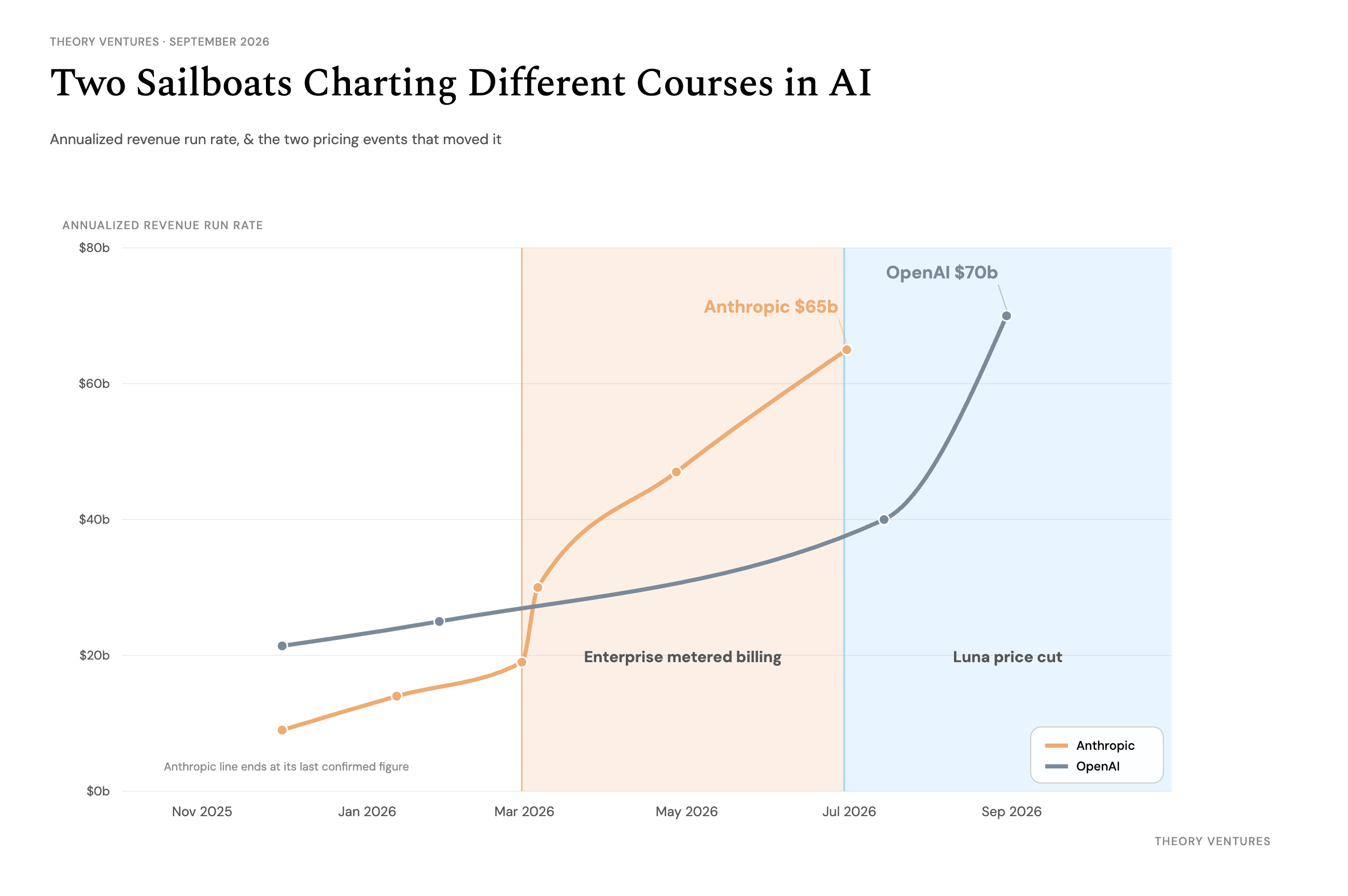
We have spent the last two years treating large language models like digital gold. The thinking was simple: whoever owns the smartest model owns the market. But the recent data suggests a violent shift in that narrative. We are watching the transition from AI as a luxury service to AI as a utility, and the fallout for founders is going to be massive.
The numbers coming out of the infrastructure layer are staggering. Model prices have plummeted by roughly 41% recently, yet token consumption has jumped by half. In any other industry, a 40% price drop alongside a 50% increase in volume is the textbook definition of commoditization. When the cost to produce a unit falls while demand scales, the value doesn't stay with the factory owner—it moves to the person who knows what to do with the finished product.
The Race to the Bottom
If you are a founder building a company where your primary value proposition is "we have a better model," you are effectively building a house on a sandbar. The proprietary moats that OpenAI, Anthropic, and Google tried to dig are being filled in by open-source competitors and aggressive price wars. When intelligence becomes cheap, it stops being a differentiator.
Think about the early days of cloud computing. Amazon, Google, and Microsoft fought a war of attrition over the cost of storage and compute. Today, we don't choose an app because it runs on AWS versus Azure; we choose it because of the user experience. AI is hitting that inflection point right now. The underlying "brain" is becoming a line item, not a strategy.
The Distribution Moat
So, where does the value go? If the model is a commodity, the moat moves to the interface. This is the lesson that the SaaS era taught us, and it is being ignored by too many AI startups today. The winners won't be the people with the most parameters; they will be the people who own the user relationship.
Distribution is the only real defense in a world of declining margins. If you own the workflow—meaning the specific place where a lawyer, a developer, or a creative professional spends their eight-hour workday—you are insulated from the model wars. You can swap out GPT-4 for Claude or Llama 3 behind the scenes without the user ever knowing or caring. The power lies in being the gateway, not the engine.
The Strategy of Reselling
For the big labs, the game is changing too. They can no longer rely solely on direct-to-consumer subscriptions to survive. We are seeing a shift toward a partnership and reseller model. To capture market share, these labs have to get their models embedded into existing platforms. It is cheaper to let a vertical SaaS company resell your API to 10,000 niche users than it is to try and acquire those 10,000 users yourself.
This creates a unique opportunity for builders. You don't need to build the infrastructure. You just need to build the best possible skin and workflow around it. The labs are desperate for your volume. They are lowering their prices to keep their hardware running at capacity, which means your margins as a builder are actually improving even as the labs struggle with theirs.
Data Routing and the Future Cost of Training
There is a hidden layer to this commoditization: routing data. The real prize for the labs isn't the pennies they make per token; it's the telemetry. By controlling the flow of requests, labs and sophisticated middleware layers can see exactly how users are interacting with AI. This data is the raw material for the next generation of training.
If you can route queries to the cheapest, most efficient model for a specific task—a process often called model routing—you aren't just saving money. You are creating a dataset that tells you exactly where the current models fail and where they succeed. This feedback loop is the only way to reduce the cost of training future models. The goal is to move away from brute-force scaling and toward precision.
What Builders Should Do Now
I talk to a lot of founders who are still obsessed with fine-tuning. They spend months trying to squeeze a 5% performance boost out of a specific model. In a world of commoditized AI, that is often a waste of time. By the time you finish your fine-tuning, a base model from a competitor will likely outperform it for half the cost.
Instead of focusing on the model, focus on these three things:
- Workflow Integration: How deeply can you embed your tool into the user's existing habits?
- Multi-Model Resilience: Can your app switch between providers instantly if one raises prices or goes down?
- Unique Data Moats: Are you collecting user feedback and specialized data that a generic model can't replicate?
The skepticism here is necessary. The hype cycle wants you to believe that the AI itself is the product. It isn't. The product is the problem you solve for the customer. If the AI is 40% cheaper today, that just means you have 40% more budget to spend on making your user experience better.
The value of any technology eventually flows to the layer that is closest to the customer. In AI, that layer is the interface, not the inference.
We are entering the "post-model" era of AI development. It’s less about who has the biggest computer and more about who has the most useful application. If you’re building for the long haul, stop worrying about the benchmarks and start worrying about the churn. The intelligence is already becoming a commodity—now it’s time to build a business.
Read the original at Tomasz Tunguz →