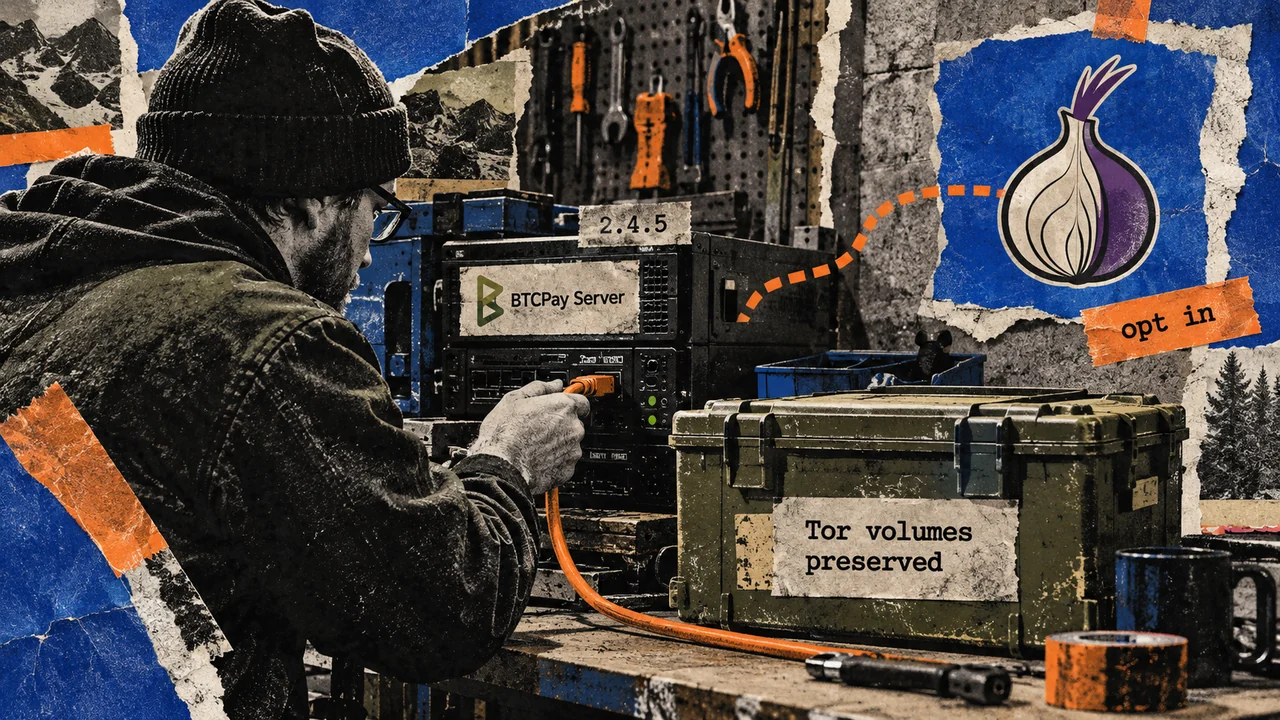
If you have been running a self-hosted Bitcoin payment processor for any length of time, you are likely using BTCPay Server. It is the gold standard for sovereign merchants. But if you are managing your instance via Docker, the next time you run an update, your server might act a little differently. Specifically, it might disappear from the dark web unless you tell it not to.
The Shift to Explicit Opt-in
For years, BTCPay Server included Tor as a default component for Docker-based installations. It was a convenience feature. You spun up a node, and suddenly you had an .onion address that allowed you to bypass firewall headaches and keep your physical location hidden from the prying eyes of the public internet. But as the project matures, the developers are making a conscious pivot: Tor is moving from a default setting to an optional one.
This means the next time you pull a new image or run your update scripts, the system will no longer assume you want Tor running in the background. If you want to keep that onion access, you have to explicitly choose it. While existing data is preserved, the service itself will not initialize unless the user flags it during the setup process.
Why This Matters for Builders
On the surface, this looks like a minor configuration change. In reality, it reflects a broader conversation happening in the developer community regarding privacy, technical debt, and reliability. For a founder or a developer building tools on top of Bitcoin, there are three main reasons why this shift is happening.
- Network Reliability: The Tor network has been under significant strain over the last year. Frequent DDoS attacks have made onion services notoriously slow or completely unreachable. By making it an opt-in feature, BTCPay reduces the number of frustrated users who think their server is broken when the issue is actually the underlying network.
- Resource Management: Running a Tor daemon consumes CPU and memory. For users running on cheap VPS instances or old Raspberry Pi hardware, every megabyte counts. Removing the default load ensures the leanest possible installation for those who don't need the anonymity layer.
- Maintenance Surface Area: Every default feature is something the core team has to debug. By separating Tor into a specific module, the development cycle becomes cleaner.
The Privacy Trade-off
We need to be honest about what this means for the average merchant. Bitcoin is often touted as private, but if you are running a node from your home office without a VPN or Tor, you are broadcasting your home IP address to every peer you connect to. For a business, this is a security risk.
However, the "always-on" approach to Tor had a downside: it created a false sense of security. Users would rely on the onion address, find it slow, and then give up on self-hosting entirely. By forcing an opt-in, the BTCPay team is requiring the user to make a conscious decision about their threat model. If you need the privacy, you toggle it on and accept the latency. If you are running a high-volume store on a public-facing cloud server with proper SSL, you might not need the extra layer of Tor at all.
Infrastructure is Not Set-and-Forget
The takeaway here for anyone in the crypto-infrastructure space is that "magic" defaults are dying. We are moving toward a modular era where the user—or the developer building for the user—is expected to understand the stack. As an editor and someone who watches these deployments closely, I see this as a sign of maturity for the BTCPay ecosystem. They are trusting their users to know what they want.
If you are a builder providing managed BTCPay services, this is your cue to check your automation scripts. If your clients rely on onion access for remote management, your next update could break their workflow if you haven't accounted for the new opt-in requirement. Don't let a simple update turn into a support nightmare.
A Founder’s Perspective on Technical Debt
Founders often fall into the trap of wanting to offer every feature out of the box to make the onboarding process seamless. We want the "one-click install." But as a project scales, those one-click defaults become anchors. BTCPay is doing the hard work of trimming the fat. It might cause a slight friction point during this update cycle, but the result is a more robust, specialized piece of software.
The lesson for us is simple: Don't be afraid to remove defaults if they complicate the core mission of your product. If your tool is meant to process payments, ensure it does that perfectly first. If a secondary feature like Tor makes the primary mission harder to achieve for a subset of users, move it to the sidebar. Let the users who truly need it go looking for it.
The move toward modularity is a sign that Bitcoin tools are moving out of the experimental phase and into the professional infrastructure phase.
Check your Docker configs, decide if you actually need the onion, and adjust your deployment scripts accordingly. The days of accidental privacy are over; we are moving into the era of intentional infrastructure.
Read the original at CryptoSlate →