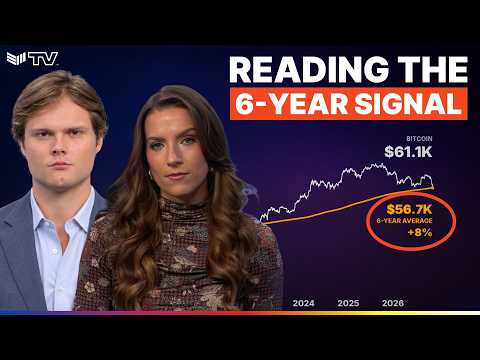
When you have been building in this space as long as I have, you learn to tune out the noise of daily candles. But every once in a while, a specific metric pops up that actually warrants a moment of silence. Right now, Bitcoin is flirting with its six-year moving average. To the uninitiated, that might sound like just another line on a chart, but for those of us who survived the 2022 carnage, this specific indicator carries a heavy weight.
The Ghost of FTX
Since 2016, Bitcoin has been remarkably consistent at staying above this specific threshold. There has only been one significant period where we saw a closing price below this six-year average: the immediate aftermath of the FTX collapse. That was a time of pure existential dread for the industry. We weren't just arguing about block sizes or fees; we were wondering if the largest players in the room had effectively poisoned the well for a generation of investors.
Seeing this indicator resurface now is a gut check. It suggests that despite the institutional inflows and the spot ETFs, the market is currently testing the limits of its long-term support. In plain English, the market is asking if the current price is sustainable based on the growth we have seen over the last half-decade. For builders, this isn't just a signal to sell or buy; it is a signal to evaluate the foundation of what we are building.
Why the Six-Year Average Matters
Why six years? In the crypto world, that is an eternity. It covers roughly one and a half halving cycles. It filters out the hype of the bull runs and the despair of the crypto winters. It represents the "true" cost basis of the believers who haven't moved their stacks since the pre-pandemic era. When the price dips toward this line, we aren't just looking at technical resistance; we are looking at the collective floor of the entire ecosystem.
During the FTX debacle, the breach of this line was a symptom of a massive liquidity vacuum. It wasn't organic selling; it was forced liquidation and a total loss of trust. The fact that we are approaching this level again—without a major exchange imploding—is actually more interesting. It implies a slow-burn repricing rather than a sudden shock. For a founder, a slow-burn is often harder to manage than a sudden crash because it drains resources over time rather than all at once.
The Builder's Perspective
If you are running a startup or developing a protocol, you probably don't spend your day looking at moving averages. You shouldn't. But you do need to understand the macro environment your users are living in. When Bitcoin tests these multi-year lows, the "risk-on" appetite for experimental AI-crypto integrations or new DeFi primitives tends to dry up. Capital becomes expensive, and the margin for error disappears.
We are currently in a phase where the market is demanding proof of utility. The days of raising ten million dollars on a whitepaper and a dream are dead, buried under the weight of these long-term averages. If the price breaks below this line, expect another wave of consolidation. This isn't necessarily bad news—it is a flushing of the system. The companies that survive a test of the six-year average are the ones that will likely be the blue chips of the next decade.
Survival Tactics for the Current Climate
- Focus on real revenue: If your project relies on token emissions to keep the lights on, you are in trouble. You need hard currency or stablecoin revenue.
- Trim the fat: Now is the time to look at your burn rate. If the market stays at these levels for another twelve months, do you have the runway?
- Build for the skeptics: Don't build for the moon-boys. Build products that provide value even if the price of Bitcoin stays flat for three years.
The market can stay irrational longer than you can stay solvent, but the six-year average is where irrationality usually meets its match.
The Skeptic's Corner
I have to be honest: I am skeptical of anyone claiming this is the "bottom" just because of a historical line. History is a great teacher, but it is a terrible predictor. The world in 2024 is vastly different from the world of the FTX crash. We have high interest rates, geopolitical instability, and a massive pivot toward AI that is sucking the oxygen out of the room for traditional blockchain projects.
We have to ask ourselves: Is Bitcoin still the primary driver of innovation, or has it become a legacy asset? If it's a legacy asset, these moving averages will behave more like those in the stock market—meaning they can be broken and stayed under for years. If you are a builder, you have to prepare for the possibility that the "V-shaped recovery" we saw after 2022 might not happen this time. We might be in for a long, flat grind.
What This Means for AI and Crypto
There is a silver lining here. As the speculative froth is wiped out by these technical tests, the intersection of AI and crypto becomes more important. We need decentralized compute and verifiable data more than ever, especially as AI models become more opaque. The builders who are ignoring the price charts and focusing on how to use blockchain to solve the bottleneck of AI infrastructure are the ones who will thrive, regardless of whether we stay above or below a moving average.
The six-year average is a reminder that the industry is maturing. Maturity is often painful. It involves shedding the skin of our younger, more volatile selves. For those of us who have been here since the early days, this feels familiar. It feels like the quiet before a different kind of storm—one where the winners are chosen by code and utility rather than tweets and hype.
The Bottom Line
Don't panic about the chart, but don't ignore the signal. The test of the six-year average is a reality check for the entire industry. It is a filter that separates the tourists from the residents. If you are building something that matters, a dip below a moving average is just a footnote in your company's history. If you are building a house of cards, this is the wind that knocks it down. Watch the close, watch your burn, and keep your head down. The work is the only thing that actually moves the needle in the long run.
Read the original at Bitcoin Magazine →