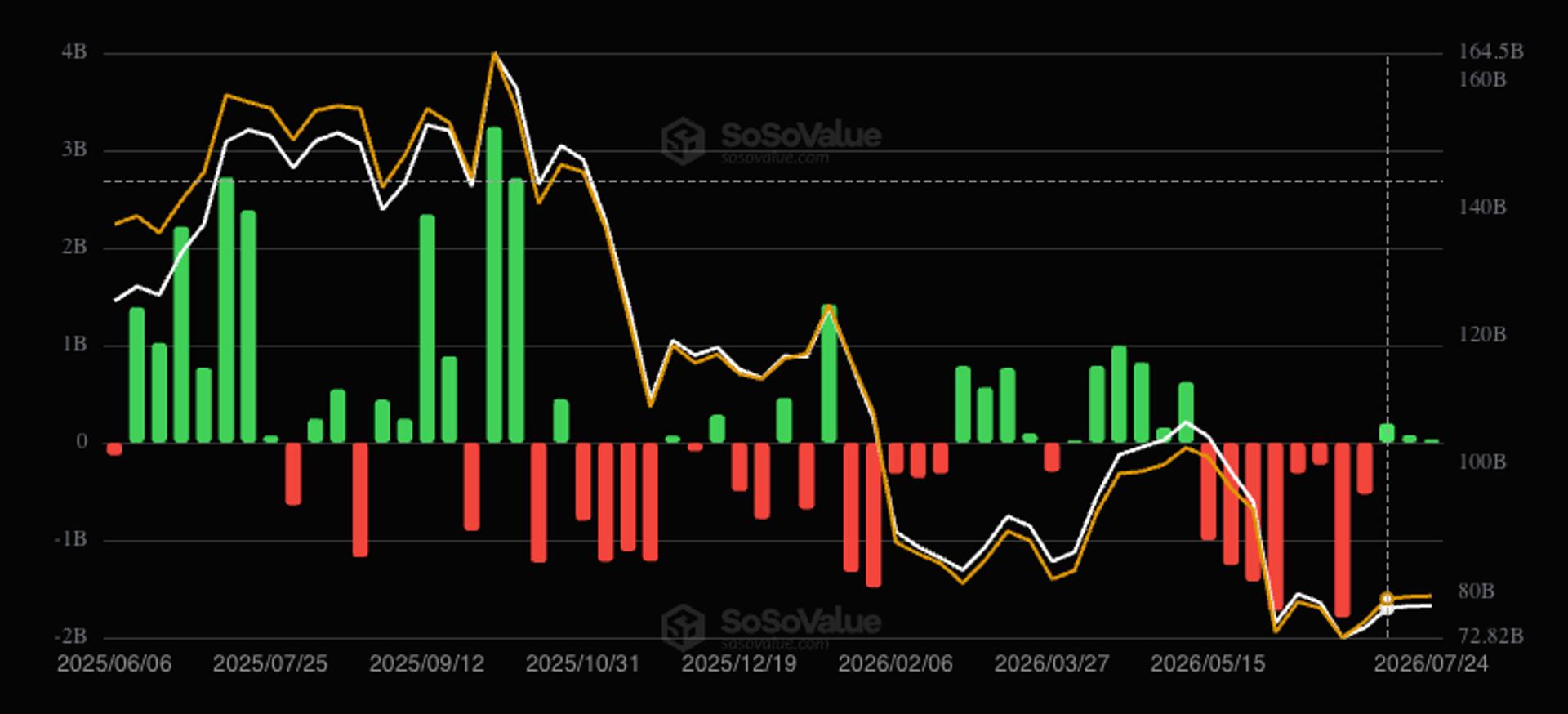
We have to look past the surface-level green on the charts this week. While the headlines will tell you that Bitcoin exchange-traded funds just finished their third straight week of positive net inflows, the end of the week told a much different story. We saw nearly half a billion dollars evaporate in a single outflow event, mostly concentrated in the heavy hitter of the space: BlackRock’s IBIT.
The Institutional Rollercoaster
For those of us building in this space, we’ve been told that the arrival of the ETFs would bring price stability. The theory was that formal institutional rails would dampen the wild volatility we usually see on native crypto exchanges. This week proved that theory is, at best, incomplete. Seeing $465 million leave the building in the final stretch of the week shows that institutional capital is just as flighty as retail capital, it just moves in larger blocks.
What is interesting here is the concentration. When you see BlackRock taking the brunt of the outflows—to the tune of $415 million—it suggests that the massive inflow numbers we saw earlier in the month weren’t necessarily long-term hodlers. It looks more like tactical positioning from big desks that are happy to take profits or move to the sidelines the moment the macro wind shifts.
Why Builders Should Care About ETF Fluctuations
You might be wondering why a founder building a decentralized protocol or an AI agent should care about what BlackRock clients are doing. In a perfect world, we wouldn’t. But we live in a world where the liquidity of the entire ecosystem is still tethered to the perceived health of these products. When these ETFs bleed, the secondary markets tighten up, and that affects everything from developer grants to the valuations of mid-stage startups.
These numbers represent a maturation of the market, but also a new kind of risk. Previously, we worried about whale wallets moving coins from 2011. Now, we have to worry about traditional finance rebalancing periods and end-of-quarter risk mitigation. It’s the same volatility, just wearing a Suit and Tie.
The BlackRock Signal
IBIT has become the de facto barometer for institutional sentiment. When it leads the inflows, the mood is bullish. When it accounts for the vast majority of late-week outflows, it signals a systemic pause. This isn’t just about one fund losing money; it is about the pace at which that money enters and exits. Three weeks of gains are easily overshadowed when a significant chunk of that progress is wiped out in forty-eight hours of trading.
As builders, we should view this as a reminder that the "Institutional Wave" is not a one-way street. These funds are tools for capital efficiency, not a religious commitment to the underlying technology of Bitcoin. If the yield looks better elsewhere or if the macro environment gets shaky, that capital will leave just as fast as it arrived.
Tactical Takeaways for Founders
If you are running a project right now, don’t get distracted by the "three weeks of inflows" narrative. Look at the velocity of the outflows. We are seeing a pattern where optimism builds slowly and fear exits quickly. This has several implications for how you should manage your project:
- Treasury Management: If your runway is tied to token price, you need to account for these massive institutional exits. The days of slow retail bleeds are being replaced by sharp, institutional stair-steps.
- Product Focus: Stop building for the "ETF Crowd." These numbers show they are transient. Build for the users who are actually interacting with the chain, not the ones clicking a button in their brokerage account.
- Market Sentiment: Take the "continuous inflow" headlines with a grain of salt. A week can be net-positive and still be a disaster for momentum if the majority of the selling happened in the final hours.
A Reality Check on Stability
I have always been a bit skeptical of the idea that ETFs would make Bitcoin a Boring Asset. Bitcoin is fundamentally a risk-on, volatile asset. Putting it inside an ETF wrapper doesn’t change its DNA; it just makes it easier for more people to gamble on it. The $465 million outflow at the end of the week is proof that the old volatility is still very much alive, even if it has been dressed up in a regulated package.
The institutional honeymoon isn’t over, but the participants are starting to look for the exit signs just in case.
We are entering a phase where the market is no longer reacting to just crypto-native news. We are reacting to how traditional finance reacts to crypto-native news. It creates a double-layered feedback loop that makes it harder, not easier, to predict short-term price action. For those of us focused on the tech, the best move is to ignore the weekly net totals and focus on the structural health of the network itself.
The Long View
Three weeks of inflows is better than three weeks of outflows, obviously. But the concentration of the exit in BlackRock’s product shows that the "floor" we think these institutions provide might be thinner than we expected. When the largest asset manager in the world sees nearly half a billion dollars leave in a few days, it’s a signal that the market is still very much in a "wait and see" mode regarding the next big leg up.
Don’t let the headline green fool you. The underlying story of the week is one of caution. The institutions are here, but they aren’t necessarily here to stay through the turbulence. They are here for the trade. As builders, our job is to make sure there is something worth staying for once the trade is over.
Read the original at CoinDesk →