The Liquidity Illusion
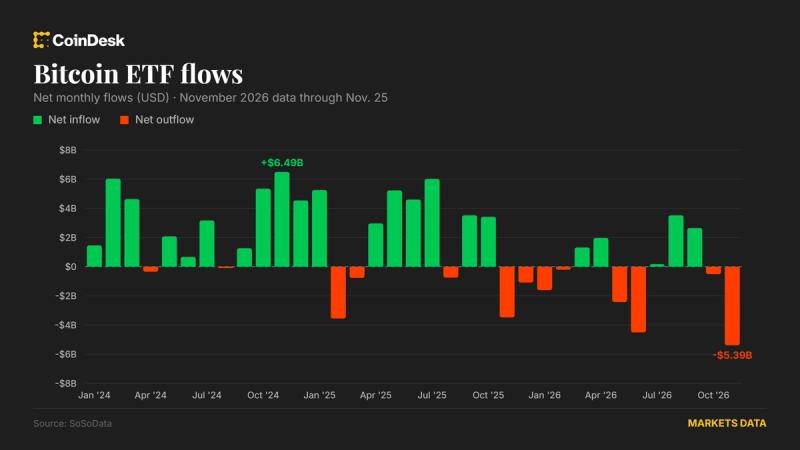
For months, the narrative surrounding Bitcoin was simple: institutional money was here, the ETFs were the new gatekeepers, and the Federal Reserve was going to cut rates until the party never ended. That script is currently being rewritten in real-time. As we move toward late November, the data is telling a different story. The massive inflows that defined the start of the year have reversed into a steady bleed, and the central bank isn't coming to the rescue.
As a founder, I have seen this cycle before. We get drunk on the idea that external macro forces will do the heavy lifting for us. When the ETFs launched, the sentiment was that the "smart money" had finally arrived to stabilize the market. But smart money is also mobile money. It leaves just as quickly as it enters when the risk-reward ratio shifts. Right now, that ratio is tilting toward the exit doors.
The Fed’s Cold Shoulder
The core of the issue lies with the Federal Reserve. The market spent the better part of the last quarter pricing in aggressive rate cuts. The assumption was that inflation was handled and the Fed would pivot to supporting growth. However, recent economic signals suggest otherwise. The Fed is signaling a "wait and see" approach, which in central-bank-speak usually means "don't hold your breath for lower rates."
This is a bucket of cold water for the crypto markets. High interest rates mean the US Dollar stays strong and "risk-on" assets like Bitcoin become less attractive compared to treasury bonds that offer a guaranteed yield. When you remove the prospect of cheap money, the speculative premium on crypto starts to evaporate. That is exactly what we are seeing with the ETF outflows. Institutional managers are rebalancing, and they are doing it with zero sentimentality.
Why Builders Should Care
If you are building in the trenches, it is easy to ignore the ticker tape. But you shouldn't. The outflow of capital from ETFs affects the entire ecosystem's runway. It impacts venture capital appetite, it affects the valuation of treasury holdings for DAOs, and it shifts the focus of the entire industry from "growth at all costs" to "sustainable utility."
In a high-rate environment, the margin for error for a crypto startup is razor-thin. You can no longer rely on a rising tide to lift your mediocre product. When liquidity dries up, users become more discerning. They stop chasing every new shiny yield farm and start looking for platforms that actually solve a problem. This is the moment where the tourists leave and the builders stay. It is an honest, if painful, pruning of the garden.
The Institutional Reality Check
We need to stop treating the ETFs as a permanent floor for the price of Bitcoin. They are a bridge, not a destination. The institutions using these products are often hedging or looking for short-term arbitrage opportunities. They are not all "HODLers" in the way the crypto-native community understands the term. When the macro environment turns sour, they treat Bitcoin like any other volatile tech stock.
This realization is important for anyone developing decentralized finance (DeFi) protocols or consumer-facing apps. If your business model depends on Bitcoin constantly hitting new all-time highs to attract users, you don't have a business; you have a levered bet. The current bleeding from these funds is a reminder that we need to build products that work even if Bitcoin stays sideways for two years.
What to Watch Next
Moving forward, the focus needs to shift away from the Fed’s meeting minutes and back to on-chain activity. We should be looking at active addresses, Layer 2 scaling efficiency, and actual throughput of non-speculative transactions. If the ETF drain continues, the market will eventually reach a point of equilibrium where only the long-term believers and the actual users remain.
I am keeping a close eye on how the remaining ETF holders behave. If the outflows accelerate, we could see a liquidity crunch that forces a deeper correction. But for those of us who have been through 2018 and 2022, this is just another Tuesday. The noise of the market is secondary to the signal of the code.
The Fed isn't your friend, and the ETFs aren't your savior. The only thing that survives a liquidity drain is real utility.
The Takeaway for Founders
The lesson here is simple: stop waiting for a macro bailout. The Federal Reserve is focused on the broader economy, not your portfolio or your protocol’s TVL. The ETF outflows are a clear signal that the easy-money era of the current cycle is over. For builders, this is actually good news, even if it doesn't feel like it today. It forces a return to fundamentals.
If you can build a product that people use when money is expensive and the markets are bleeding, you will be unstoppable when the cycle eventually turns. Focus on your burn rate, focus on your core users, and ignore the Fed. The institutions will come back when there is something worth buying again. Until then, it is up to us to make sure there is a reason for this industry to exist beyond just trading numbers on a screen.
Read the original at CoinDesk →