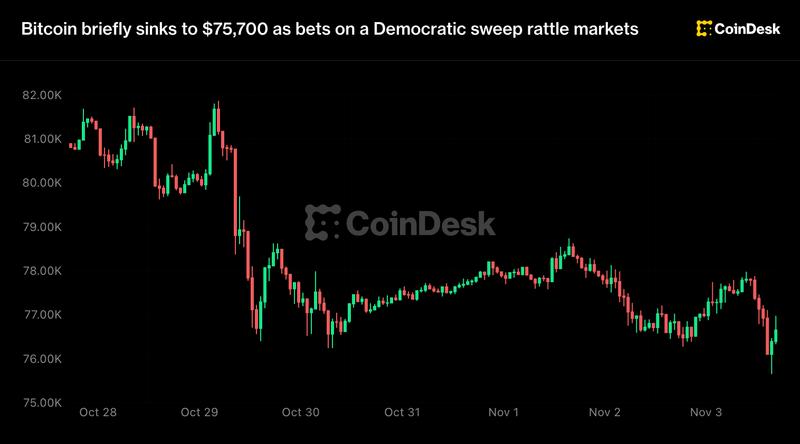
We just saw Bitcoin take a sharp dip to the $75,700 mark, and while the charts look messy, the reason is simple: political uncertainty. Early midterm returns are suggesting a potential Democratic sweep of both chambers of Congress, and the market is reacting exactly how you would expect it to. Stock futures are down, the dollar is sliding, and Treasury bonds are seeing a rush of activity.
The Market Dislikes a Monolith
For those of us building in this space, price action is usually noise. But this specific dip is a signal about regulatory sentiment. Historically, markets tend to favor a split government. When power is divided, radical policy shifts are harder to pass, creating a stable, if stagnant, environment for business. A sweep by one party—regardless of which side it is—removes those checks and balances in the short term.
When the news started filtering in that Democrats might take both the House and the Senate, the "Trump trade" or the "de-escalation trade" that many had priced in began to unwind. The immediate reaction was a flight to safety in Treasuries and a quick exit from risk assets like Bitcoin. It is a reminder that despite our talk of decentralization, the king of crypto is still very much tethered to the macro-economic and political whims of Washington D.C.
Why Builders Should Care
If you are a founder, you should not be watching the $75,700 candle with fear, but you should be watching the legislative implications. A single-party control over the legislative branch means the path for bills like the Financial Innovation and Technology for the 21st Century Act (FIT21) or stablecoin regulation could change overnight. We have seen a lot of friction between the current administration's regulatory bodies and the crypto industry. A sweep suggests that this friction might not just continue, but potentially accelerate without a legislative counterweight.
The sliding dollar is another piece of the puzzle. Usually, a weaker dollar is a tailwind for Bitcoin, but right now, the fear of regulatory heavy-handedness is outweighing the benefits of currency devaluation. Investors are worried about capital gains tax discussions, stricter KYC requirements, and a potential crackdown on decentralized protocols that do not fit into traditional banking boxes.
The Volatility of Perception
Bitcoin's drop wasn't a failure of the protocol. It was a failure of expectations. Much of the recent rally was built on the assumption that we would see a more "crypto-friendly" legislative shift. When that narrative gets challenged by real-time voting data, the leverage in the system gets flushed out. That is what we saw at $75,700—a massive flush of late-long positions who were betting on a specific political outcome.
For those of us in the trenches, this is actually a healthy, albeit painful, reset. Building a product around a specific political candidate or a specific party’s success is a fragile strategy. The best founders I know are building things that work regardless of who sits in the Oval Office or who holds the gavel in the Senate. If your project requires a specific person to be in power to survive, you aren't building a protocol; you're building a political derivative.
What Happens Next?
We need to look at the Treasury rally. When investors pile into bonds, they are looking for protection against volatility. Bitcoin is often called digital gold, but in moments of extreme political pivot, it still behaves like a high-beta tech stock. The decoupling from traditional markets is a long-term goal, but we are clearly not there yet. The dollar sliding indicates that the global market is wary of U.S. fiscal policy moving forward, which could eventually be the catalyst Bitcoin needs to rebound, but the initial shock has to wear off first.
- Legislative Risk: A sweep makes it easier to pass comprehensive tax and oversight bills without bipartisan compromise.
- Market Sentiment: The "risk-off" move proves Bitcoin is still viewed as a speculative asset by the institutional majority.
- Founder Strategy: Focus on censorship resistance and utility that doesn't rely on regulatory benevolence.
The next few days will likely be characterized by more of these sharp moves as final counts come in. We should expect the $75,000 level to be tested again if the sweep is confirmed. If you’re managing a treasury for a startup, now is the time to ensure you have enough runway in stables or fiat to weather a period of high-amplitude swings.
The market hates surprises. A Democratic sweep wasn't the consensus bet, and we are seeing the cost of that miscalculation in real-time.
The Bottom Line
Don't get distracted by the red candles. The fundamental tech hasn't changed. The block time is still ten minutes. The supply is still capped. What has changed is the perceived difficulty of the next two years for U.S.-based crypto companies. If you are building in America, the regulatory moat just got a little wider and a little deeper. Use this volatility to stress-test your assumptions and ensure your business model isn't dependent on a friendly Congress that might not be coming.
Read the original at CoinDesk →