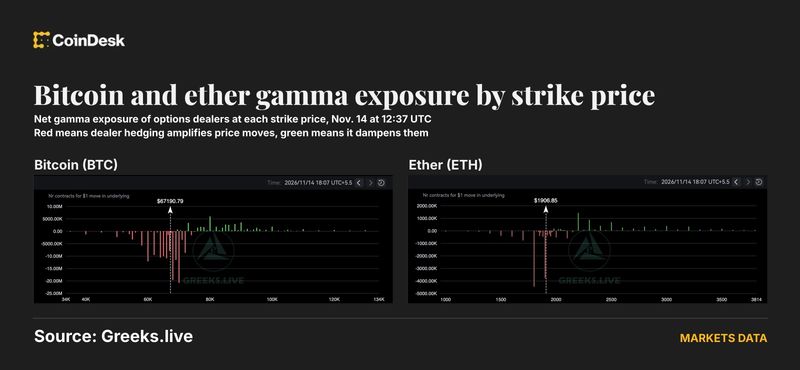
If you have been watching the charts lately, you have probably noticed that Bitcoin and Ether aren't just moving; they are teleporting. One minute we are ranging, the next we are blowing through resistance levels like they are made of wet paper. Most retail traders blame whales or some secret government agenda, but the truth is usually much more mechanical.
We are currently sitting in a specific price range where market makers—the guys who provide the liquidity that lets you trade without massive slippage—are being forced to behave in ways that actually make the market less stable. In the industry, we call this being short gamma. For builders and founders, understanding this isn't just about trading; it is about understanding why the infrastructure of our industry feels so fragile during high-growth periods.
The Liquidity Trap
Market makers don't take directional bets. They aren't hoping Bitcoin goes to $100k or drops to $50k. Their entire business model is based on collecting the spread—the tiny difference between the buy and sell price. To do this safely, they have to stay 'delta neutral,' which is a fancy way of saying they want their net exposure to the price to be zero.
When you buy an options contract from a dealer, they are now 'short' that contract. To stay neutral, they have to buy or sell the underlying asset (Bitcoin or Ether) to balance the books. The problem arises when price volatility hits certain thresholds. As the price moves fast, the 'delta' of those options changes even faster. To stay neutral, dealers are forced to buy more when the price goes up and sell more when the price goes down.
Instead of acting as a shock absorber, market makers become an accelerant. They are effectively forced to chase the trend, adding fuel to the fire that is already burning.
Why Builders Should Care
As a founder, it is easy to ignore the plumbing of the options market. You are focused on shipping code, hiring engineers, and finding product-market fit. But these 'behind the scenes' forces dictate the cost of capital and the stability of the entire ecosystem.
When volatility is amplified by dealer hedging, everything becomes more expensive. Gas fees on Ethereum spike because liquidations are happening en masse. Flash loans become riskier. Stablecoin pegs get tested. If you are building a DeFi protocol, these are the moments when your smart contracts face their real-world stress tests. If your liquidation thresholds don't account for 'gamma-induced' slippage, your protocol could end up under-collateralized in a matter of seconds.
- Increased Slippage: Even on high-volume pairs, the depth of the order book can vanish if dealers are busy hedging their own skins.
- Oracle Lag: Fast moves can outpace the speed of decentralized oracles, leading to arbitrage opportunities that drain protocol reserves.
- User Friction: High volatility scares off the 'normal' users we are all trying to onboard into Web3.
The Ether Problem
While Bitcoin gets all the headlines, the situation in the Ether markets is often more volatile because the liquidity is thinner. When market makers find themselves short gamma on ETH, the resulting moves are more violent. This creates a feedback loop for the thousands of altcoins paired against ETH. When the denominator moves 10% in an hour, the entire ecosystem feels the whiplash.
We have seen this play out repeatedly. A small move triggers a dealer hedge, which triggers a liquidations cascade, which triggers more dealer hedging. It is a mechanical cycle that has very little to do with 'fundamentals' or 'news.' It is just math and margin calls.
A Founder Perspective
I have always been a bit skeptical of the 'up only' narrative. Not because I don't believe in the tech—I've spent my career in it—but because I see how the sausage is made. The financial products being built on top of these assets are becoming increasingly complex, and that complexity carries hidden costs.
If you are building a project right now, you need to be prepared for 'gap risk.' This is the risk that the price jumps from $60,000 to $65,000 without ever actually trading at the prices in between. When dealers are forced to hedge aggressively, they don't use limit orders; they use market orders. They need out, and they need out now. This skips over the price levels where your users might have placed their stop-losses or where your protocol might have planned to liquidate a position.
Real builders don't just account for the price; they account for the liquidity environment. If your system depends on a stable, slow-moving market, it isn't a robust system.
The Takeaway
We are entering a phase where the technical structure of the market is just as important as the macro environment. You can have the best news in the world—ETF approvals, institutional adoption, regulatory clarity—and still see a 15% flash crash because a few major dealers got caught on the wrong side of a gamma hedge.
Don't mistake volatility for a lack of value, but don't mistake a pump for organic demand either. A lot of what we are seeing is just the mechanical rebalancing of the giants who run the exchange floors. For those of us building the future, the goal remains the same: build systems that can survive the chaos, because the chaos is a feature of the system, not a bug.
Keep your leverage low, your cash reserves high, and your eyes on the order books. The next few months are going to be a masterclass in market mechanics, and only the builders who understand the plumbing will be left standing when the dust settles.
Read the original at CoinDesk →