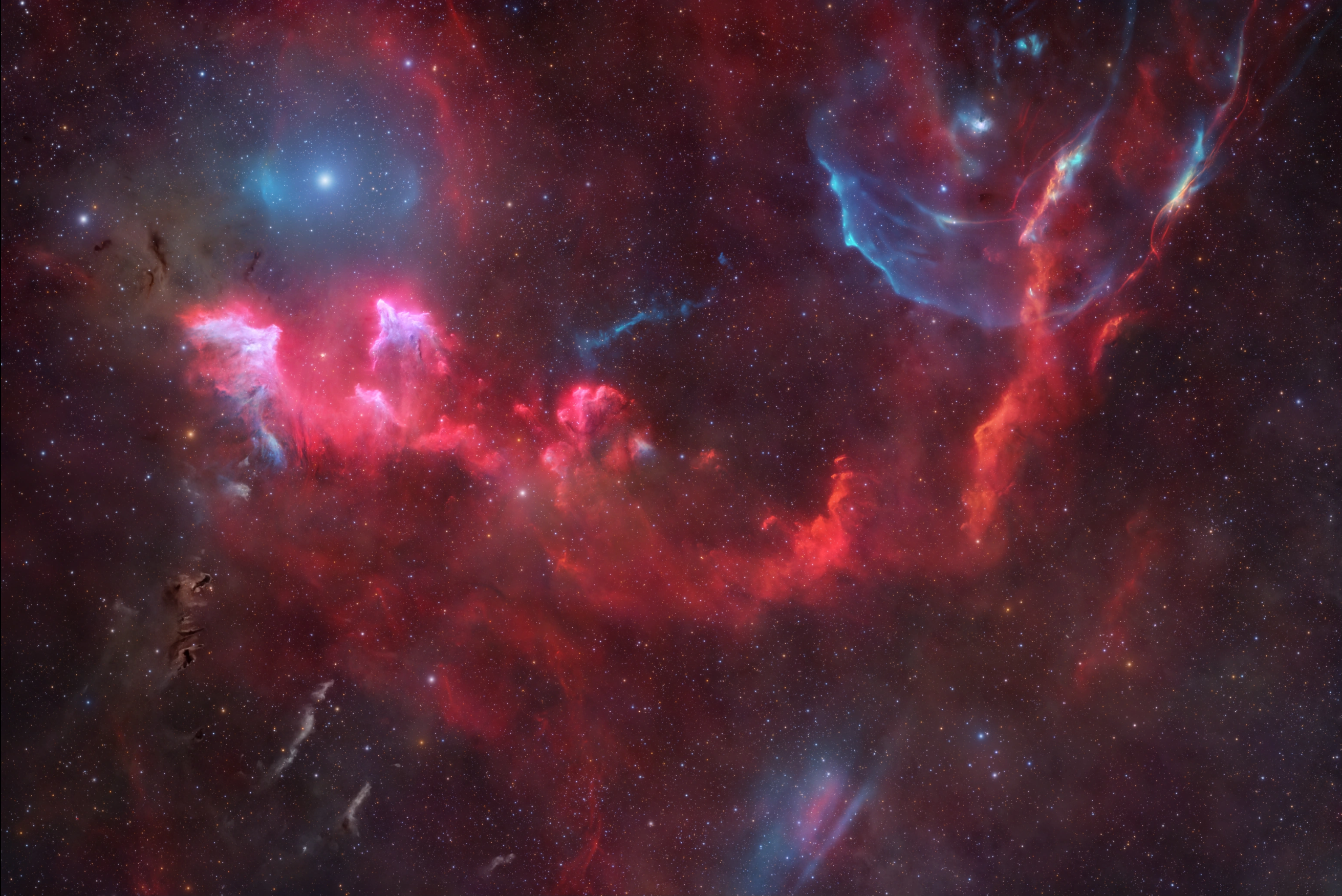
We spend a lot of time talking about the next layer of the internet or the latest LLM iteration, but sometimes it is worth looking at the original open-source hardware: the universe. NASA recently dropped new imagery of the Cassiopeia constellation, specifically focusing on the IC 63 and IC 59 nebulae. They call them the Ghosts of Cassiopeia. While the mainstream media treats this like a pretty wallpaper update, there is a founder-level lesson here about visibility, infrastructure, and the limitations of our current tech stack.
The Infrastructure of the Void
In the tech world, we are obsessed with transparency. We want to see the code, the transaction on the ledger, and the weights of the model. But in deep space, visibility is a luxury. These nebulae are essentially vast clouds of gas and dust being bombarded by radiation from a nearby star, Gamma Cassiopeiae. The radiation is slowly eroding these clouds, causing them to glow. It is a process of destruction that creates visibility.
Think about that from a builder’s perspective. Often, the most critical parts of a system are invisible until they are put under immense stress. You don't know how your database handles scale until the traffic spikes; you don't know how robust your smart contract is until someone tries to drain the liquidity. These ghosts in Cassiopeia are only visible because a massive energy source is literally tearing them apart. In our world, we call that a stress test.
Why Better Lenses Matter for Builders
The reason we are seeing these ghosts with new clarity isn't because the stars changed. It is because our sensors got better. This is a direct parallel to the current AI arms race. We had the data (the stars) for decades, but we didn't have the compute (the lenses) to make sense of the patterns. NASA’s ability to pull detail out of what looked like empty space a few years ago is the same leap we are seeing in data science today.
- Precision over Volume: It is not about taking more photos; it is about the sensitivity of the sensor. In crypto, it is not about more transactions; it is about the quality of the state transition.
- Filtering the Noise: Space is noisy. To see these nebulae, scientists have to filter out massive amounts of light pollution and cosmic interference. Builders need to do the same with market hype.
- Long-term Observation: These formations don't change overnight. They require patience. If you are building for a one-week exit, you aren't building for the long haul.
The Technical Debt of Discovery
When you look at the IC 63 nebula, you are looking at hydrogen gas being ionized by ultraviolet radiation. This isn't just a chemical reaction; it is a transfer of energy that has been happening for eons. In our industry, we often ignore the energy costs of our systems. Whether it is the kilowatt-hours required to train a new model or the gas fees on a congested network, there is always a trade-off between visibility and sustainability.
The Ghost of Cassiopeia is essentially a visualization of technical debt. The nebula is losing mass. It is being burned away. It looks beautiful now, but it is a temporary state. As founders, we often build things that look great on a slide deck but are being burned away by high burn rates or unsustainable tokenomics. The goal is to build something that doesn't just glow under pressure but survives the radiation.
The most important things in any system are usually the ones you can't see until they start to break.
Founders: Stop Chasing the Glow
It is easy to get distracted by the aesthetics of a project. The new imagery from NASA is stunning, but the real value is in the data behind the pixels—the distance, the composition, and the rate of decay. Similarly, in the AI and crypto space, the value isn't in the UI or the flashy announcement. It is in the underlying architecture.
If you are building right now, you need to ask yourself if you are building the star or the nebula. The star (Gamma Cassiopeiae) is the energy source, the catalyst, the thing that drives the system. The nebula is the byproduct, reacting to the energy. Too many founders are building byproducts. They are reacting to trends rather than setting them. They are the ghosts, not the light.
What This Means for the Next Cycle
As we move into 2025 and 2026, the tools we use to observe our own industries are going to get as sharp as NASA's telescopes. On-chain analytics are becoming more granular. AI auditing tools are becoming more perceptive. The days of hiding inefficiencies in the dark are over. The radiation is hitting every cloud, and everything is going to be revealed.
My advice? Don't be a ghost. Be the infrastructure that survives the observation. Build systems that are robust enough to handle the radiation of public scrutiny and the erosion of time. The universe doesn't care about your roadmap, and neither does a bear market. It only cares about the physics of the system.
The takeaway here is simple: visibility is a double-edged sword. It reveals your beauty, but it also reveals your decay. Make sure that when the lights finally hit your project, there is something solid left to see.
Read the original at NASA Breaking News →