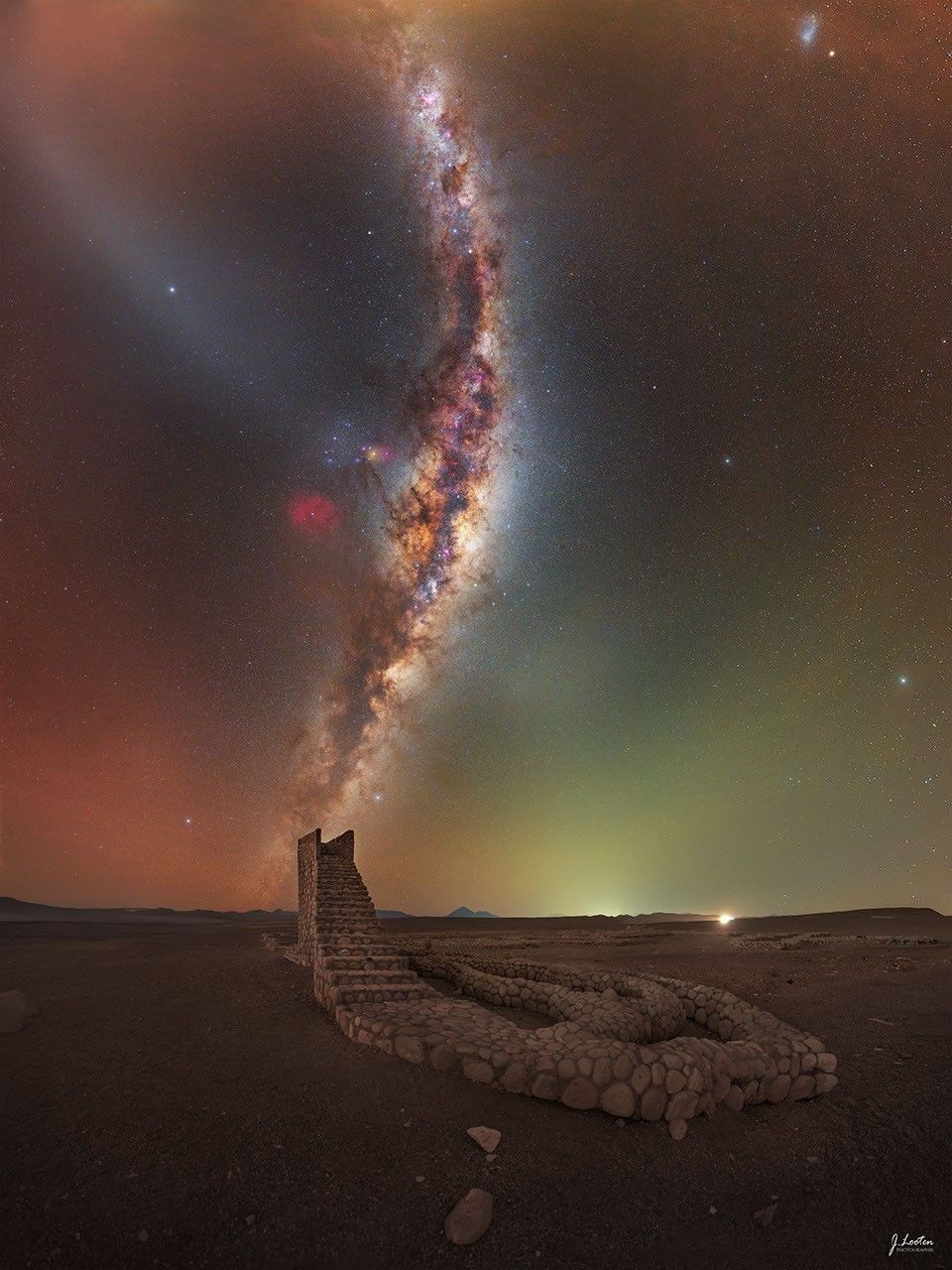
We talk a lot about the hardware stack in crypto and AI, but we rarely talk about the inputs that actually make these systems worth using. Most founders are obsessed with the plumbing—the rollups, the low-latency inference, the tokenomics. But the real value usually lives in the data layers that humans find visually and intellectually compelling. A recent feature from NASA’s Astronomy Picture of the Day, titled Desert Stairway to Heaven, serves as a perfect case study for why founders need to stop looking at the ground and start looking at the infrastructure required for high-fidelity spatial data.
The High-Resolution Bottleneck
When you look at a professional astronomical image, you aren’t just looking at a pretty picture. You are looking at a massive dataset captured through precise sensors, layered over time, and processed to remove noise. For a builder in the AI space, this is the gold standard of training data. For a builder in the DePIN space, this represents a logistical nightmare and a massive opportunity.
Currently, the storage and verification of high-resolution scientific imagery are centralized. If you want to build an application that utilizes real-time or archival celestial data, you are at the mercy of government-funded APIs or academic silos. These systems are reliable but slow, and they aren’t built for the permissionless economy. If we want to integrate this kind of data into decentralized visual models, we need a better way to incentivize the capture and storage of the physical world—and the space above it.
Decentralized Infrastructure for Global Observation
The image in question shows a staircase-like formation against a star-studded sky. It reminds me of the early days of Bitcoin mining: people finding remote locations with clear advantages—in this case, lack of light pollution—to generate value. In the near future, I expect to see DePIN protocols that reward individuals for setting up high-end optical sensors. We already see this with weather stations and dashcams, but the next logical step is scientific-grade observation.
Imagine a network of thousands of amateur and professional astronomers contributing RAW sensor data to a decentralized ledger. Instead of a single image being featured once a day by a centralized body, you have a continuous stream of verified spatial data. This isn't just for hobbyists. High-resolution sky data is critical for satellite navigation, climate modeling, and defensive monitoring. By removing the central point of failure, we make this data more resilient and more accessible to the builders who need it.
AI and the Search for Meaningful Patterns
From a founder’s perspective, the AI play here is even more interesting. We are currently hitting a wall with LLMs because they are running out of high-quality human text to scrape. The next leap in intelligence will likely come from multi-modal models that understand physics, spatial relationships, and deep-time data. A photograph of a desert stairway reaching toward the stars is a complex arrangement of light, geology, and atmospheric conditions.
Training an AI to understand these relationships requires massive amounts of labeled, high-fidelity imagery. The problem is that most data on the open web is garbage. It’s compressed, it’s watermarked, or it’s AI-generated itself, leading to model collapse. Scientific data sources, like those provided by astronomical archives, are the antidote. They provide ground truth. Founders building in the AI space should be looking at how to bridge these legacy scientific archives into decentralized training sets.
The Skeptic’s View: The Cost of Reality
I’m always skeptical of "data for the sake of data" plays. Just because you put a picture of the stars on a blockchain doesn’t mean you’ve created value. The friction point is always the cost of bandwidth and storage. Storing a single high-res RAW file is exponentially more expensive than storing a transaction hash. For this to actually work for builders, we need to see significant improvements in decentralized storage efficiency.
Furthermore, there is the issue of provenance. In an era where AI can generate a "Desert Stairway" in three seconds with a text prompt, how do we verify that a scientific image is real? This is where the intersection of crypto and AI becomes mandatory. We need hardware-level signatures at the sensor point to prove that light actually hit a lens at a specific coordinate at a specific time. Without that, the data is useless for serious scientific or industrial applications.
Why Founders Should Care
If you are a founder, don’t just look at this as an astronomical curiosity. Look at it as a roadmap for the next generation of data-heavy applications. The world is moving toward a state where the physical and digital are inseparable. Capturing the majesty of the universe is a high-level goal, but the underlying tech—verified sensor data, decentralized storage, and high-fidelity AI training—is where the real businesses will be built.
We need to move past the "meme coin" phase of crypto and into the "utility of reality" phase. That means building tools that help us document, verify, and understand the physical universe more effectively than a government agency with a legacy website can. The tech is mostly here; the builders just need to stop chasing the hype and start chasing the data.
The Takeaway
The future of spatial computing and AI relies on high-fidelity, verified data that currently sits in centralized silos. Founders who figure out how to decentralize the capture and verification of this data will be the ones who provide the foundation for the next decade of technological growth. The sky isn’t a limit; it’s an untapped dataset.
Read the original at NASA Breaking News →