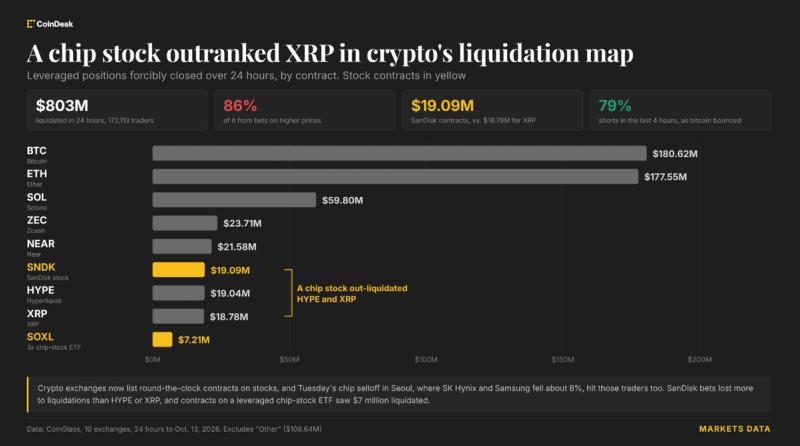
We talk a lot about volatility in crypto, but we usually expect it to come from a dog coin or a regulatory tweet. This week, the pain came from the hardware sector. About $800 million in leveraged positions vanished in a single 24-hour window. The interesting part isn't just the dollar amount; it's where the bleeding was most intense. Tokenized bets on SanDisk saw more liquidations than XRP, a long-time favorite for high-leverage gamblers.
This is a wake-up call for anyone building in the Real World Asset (RWA) space. We are seeing the convergence of two high-risk environments: the cyclical, often brutal semiconductor market and the 24/7, high-leverage world of crypto exchanges. When Asia's chip rout started, the liquidations didn't just stay on traditional brokerage apps. They spilled over into the decentralized and off-shore crypto ecosystem, catching a lot of "sophisticated" builders and traders off guard.
The Leverage Trap in Synthetic Assets
About 86% of the liquidated positions were long. That tells you everything you need to know about the current sentiment. People were betting big on a continued AI-driven hardware rally. They weren't just buying the stocks; they were using tokenized contracts on crypto exchanges to get 10x, 20x, or even 50x exposure to companies like SanDisk. When the underlying chip sector in Asia took a hit, these positions didn't just decline—they evaporated.
For founders, this is the double-edged sword of tokenization. We talk about "liquidity" as the ultimate goal, but liquidity goes both ways. In a traditional market, circuit breakers and trading hours provide a bit of friction that can slow down a total collapse. In the crypto version of these markets, the liquidation engines are automated, cold, and extremely fast. If you're building a platform that offers these products, you have to realize that you aren't just facilitating trading; you're building a high-velocity demolition derby.
Why SanDisk Outpaced XRP
It’s almost surreal to see a legacy hardware name like SanDisk causing more liquidations than a volatile crypto staple like XRP. But it makes sense if you look at the macro picture. XRP has been range-bound for a while; the people trading it know the risks. The people piling into tokenized chip stocks were likely chasing the AI hype, thinking that hardware is a "safe" bet because every AI model needs silicon to run. They forgot that hardware is a commodity business prone to massive supply-chain shocks.
When the rout started in Asian markets, the crypto-synthetic versions of these stocks were the first to feel the squeeze. Because these platforms often have less depth than the NASDAQ or the HKEX, the price slippage during a sell-off is magnified. A 5% drop in the underlying stock can trigger a cascading liquidation event on a crypto exchange that wipes out everyone who isn't over-collateralized by 300% or more.
The Founder Perspective: Infrastructure Risks
If you are building in DeFi or RWA, you need to look at this $800 million wipeout as a stress test for your risk models. Most builders spend their time thinking about smart contract audits and UI/UX. Not enough time is spent thinking about the volatility profile of the underlying asset once it's wrapped in a token.
- Cross-Contagion: We are now at a point where a bad day for semiconductor manufacturing in Taiwan or Japan directly triggers a liquidation spike on decentralized perps platforms.
- Oracle Latency: During a fast-moving rout, the gap between the real-world stock price and the on-chain oracle can be fatal. If your oracle is slow, your users get rekt. If it's too fast, you might trigger false liquidations during a brief flash crash.
- Leverage Limits: As a founder, offering 50x leverage on a tokenized stock might bring in volume, but it also builds a fragile ecosystem. The $800 million lost here shows that the appetite for risk far exceeds the market's ability to absorb it.
We need to stop pretending that tokenizing an asset makes it inherently better. It makes it more accessible, yes. It makes it more composable, sure. But it also strips away the protective layers that traditional finance has built over decades. When you remove the friction, you accelerate the crash.
The AI Hardware Mirage
There is a lesson here for AI builders, too. We’ve been living in an era where anything associated with "chips" or "compute" is viewed as a perpetual money machine. This liquidation event is a reminder that hardware is cyclical. We are seeing a massive correction in expectations. The supply of chips is catching up to the demand, and the speculative premium is starting to leak out.
If your AI startup relies on the assumption that hardware costs will stay stable or that chip-stock valuations will stay astronomical to fund your next round, you’re in trouble. The market just proved that it can and will dump the hardware sector just as fast as it dumps a meme coin.
The Takeaway
The $800 million wiped out wasn't just "crypto money." It was capital that had moved into synthetic representations of the physical world. This is the new reality. As we blur the lines between traditional equities and digital assets, the crashes will become more synchronized and more violent.
The goal of builders shouldn't just be to tokenize everything. The goal should be to build systems that can survive the velocity of the technology we’ve created.
If you’re trading these markets, stop treating SanDisk like it’s a stable blue-chip when you’re holding it on a crypto exchange. On-chain, everything is a high-beta play. If you're building these platforms, look at the 86% long liquidation rate and ask yourself if you're building a financial tool or a digital casino. The answer will determine whether you're still around after the next rout.
Read the original at CoinDesk →