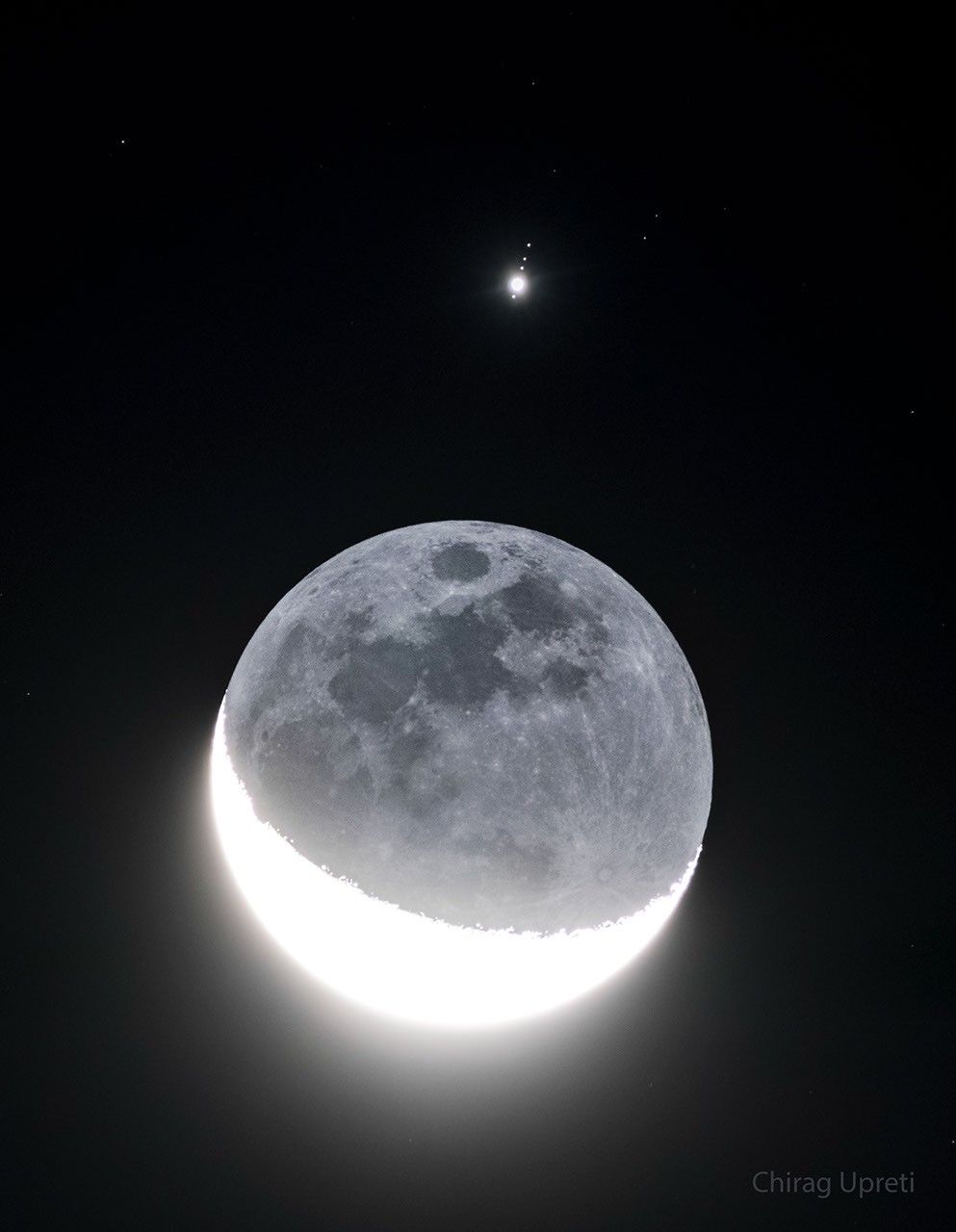
NASA recently published an updated look at Jupiter and its surrounding moons through their Astronomy Picture of the Day program. At first glance, it is another high-resolution shot of a gas giant we have seen a thousand times. But if you look at this through the lens of a founder or a developer, there is a lot more going on than just space photography. It is a case study in scale, observation, and the reality of complex systems.
When we talk about Jupiter, we are talking about the ultimate legacy system. It is a massive, gravity-heavy environment that dictates the rules for everything around it. In the crypto and AI space, we see these types of systems all the time. Large language models and base-layer protocols act just like Jupiter. They provide the gravity, the infrastructure, and the environment, but the interesting activity usually happens in the orbit.
The Gravity of Infrastructure
In the recent imagery, the focus is not just on the planet, but on the moons that inhabit its space. These moons represent the decentralized applications and agents we are building today. They are smaller, more agile, yet entirely dependent on the primary gravity of the host system. If you are building on Ethereum or leveraging OpenAI's API, you are effectively a moon orbiting a gas giant. You have your own composition and your own trajectory, but you cannot ignore the massive forces pulling on you.
As builders, we often get caught up in the majesty of the 'big' tech. We obsess over the next update to a model or the next hard fork of a chain. But the NASA image shows us that the planet is mostly gas and turbulence. The moons, however, are where the solid ground is. That is where the potential for life, or in our case, utility, actually resides.
Building in a Turbulent Environment
Jupiter's surface is a chaotic mess of storms that have lasted for centuries. This is a perfect metaphor for the current state of AI development. It is loud, it is changing constantly, and if you get too close to the center without a plan, you will get crushed by the pressure. The astronomers who captured these images have to account for light, distance, and the relative motion of every body in the frame just to get a clear shot.
Software development in 2024 feels very similar. You aren't just writing code in a vacuum. You are writing code that has to account for shifting regulatory environments, fluctuating compute costs, and the rapid deprecation of yesterday's 'state-of-the-art' tools. The lesson from the astronomers is simple: stabilize your view. They don't try to stop the storm; they just find the right aperture and timing to make sense of it.
Why Small Satellites Matter
We often ignore the smaller satellites in favor of the big four: Io, Europa, Ganymede, and Callisto. But the Jovian system is crowded with smaller bodies. In tech, everyone wants to be the next Europa—the one everyone talks about because of its potential for subsurface oceans. But there is a massive amount of value in being a specialized, smaller satellite that performs one function perfectly within the ecosystem.
I see too many founders trying to build their own Jupiter. They want to create the next foundational layer or the next massive ecosystem. Most of the time, they don't have the mass for it. They end up as space debris. There is no shame in being a moon. Moons are where the exploration actually happens. Moons are where we land probes. Moons have specific, tangible boundaries that a gas giant lacks.
The Skeptic's View of the Big Picture
NASA likes to talk about 'discovering the cosmos,' which sounds great in a press release. But the reality is that these images are the result of rigorous, often boring data processing. They are not 'snapshots' in the way we think of them on our phones. They are composites. They are interpretations of data captured across different spectrums.
This is where the skepticism comes in for me. In the AI world, we are constantly shown 'perfect' demos and high-resolution visions of the future. But just like a NASA image, those demos are often composites. They are cherry-picked frames meant to show the best possible version of a reality that is actually much noisier and more difficult to navigate. As a builder, you need to be able to look at the pretty picture and see the raw data behind it. Don't buy the hype of the polished output; understand the sensors that captured it.
Takeaway for Founders
The Jovian system is a reminder that scale creates its own set of rules. If you are building in the orbit of a major tech giant, your job is to stay stable while the atmosphere below you churns. Focus on your own orbit, manage your own gravity, and don't mistake the beauty of the big picture for a lack of complexity.
- Respect the gravity: Know which platform or protocol controls your environment and plan for its shifts.
- Find solid ground: Don't just build more 'gas.' Build features and tools that have a solid, tangible utility.
- Filter the noise: Like an astronomer, learn to process the raw data of the market rather than reacting to the polished headlines.
Complexity is not a feature; it is a condition. Your job is to navigate it without getting pulled into the storm.
We will keep watching the big players, just like we keep watching Jupiter. But the real work is happening on the satellites. That is where the builders are, and that is where the future is actually being shaped.
Read the original at NASA Breaking News →