I have spent a lot of time looking at how we build systems that last. Whether it is a blockchain protocol or a new AI model, the goal is usually the same: find a way to extract signal from an immense amount of noise. That is why the recent focus on NASA’s IceCube Neutrino Observatory caught my eye. It is a massive project that involves literally burying sensors in the Antarctic ice to catch particles that most people do not even know exist.
The Hardware of the Impossible
If you are building a startup, you probably think your operating environment is tough. You have low margins, high churn, or maybe a messy codebase. But the team behind IceCube had to build a detector in a place where the temperature drops to minus forty and the sun stays down for months. They did not just build a lab; they turned a cubic kilometer of Antarctic ice into a giant piece of hardware.
Neutrinos are often called ghost particles. They have almost no mass, they travel at near-light speeds, and they pass through almost everything. Right now, trillions of them are passing through your body. They do not stop for lead walls or planets. To catch one, you need a very specific set of circumstances. You need a massive, transparent medium where you can see the faint blue light, known as Cherenkov radiation, emitted when a neutrino finally hits an atom.
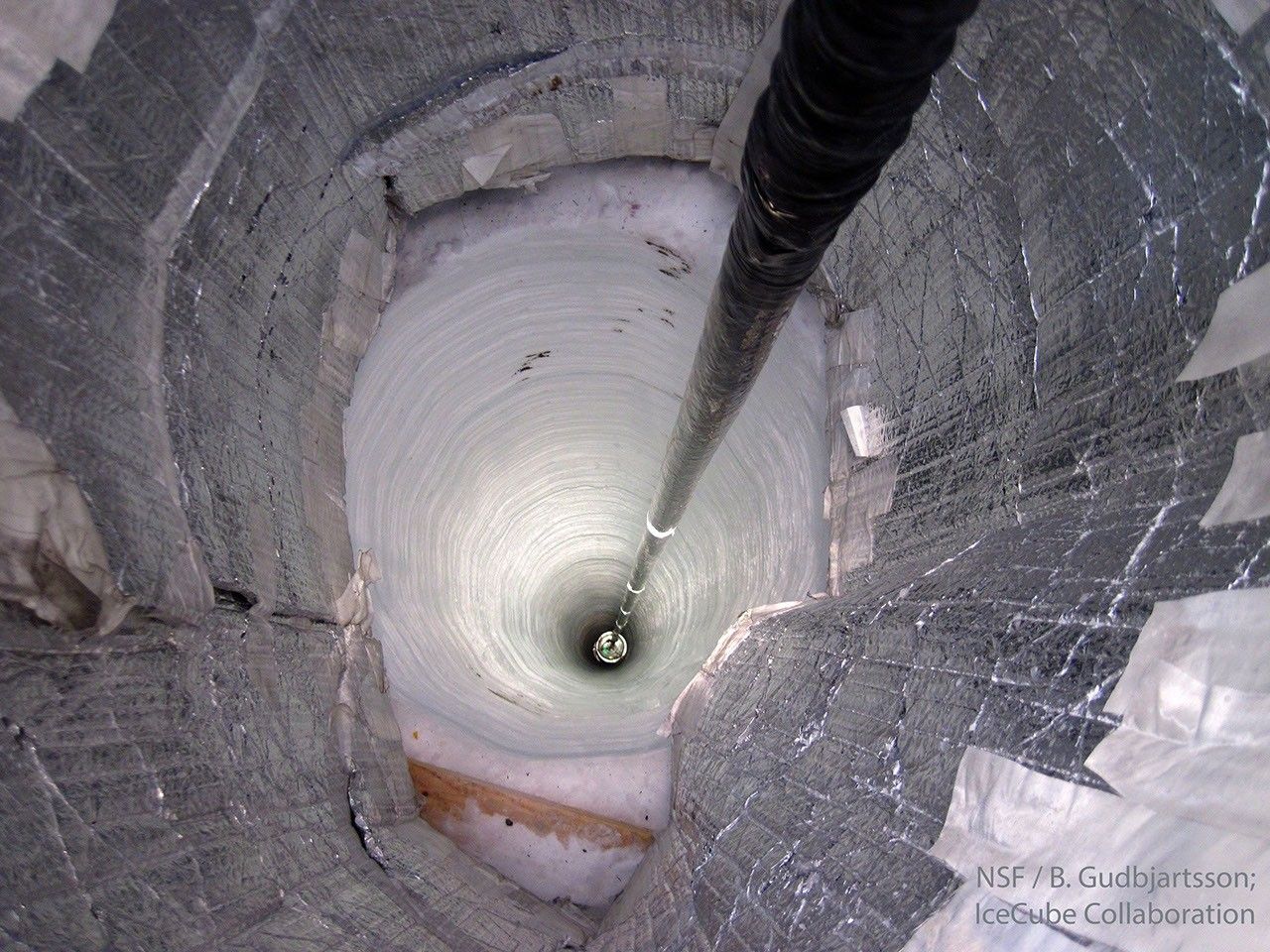
The builders of this project chose the ice at the South Pole because it is clear and stable. They drilled holes over two kilometers deep and lowered strings of sensors into the dark. It is a lesson in environment-first engineering. They did not try to build a perfect sensor in a vacuum; they used the natural environment as the primary component of the machine.
The Data Filtering Problem
For those of us in crypto or AI, the IceCube project is essentially a masterclass in data filtering. The sensors in the ice are constantly being bombarded by cosmic rays and other noise. Out of billions of events, the researchers are looking for just a handful of high-energy neutrinos that come from outside our galaxy.
This is the same struggle we face when trying to verify a transaction on a congested network or trying to train a Large Language Model on the open internet. The signal-to-noise ratio is abysmal. The IceCube team uses a combination of hardware timing and software algorithms to reconstruct the path of these particles. They are reverse-engineering the history of the universe by looking at a few flashes of light in a frozen hole.
From a founder’s perspective, this is a reminder that the most valuable data is often buried under layers of garbage. If you want to find the breakthrough, you have to be willing to build the infrastructure that can discard 99.9% of what it sees without blinking.
Why Builders Should Care
You might wonder what deep-space particles have to do with shipping code. The answer is perspective. We often get caught up in the hype cycles of the next big token or the newest API wrapper. Projects like IceCube remind us that real progress takes decades of quiet, difficult work.
- Infrastructure precedes insight: You cannot study cosmic neutrinos without first building the most extreme refrigerator on Earth.
- Scale changes the game: A small detector would see nothing. You need a cubic kilometer of ice to get enough hits to be statistically significant.
- Persistence is the only moat: The South Pole is not a friendly place to work. The teams that succeed are the ones who can handle the friction of the real world.
When I look at the decentralized web, I see a similar trajectory. We are currently in the drilling phase. We are trying to figure out how to lower our sensors into the ice without them breaking. We are trying to figure out how to tell the difference between a real user and a bot. It is slow, it is cold, and it is expensive. But the payout is a new way of seeing the world.
The Skeptic's View
I am always a bit skeptical of high-level science being presented as just a cool picture of the day. The reality of IceCube is not just a pretty blue light; it is thousands of hours of troubleshooting broken cables and debugging sensor arrays in the dark. It is hard work that often results in more questions than answers.
In the tech world, we tend to overpromise. We say that AI will solve everything next year or that crypto will replace banks by Friday. The scientists at the South Pole don't talk like that. They talk about probabilities. They talk about uncertainty. They talk about the next ten years of data collection. We could use a little more of that honesty in our own industries.
Real innovation is usually boring, difficult, and takes place in conditions that most people would find intolerable.
If you are building something right now, ask yourself if you are looking for the easy win or if you are willing to go to the South Pole for your data. The easy wins are crowded. The deep ice is empty, and that is where the real discoveries are hiding.
The Takeaway
Success in complex systems requires two things: an environment that allows for clarity and the patience to filter out the noise. Whether you are catching neutrinos or building the next generation of the internet, the principles remain the same. Don't fear the cold, and don't stop drilling.
Read the original at NASA Breaking News →