The South Pole’s Shrinking Safety Margin
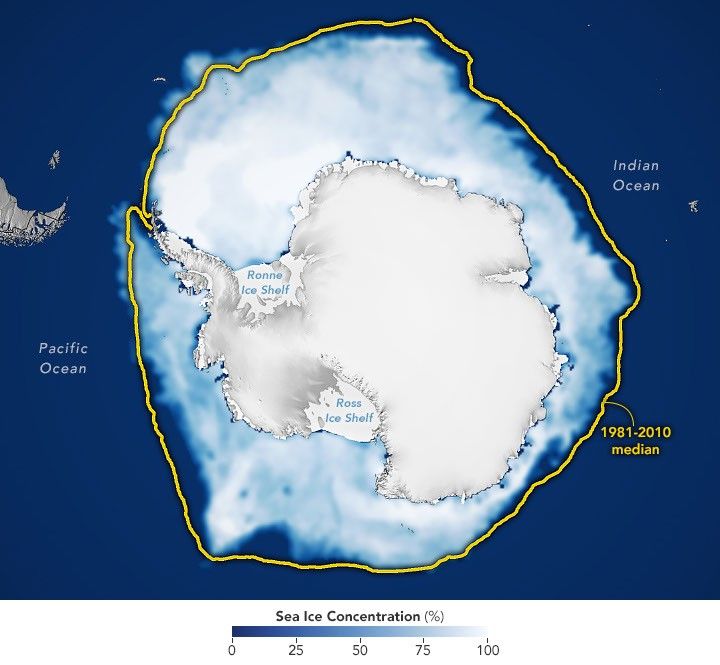
Data recently released by NASA and the National Snow and Ice Data Center reveals that Antarctic sea ice reached its maximum extent for 2024, and the numbers are far from reassuring. For those of us building in tech and AI, we often talk about 'edge cases' and 'system failures.' Antarctica is currently our planet’s most critical edge case, and the system is showing clear signs of structural fatigue.
This year, the ice peaked at roughly 17.16 million square kilometers. On paper, that sounds like a lot of frozen water. In reality, it is the third-lowest maximum since we started tracking this via satellite in the late 70s. We aren’t just looking at a bad year; we are looking at a pattern that is becoming increasingly difficult to ignore.
Moving Past the Boom-and-Bust Cycles
For decades, Antarctica was the climate skeptic’s favorite rebuttal. While the Arctic was melting at an alarming rate, Antarctic sea ice remained relatively stable, even showing slight growth in some years. It was a cyclical system with high volatility. But around 2016, something shifted. The volatility stopped swinging upward and started trending sharply downward.
As a founder, I look at these charts the same way I look at a dying SaaS metric. When your churn suddenly spikes and never recovers, you don’t have a seasonal fluctuation—you have a product-market fit problem. Antarctica has an environmental-stability problem. The southern pole has now seen three of its lowest years on record in just the last decade. The 'old normal' is officially gone.
The Impact on the Global Stack
Why should builders care about ice at the bottom of the world? It comes down to the albedo effect. Sea ice acts as the Earth’s primary heat shield. Bright white ice reflects about 90% of solar energy back into space. When that ice disappears, it is replaced by dark ocean water, which absorbs 90% of that same energy. This creates a feedback loop that accelerates warming.
This isn’t a linear problem; it’s an exponential one. For anyone working in infrastructure or supply chain logistics, these shifts mean more than just rising sea levels. They mean altered weather patterns that will eventually impact data centers, energy grids, and the raw materials needed for our hardware. We are building our digital empires on a physical foundation that is becoming less predictable every year.
Builder Perspective: Resilience Over Optimism
We see a lot of 'greenwashing' in the tech world. Companies buy carbon credits and slap a sticker on their website, claiming they are part of the solution. But data like this from NASA forces us to be more honest. The climate is a complex system, and we are currently pushing it past its operating limits.
For the founders reading this, the takeaway isn't to panic, but to build for resilience. If you are developing AI models for agriculture, energy, or logistics, your training data from ten years ago might already be obsolete. We are entering a period of 'non-stationarity,' where the past is no longer a reliable predictor of the future. Your models need to account for higher volatility and more frequent 'black swan' events in the physical world.
Is Technology the Solution?
I’m a tech guy, so I want to believe we can code our way out of this. We are seeing incredible work in satellite monitoring, AI-driven climate modeling, and new materials science. These are necessary tools, but they aren't magic bullets. A better dashboard won't freeze the ocean.
The data from this year’s maximum shows that the southern ocean is retaining more heat than before. This heat prevents ice from forming in the winter and speeds up melting in the summer. It’s a hardware failure at a planetary scale. While we focus on building the next great LLM or decentralized protocol, we have to acknowledge that these systems require a stable environment to function.
The Hard Truth
We need to stop treating these reports as isolated scientific curiosities. The fact that Antarctic ice is hitting record lows year after year is a signal. In the startup world, if your core infrastructure is failing, you pivot or you fix it. You don’t just keep adding features to the front end.
Building for a future with less ice means building for a world with more extreme heat, more volatile weather, and more economic disruption. It means prioritizing efficiency and sustainability not because it looks good in a pitch deck, but because it’s a requirement for long-term survival.
What It Means for the Ecosystem
The third-lowest maximum isn’t a fluke. It is a confirmation of a trend that began nearly a decade ago. As builders, we should be looking at how our work can mitigate these risks. Whether that is through more efficient compute, better resource management, or creating tools that help humanity adapt to a changing planet, the mission is clear.
The Earth is giving us the data. It’s up to us to actually read it and build accordingly. We can’t afford to ignore the edge cases anymore, especially when the edge case is the very ground—or ice—we stand on.
Read the original at NASA Breaking News →