The Return of the Trenches
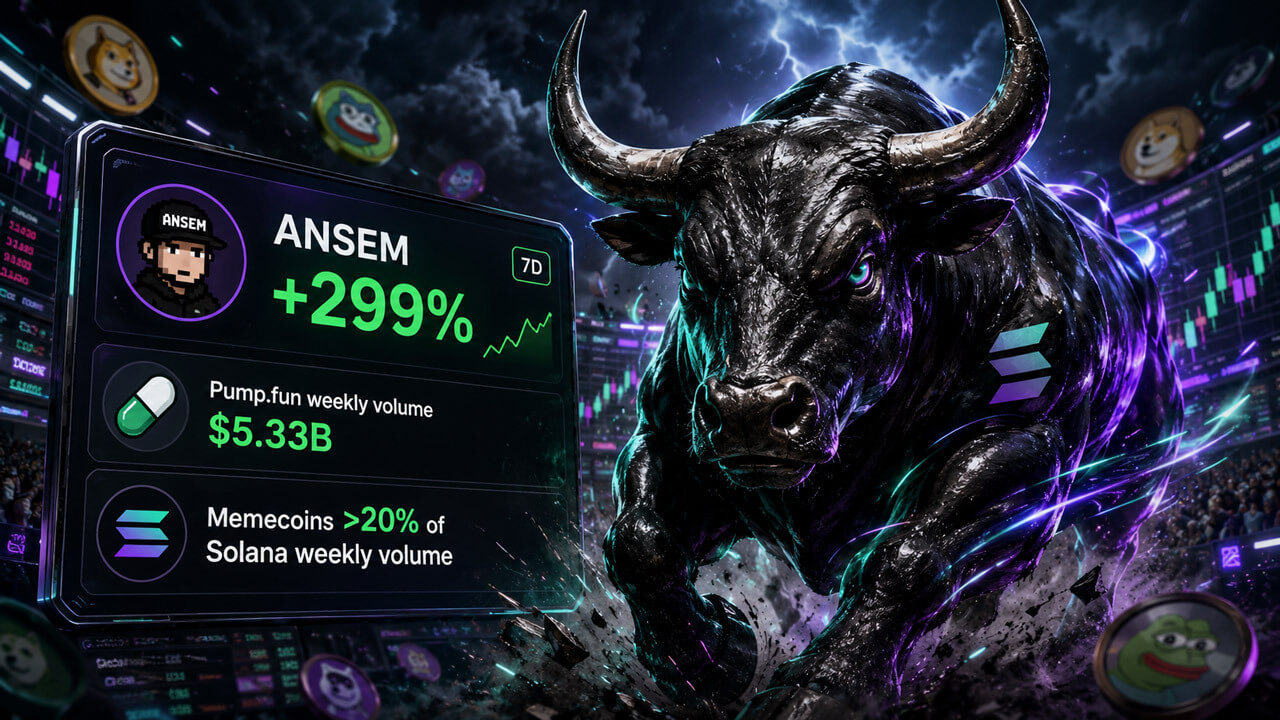
For a few weeks there, it looked like the air was finally coming out of the Solana memecoin bubble. The volume was drying up, the rug pulls were getting faster, and even the most dedicated degen gamblers were starting to look toward AI agents or utility protocols for their next fix. Then, the ANSEM token decided to move. In a seven-day span, it shot up nearly 300 percent, hitting a market cap north of $170 million and pulling in tens of millions in daily volume. Looking at the charts, it is clear the gambling appetite has not left the building; it was just sleeping.
When a ticker like ANSEM moves this aggressively, it acts as a signal flare for the entire ecosystem. Traders call it the return of the trenches. It is that hyper-volatile, high-risk environment where fortunes are made and lost in the time it takes to get a cup of coffee. As a founder, I watch these cycles with a mix of fascination and frustration. On one hand, the liquidity is impressive. On the other, you have to wonder what this does to the long-term viability of the network when the primary use case remains digital slot machines.
Why This Ticker Matters
ANSEM is not just another random token; it is effectively a bet on the influence of certain personalities within the crypto space. In this industry, attention is the only real currency with a fixed supply. When a token associated with a major influencer starts to moon, it creates a gravity well that sucks in capital from other chains and other sectors. We are seeing that happen right now on Solana. With a $173 million market cap, this is no longer a small-scale experiment. It has become a benchmark for risk appetite.
For those building actual infrastructure, these spikes are a double-edged sword. They provide a massive injection of active users and network stress-testing, but they also create a noise-to-signal ratio that is almost impossible to navigate. When everyone is chasing a 300 percent gain on a meme, nobody wants to hear about your decentralized database or your new middleware solution. The focus shifts entirely to the immediate, the speculative, and the superficial.
The Cycle of Attention and Fatigue
We have seen this movie before. A project leads the way, the hangers-on follow, and eventually, the liquidity gets spread so thin across thousands of derivative tokens that the whole thing collapses under its own weight. What makes this current moment different is the speed. The recovery from the previous lull happened in days, not months. This suggests that the capital sitting on Solana is much stickier than we originally thought. People aren't leaving the ecosystem when things get boring; they are just waiting for a reason to hit the buy button again.
However, there is an underlying sense of fatigue starting to creep in. Even the proponents of the trenches are asking if we actually need another round of this. At some point, the novelty wears off. If the only value proposition is that a price went up because people talked about it, the crash is inevitable. As a builder, you cannot rely on this kind of momentum. It is a weather pattern, not a foundation. You can use the rain to fill your tanks, but you shouldn't try to build a house on the clouds.
What Builders Should Take Away
If you are developing on Solana, the ANSEM rally is a reminder that the network has unique characteristics that distinguish it from Ethereum or Layer 2s. Solana is the home of the retail user. It is where the UX is smooth enough to support this kind of chaotic activity. If you can tap into that energy without succumbing to the pump-and-dump mentality, there is a massive opportunity. The challenge is bridge-building: taking the people who are currently gambling on memes and giving them something substantive to do once they win (or lose).
- Don't fight the tide: Understand that memecoin cycles drive network development and wallet adoption. Use the surge in traffic to test your own applications.
- Filter the noise: A 300 percent rally is exciting, but it doesn't change the roadmap for meaningful technology. Keep your eyes on the product, not the price floor of a sentiment-led token.
- Watch the liquidity: The fact that $170 million can congregate around a single ticker proves that there is plenty of capital available for projects that catch the public's imagination.
The Maturity Wall
Eventually, Solana will hit a maturity wall. The community will have to decide if it wants to be the world's most efficient casino or if it wants to be the back-end for the next generation of the internet. Right now, it is trying to be both, and the casino is winning. Tokens like ANSEM are proof that the speculative fire is still burning hot. That is great for short-term fees and headline numbers, but it creates an environment where long-term thinking is punished. Every dollar that goes into a trench play is a dollar that isn't going into a seed round for a new AI primitive or a cross-chain protocol.
There is nothing inherently wrong with memecoins. They are the purest expression of market sentiment. But when they become the only story worth telling, the ecosystem loses its edge. We need more than just high-volume gambling to sustain a multi-billion dollar blockchain. We need utility that doesn't rely on being the loudest person on social media. The current rally is a sign of life, but it isn't necessarily a sign of health.
The liquidity is impressive, but the volatility is a distraction. If you are building for the long haul, ignore the 300 percent candles and focus on the users who stay after the hype dies down.
We are currently in a phase where the market is testing its boundaries. It wants to see how much more it can squeeze out of the meme meta. As long as there is an appetite for risk, we will see tickers like ANSEM dominate the conversation. My advice to founders is simple: stay honest, stay skeptical, and don't let the noise of the trenches drown out your vision for what this technology can actually achieve when the gambling stops being fun.
Read the original at CryptoSlate →