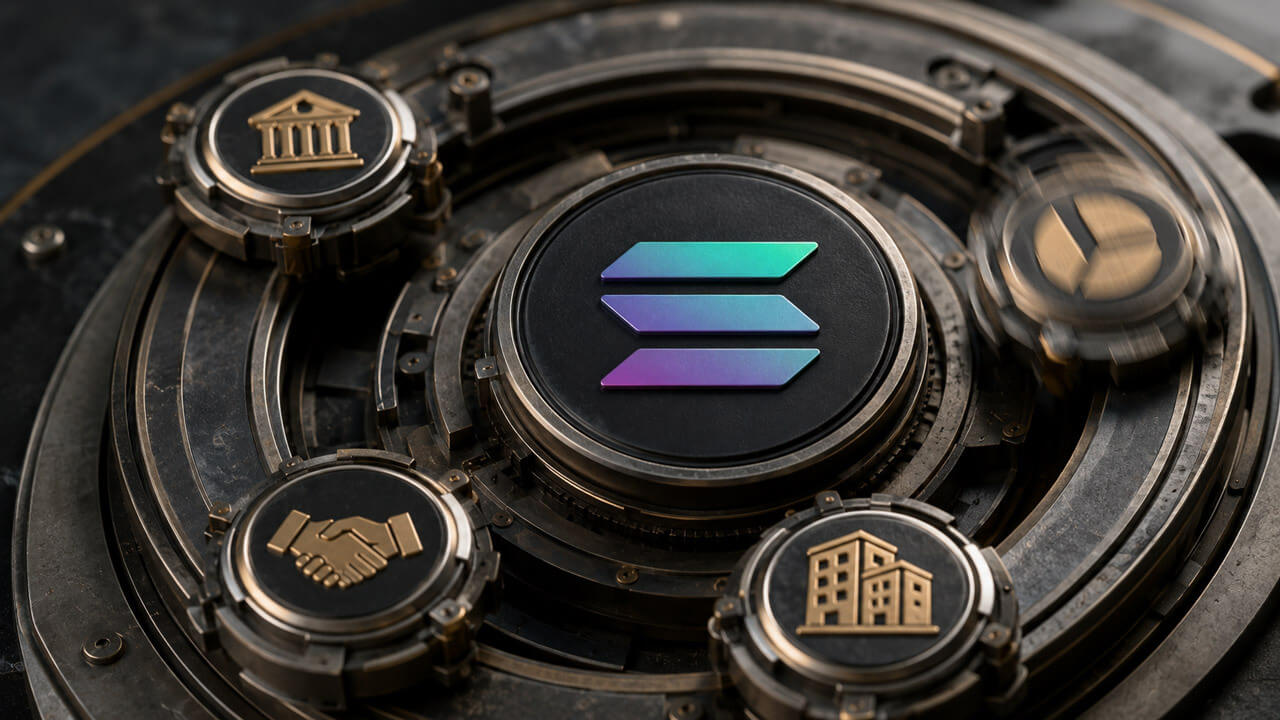
We have spent years hearing about the potential of Real World Assets (RWAs). The narrative is always the same: everything from real estate to US Treasuries will eventually live on a ledger. For a long time, that was just a theory supported by stagnant balance sheets. People were minting tokens, but nobody was passing them around. That is finally starting to change, and the data coming out of the Solana ecosystem is the first real proof I have seen that this market is maturing.
The Shift from TVL to Velocity
For most of 2023 and early 2024, the primary metric for RWA success was Total Value Locked (TVL). If a protocol had $100 million in tokenized gold or credit, we called it a success. But TVL is a lazy metric. It tells you how much money is sitting in a vault, not how much value is being generated or how much utility the asset actually provides to a founder or a business owner.
Recent data from RWA.xyz shows that Solana’s RWA transfer volume recently surged to roughly $8.7 billion. To put that in perspective, that number more than doubled in a thirty-day window. This is the difference between a museum and a marketplace. In a museum, you look at the assets; in a marketplace, you move them. We are officially entering the marketplace phase for tokenized assets.
Why Solana is Winning the RWA Race
I have always been a bit skeptical of the high-speed chains until they prove they can handle institutional-grade traffic without falling over. Solana seems to be hitting a stride here because of its low latency and cheap execution. If you are a founder trying to move $1 million in tokenized Treasury bills, you don't want to spend $50 on a gas fee and wait ten minutes for a block to finalize. You want it to feel like a database entry update, but with the security of a public ledger.
The current volume is being driven by a few specific sectors. These aren't just speculative memecoins; we are talking about digital representations of hard assets. When transfer volumes spike like this, it suggests that these assets are being used as collateral, being traded for liquidity, or being moved between institutional accounts. This is active utility, not passive holding.
What This Means for Builders
If you are building in the crypto space right now, you need to look past the retail noise. The move toward $8.7 billion in monthly transfers suggests that the infrastructure is finally ready for 'boring' finance. Here is what I am watching closely:
- Middleware is the new alpha: As more assets move onto Solana, the tools required to track, audit, and tax these transfers become essential. We need better settlement layers that sit on top of the chain.
- Interoperability matters more than ever: If $8.7 billion is moving on Solana, those users will eventually want to bridge that value into other ecosystems or back into traditional bank accounts without friction.
- The death of the 'Tokenization' pitch: Simply putting an asset on-chain is no longer a business model. The business model is now what you can do with that asset once it is liquid.
As a developer or a founder, your focus should shift from 'how do I mint this' to 'how do I make this move.' Velocity is the only metric that proves a market exists. If your protocol has high TVL but zero transfer volume, you don't have a product; you have a spreadsheet.
The Institutional Reality Check
We should be careful not to get too ahead of ourselves. While $8.7 billion is a massive number for the blockchain world, it is a rounding error for global credit markets. The reason I find this exciting isn't the total dollar amount—it’s the growth rate. When a metric doubles in a month, it implies that someone found a shortcut or a more efficient way to conduct business that they didn't have thirty days prior.
The surge in Solana RWA transfers represents a transition from speculative curiosity to operational reality. It is the first sign that tokenization is solving actual liquidity problems.
The Skeptic's Corner
I still have questions. We need to see if this volume is concentrated among a handful of whale wallets or if it is distributed across a broader base of users. If three institutions are just swapping the same $500 million back and forth to juice the numbers, then this is just more crypto theater. However, the diversity of the assets being tokenized—from private credit to US Treasuries—suggests that the activity is more organic than the skeptics might assume.
The biggest hurdle remains the regulatory environment. Technology moves faster than the law, and while Solana can handle thousands of transactions per second, the legal frameworks for reclaiming a physical asset tied to a digital token still move at the speed of a 1980s courthouse. Builders who can solve the legal-to-digital bridge will be the ones who own this space in five years.
Takeaway for the Week
Stop looking at how much money is 'locked' in a protocol. Start looking at how much is moving. Solana’s $8.7 billion surge tells us that the infrastructure is no longer the bottleneck. The bottleneck now is product design and regulatory clarity. If you can build a tool that increases the velocity of these assets, you are sitting on a goldmine. The era of the static token is over; the era of the moving asset has begun.
Read the original at CryptoSlate →