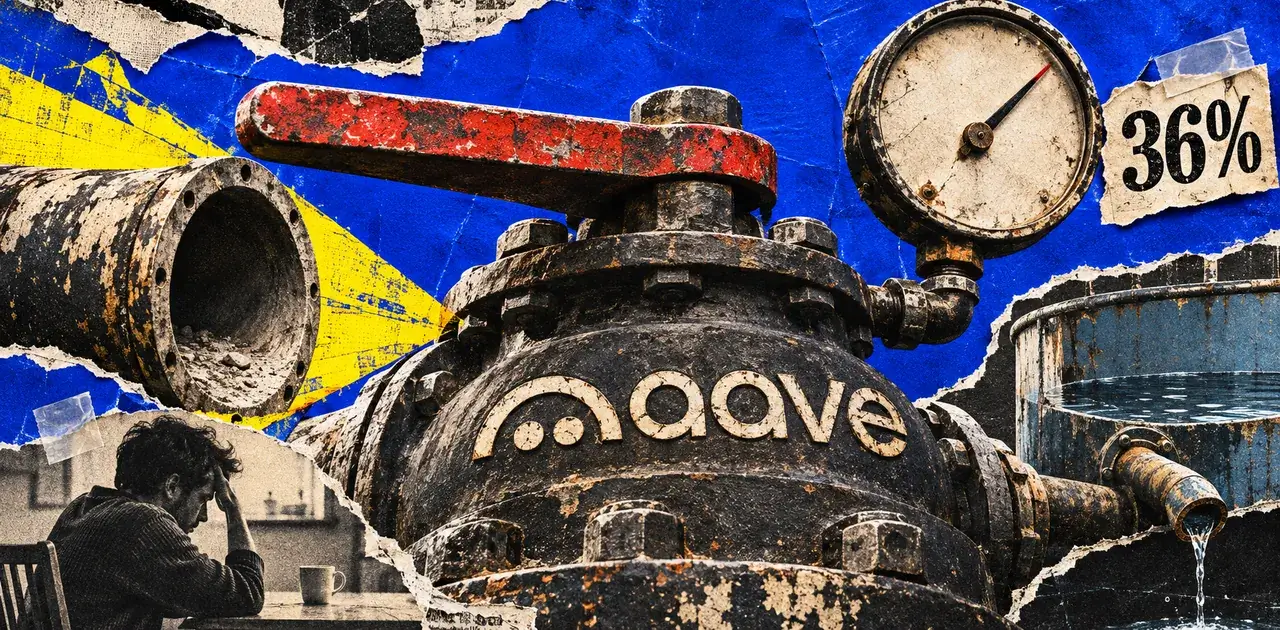
The Cost of Safety
Last week, a security incident on a major exchange triggered a ripple effect through the DeFi landscape that many builders failed to anticipate. When the Binance hack occurred, the governance mechanisms at Aave did exactly what they were designed to do: they froze specific reserves to mitigate risk. But for the builders and traders actually using the protocol, this safety measure turned into a financial vice. While the freeze prevented new bad debt from entering the system, it effectively locked existing borrowers in a room where the ceiling was slowly lowering.
As the freeze took hold, borrowers watched their interest rates climb as high as 36% APR. In a normal market, a spike like that is a signal to either pay down the loan or add more collateral to avoid liquidation. But because the deposits were frozen, users couldn't add fresh capital to buffer their positions. They were stuck paying premium rates for the privilege of being unable to manage their own risk.
The Liquidity Paradox
In the world of decentralized finance, we often talk about composability as a superpower. We build bricks that stack on top of each other, assuming that if one brick wobbles, the others stay firm. This event proved that logic is flawed. When Aave froze deposits to protect the protocol's overall health, it inadvertently broke the primary defense mechanism for the individual user: the ability to re-collateralize.
The mechanics here are simple but brutal. Even when new borrowing is blocked, existing suppliers are often still allowed to withdraw their liquidity if the protocol has enough idle capital. As suppliers pulled their funds out of the frozen pools—likely out of fear or a need for liquidity elsewhere during the hack—the utilization rate of the remaining capital spiked. In DeFi math, higher utilization equals higher interest rates. The borrowers who were already in the pool were left to foot the bill for the shrinking supply, with no way to improve their health factor by depositing more assets.
Builder Blind Spots
From a founder's perspective, this is a classic case of prioritizing the macro over the micro. Aave’s governance acted to save the protocol, which is the right move for the long-term survival of the brand. However, the user experience during this period was a disaster. If you are building a lending protocol or a yield aggregator, you have to ask yourself: what happens to my users when I hit the emergency stop button? Most developers spend 90% of their time on the 'happy path' and 10% on security, but they rarely spend time on the 'limping path'—the state where the protocol is technically alive but functionally broken for its customers.
We have to stop treating protocol freezes as a binary on/off switch. There needs to be a middle ground where risk management doesn't mean user abandonment. For builders, this might look like 'grace periods' for liquidations during freezes, or specific channels that allow for collateral-only deposits even when new borrowing is halted. If a user wants to give the protocol more money to secure a debt, the protocol shouldn't be the one saying no.
The Trust Gap in Decentralized Governance
This incident also highlights the lag time in decentralized governance. While the freeze happened relatively quickly, the adjustment of these parameters often requires a voting process that feels like an eternity when you're losing 36% on a loan. It exposes the reality that many 'decentralized' systems are still heavily reliant on emergency multisigs or slow-moving DAOs that aren't equipped to handle high-frequency market stress.
If you're building in this space, take note: transparency isn't just about showing your code; it's about being clear about the risks of the 'emergency' state. Users didn't sign up for a 36% interest rate while being locked out of their accounts. That’s not a feature; it’s a failure of system design. We need to build systems that are resilient enough to handle a hack without turning their own users into collateral damage.
Real-World Consequences
For the average founder looking at this, the takeaway isn't that Aave is bad. Aave is actually one of the most robust systems we have. The takeaway is that even the best systems have structural flaws that only appear during a crisis. If the gold standard of DeFi can leave users in a 36% APR trap, your startup's protocol is likely even more vulnerable.
We need to be honest with our communities. Decentralization often comes with a trade-off in agility. When things break, the 'code is law' mantra becomes a very expensive reality for those caught on the wrong side of the ledger. Builders should be looking at how to automate 'fairness' into these emergency states, rather than just focusing on 'solvency.'
The Takeaway
Protocol safety shouldn't come at the direct expense of user solvency. When you freeze a system, you have to ensure you aren't also freezing a user's ability to protect themselves. If your emergency plan involves locking the doors while the building is on fire, don't be surprised when people stop wanting to live there. Builders need to design for the 'limping path' as much as the 'happy path' to maintain true trust in the ecosystem.
Read the original at CryptoSlate →