Most of the "trading war" headlines this week missed the actual story.
FOMO didn't grow 9x in eight months because it out-marketed Pump.fun.
It grew because it removed friction nobody else bothered to remove, and that's a far more useful lesson for builders than another platform rivalry recap.
Six Weeks of All-Time-Highs
FOMO, a social trading app built natively on Solana, has posted six consecutive weeks of all-time-high trading volume.
Here's what the momentum looks like:
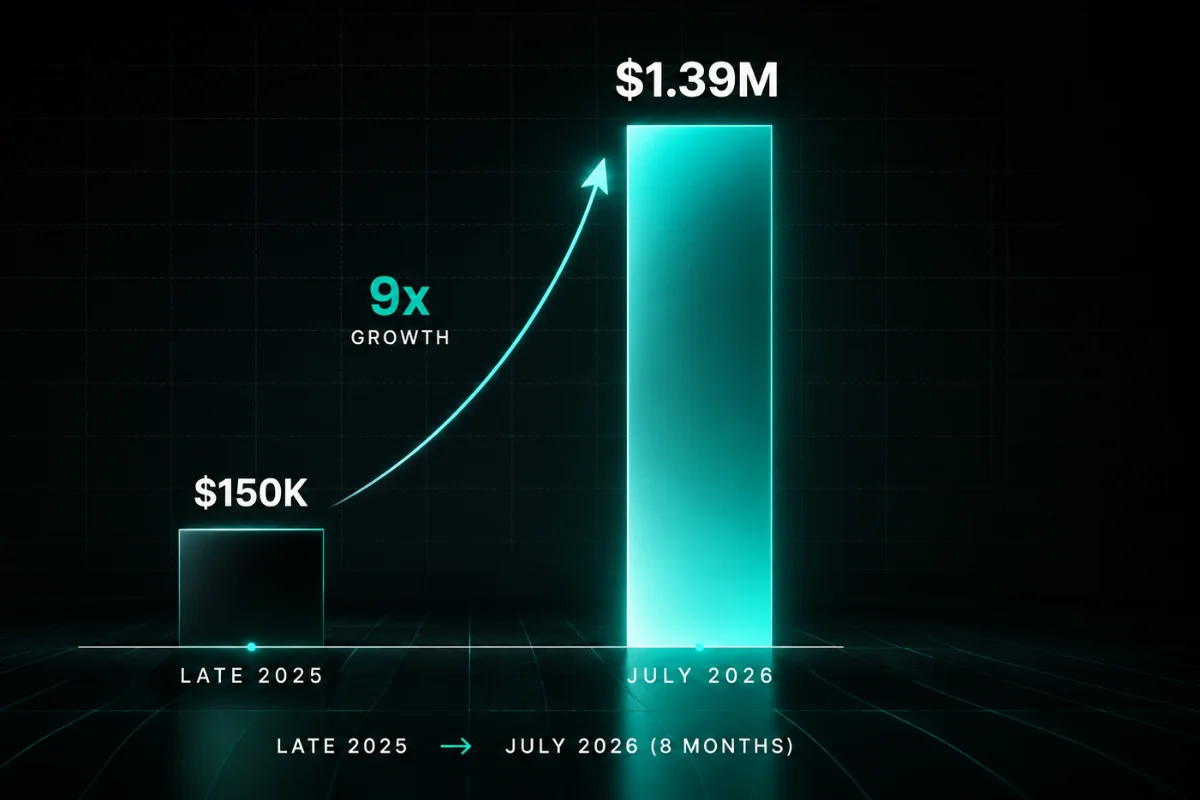
Weekly revenue: Climbed from $150K (late 2025) to $1.39M (July 2026)—a 9x increase achieved during a bear market.
30-day revenue: $8.17 million, ahead of both Uniswap and Phantom over the same period.
Total funding: $94 million (Series B led by Index Ventures, Union Square Ventures, Benchmark).
Company valuation: $550 million
User base: 625,000+ active users
Trading volume: $4 billion cumulative
Mobile category growth: Phantom and FOMO combined grew from 28% to 36% of all Solana spot volume in six days (per Blockworks).
Pump.fun, still the larger platform by revenue, didn't sit still. It shipped social trading features, zero-fee trading, and cross-chain USDC support within roughly 24 hours of FOMO's momentum becoming impossible to ignore.
"Features get copied in 24 hours. Trust doesn't."
Onboarding Was the Real Bottleneck
The friction removal is the actual headline. FOMO gets users from fiat to on-chain in about 30 seconds via Apple Pay, and more than 68,000 first-time crypto buyers have entered through that flow alone.
That's not a trading story; that's an onboarding story, and onboarding is the thing this industry has been bad at for a decade.
It also matters for anyone thinking about token distribution. Skill Stacker's own FOMO presence is a live example of using a mobile-first social trading rail to reach exactly the kind of first-time, phone-native user that legacy exchange onboarding has never been good at converting.
My Interpretation
I don't think this is really a "Pump.fun vs. FOMO" story, and I'd push back on anyone framing it that way. It's a story about what happens when a category gets genuine competitive pressure instead of a single dominant player coasting.
FOMO built for mobile-first social discovery; Pump.fun owns token launch and first liquidity. Neither company is going to win by copying the other's homework forever; they're going to win by getting better at the thing they're actually good at, faster than the other side can catch up.
That's a healthy dynamic. The mobile trading category growing from 28% to 36% of Solana spot volume in six days isn't two platforms cannibalizing the same users—it's the category itself expanding, which is the outcome you actually want if you're building anything downstream of retail crypto adoption.
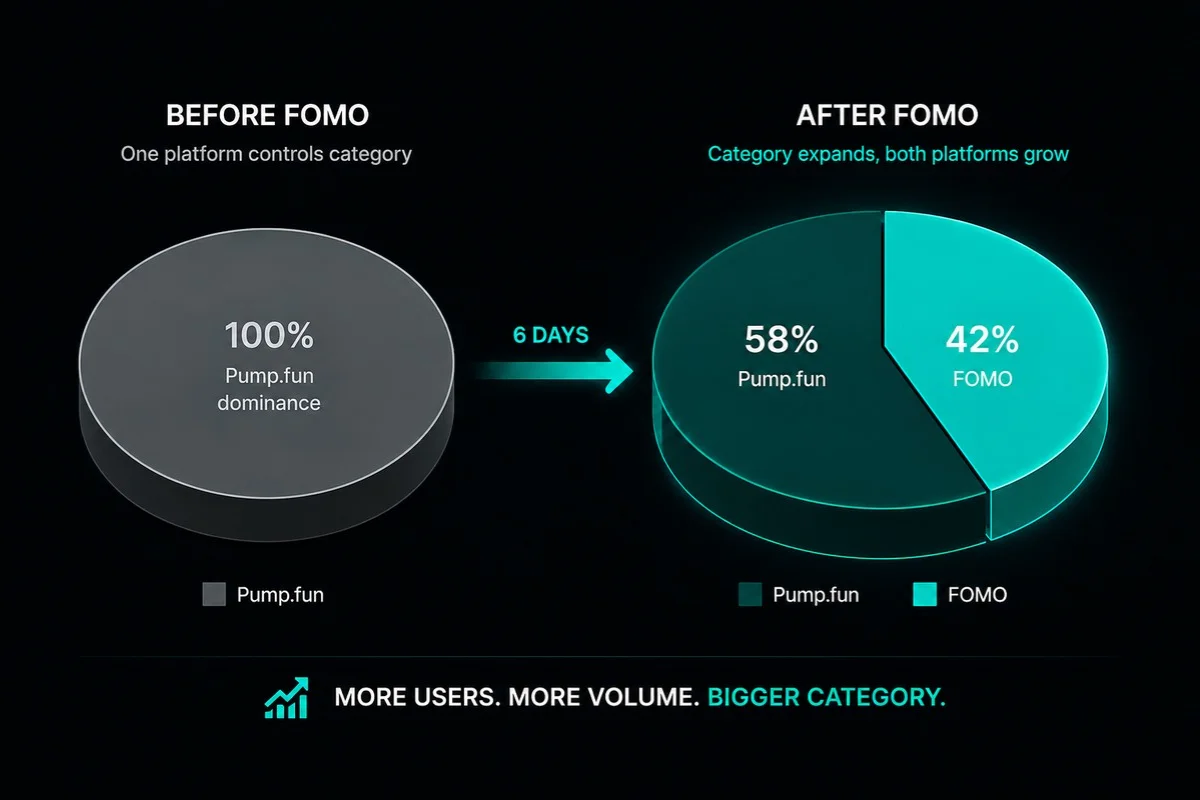
"The category isn't splitting a fixed pie. It's growing the pie—and that's the number that should actually matter to builders."
Critical Lens
A few things are worth being skeptical about before treating this as an unqualified win. FOMO's flat $1 per-trade fee is genuinely competitive on trades above $100, but it's a rough deal on anything smaller; a $5 trade effectively carries a 20% fee, which quietly excludes exactly the smallest, most first-time user-friendly trades the platform is otherwise optimized for.
FOMO also isn't a full-stack product: it leans on Privy for wallets, Coinbase for fiat rails, and Hyperliquid for perpetuals, which means its growth is partly a bet on three other companies' infrastructure staying reliable.
And revenue growth during a bear market is impressive, but it's also happening off a small base. $150K to $1.39M weekly is a real number, but it's not yet at a scale where you can call the category settled. Six days of Blockworks volume data is a real signal, not a proven trend.
What Happens Next
Expect Pump.fun to keep shipping FOMO's features faster than FOMO can build genuinely new ones, which means FOMO's real moat has to become its social graph and community trust, not its feature list.
I'd also expect more Solana-native projects to build their own presence directly inside these social trading apps rather than treating them purely as trading venues, the same way Skill Stacker already has.
Key Takeaway
The lesson for builders isn't "pick a side in a platform war." It's that removing friction—fiat onboarding in 30 seconds, mobile-native discovery, a flat and predictable fee—grew a company 9x in a bear market when almost nothing else in the sector was growing at all.
If you're building anything that touches retail crypto users, that's the number worth studying, not who wins the current news cycle.
Skill Stacker's community is active on FOMO. Keep in touch ➔