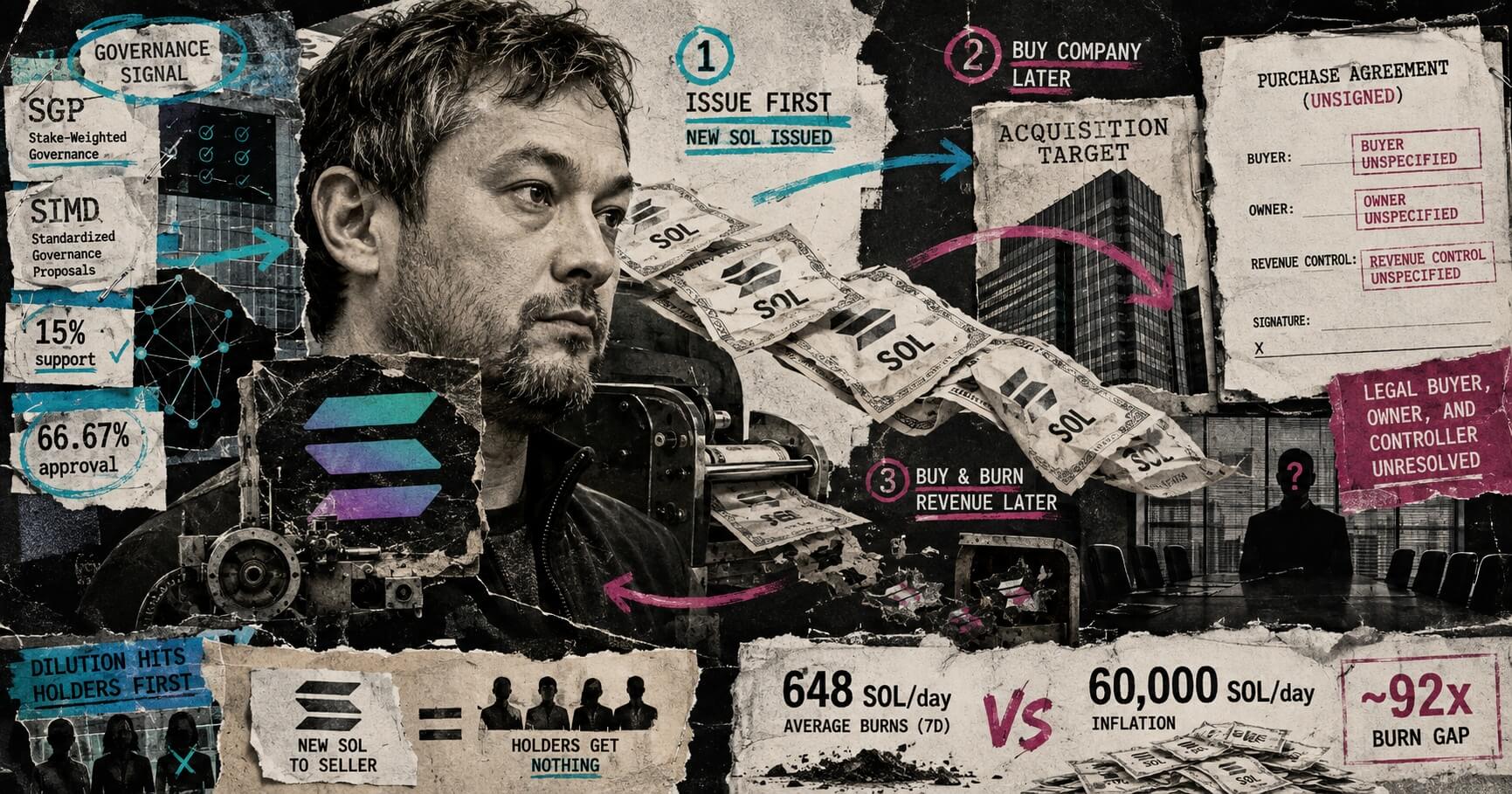
Anatoly Yakovenko recently floated an idea that feels like it belongs in a corporate boardroom rather than a decentralized network. He suggested that Solana could mint new SOL tokens to acquire a company. It sounds simple on the surface, almost like a tech giant using its stock as currency to swallow a competitor. But once you peel back the first layer, you find a logistical and philosophical mess that should make every builder in this space stop and think.
The Core Proposition
The proposal is straightforward. The network votes to inflate the total supply of SOL. This newly minted capital is then used to buy a private company that provides value to the ecosystem. Maybe it is a middleware provider, a dev-tooling firm, or a core infrastructure team. The goal is to bring critical talent or technology in-house under the Solana umbrella.
In a traditional startup world, this is M&A 101. If Apple wants a sensor company, they issue shares or spend cash and buy it. But Solana is not Apple. It is a protocol. When a protocol buys a company, who actually holds the keys? Who sits on the board? Who signs the payroll checks for the newly acquired employees? These are not just bureaucratic hurdles; they are fundamental questions about what a blockchain actually is.
The Ownership Vacuum
The biggest hurdle here is legal personhood. A decentralized network is a collection of validators, developers, and token holders. It is not a corporation. If the network mints tokens to buy "Company X," who owns the equity? If the answer is "the network," then we have a problem because the network cannot legally sign a merger agreement.
We have seen DAOs try to navigate this with Cayman foundations or Swiss associations, but those structures are often clunky and fragile. They are legal wrappers designed to shield participants from liability, not necessarily to act as aggressive corporate raiders. If Solana tries to execute a major acquisition, they are essentially asking a decentralized community to act like a centralized private equity firm without the legal infrastructure to support it.
The Dilution Dilemma
As a founder, I look at minting as the ultimate cost. Every time you mint new tokens to fund a project or an acquisition, you are diluting every single person who currently holds that token. In a startup, you do this because you believe the acquisition will grow the pie enough to offset the smaller slice you now own.
But in crypto, the "pie" is volatile. If Solana mints $500 million worth of SOL to buy a company, and the market decides that company is worth zero, the token holders are the ones who eat the loss. Unlike a company, where a CEO is accountable to a board, a protocol has no singular throat to choke if the deal goes south. It is an experiment in collective risk with no clear path to collective reward.
The Governance Trap
Anatoly suggested a stake-weighted approval process. This means the people with the most SOL get the most say. On paper, that is fair. The biggest stakeholders should decide the direction of the ship. In practice, it creates a feedback loop that could alienate the very builders who make Solana valuable.
If the large validators and VCs decide to start buying up companies, they are effectively turning Solana into an Investment Trust. Is that what we want our L1s to be? If I am building a dApp on Solana, I want the core team and the foundation focused on throughput, latency, and uptime. I don't necessarily want them distracted by the complexities of human resources, office leases, and corporate integration.
What This Means for Builders
If you are building in the Solana ecosystem, this proposal is a signal. It tells you that the leadership is thinking about vertical integration. While that might mean better tools and more stability if the "right" companies are bought, it also means the network is moving toward a more structured, perhaps even corporate, future.
There is also the threat of competition. If the network can mint tokens to buy a competitor to your startup, the network becomes your rival. That is a dangerous precedent. Builders choose decentralized platforms specifically to avoid the "platform risk" inherent in the Apple or Google ecosystems. If Solana starts behaving like a conglomerate, it risks losing the trust of the independent developers who value neutrality.
The Tactical Reality
Let's talk about the logistics. Who manages the acquisition? Even if the community votes "yes," you need a team of lawyers and accountants to perform due diligence. You need an entity to hold the intellectual property. You need a management structure to ensure the acquired company actually does what it was bought to do.
If the Solana Foundation does it, then the Foundation becomes even more powerful, further centralizing the network. If a new DAO is formed, we are back to square one with the inefficiency of committee-based management. There is no version of this that doesn't involve a significant increase in centralization, at least in the short term.
A Better Path Forward?
Instead of minting tokens to buy companies, the ecosystem should focus on what blockchains do best: incentivizing behavior. We have grants. We have hackathons. We have ecosystem funds. These are ways to distribute capital without the legal nightmare of corporate ownership.
If a company is vital to Solana, the community can fund them via a long-term contract or a strategic partnership. This keeps the company independent and the protocol neutral. It allows for the same outcome—securing the future of the network—without the baggage of becoming a legal entity.
Final Thoughts
Anatoly is a visionary, and he is right to think about how Solana can compete with the massive war chests of TradFi and Big Tech. But a blockchain's strength is its decentralization. The moment we start trying to make it look like a Delaware C-Corp, we lose the very thing that makes this technology revolutionary.
Buying a company is an act of consolidation. Crypto is supposed to be an act of distribution. Bridging those two worlds is likely going to be much harder, and much more expensive, than anyone currently realizes. If we aren't careful, we might end up building the very systems we spent the last decade trying to replace.
Takeaway: The proposal to mint SOL for acquisitions is a bold attempt at protocol-level M&A, but it faces insurmountable legal and philosophical hurdles. For builders, it signals a shift toward a more corporate, integrated ecosystem that may prioritize scale over decentralization.
Read the original at CryptoSlate →