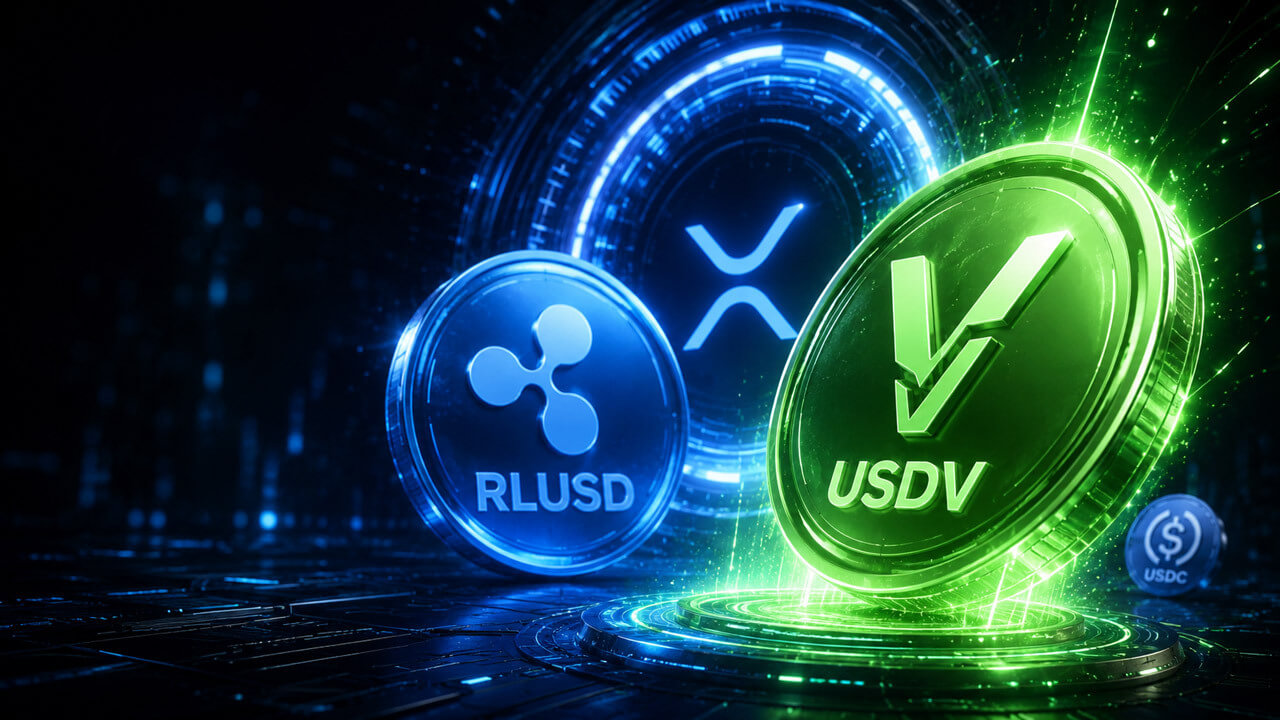
We have spent years hearing about the potential of the XRP Ledger as a payments rail. For a long time, it felt like a lot of academic theory backed by a very vocal community, but the actual liquid dollar movement was often overshadowed by other chains. That is changing quickly. The stablecoin supply on XRPL has recently climbed toward the $900 million mark, representing a 20% jump in just a single month.
If you look at the surface, you see Ripple’s own stablecoin, RLUSD, doing the heavy lifting. It accounts for about $844 million of that total. But as someone who looks at the plumbing of these systems, the total number is less interesting than the diversification of who is actually minting the coins. We are seeing a second player, Valtorum's USDV, carve out a significant niche. This matters because it signals that the XRPL is moving away from being a single-issuer ecosystem into something that looks a bit more like a functional market.
The Weight of the Ripple Name
Ripple’s RLUSD is naturally the headline act. When you have the primary architect of the ledger launching a first-party dollar, it is going to dominate the charts. For builders, this provides a massive amount of liquidity and a "safe" perceived bridge for institutional capital. It creates a floor for the ecosystem. However, a chain is only as strong as its third-party developer growth. If the only thing moving on XRPL is Ripple’s own token, it’s just a private database with extra steps.
That is why the rise of USDV is worth watching. It currently sits around $39.3 million. While that is a fraction of the RLUSD supply, the growth rate suggests that there is an appetite for alternative issuers. For a founder, this is a signal. It means the infrastructure is mature enough to support multiple stablecoin models simultaneously without them cannibilizing each other immediately.
Beyond the Pump Logic
In the crypto space, people usually see a supply surge and think "price pump." I look at it and think "utility runway." Stablecoins are the gas that makes decentralized finance actually work for people who aren't trying to gamble on 100x leverage. If you are building a cross-border payment app or a supply chain tracking tool on XRPL, you need these stable assets to be deep and liquid.
The current 20% growth in a 30-day window isn't just retail hype. It looks more like institutional positioning. We are seeing the rails being greased before the actual train cars arrive. When liquidity enters a chain in the form of stables, it stays there. It doesn't flutter away as easily as speculative assets do during a market dip. This creates a more stable environment for those of us trying to build long-term products.
The Risks of Centralized Issuance
We have to be honest: both RLUSD and USDV are centralized. They are IOUs. For a ledger that prides itself on being decentralized, having 95% of its dollar volume tied to a single corporate entity (Ripple) is a point of failure. If regulators decide to lean on the issuer, the liquidity on the chain can be frozen or clawed back. This is the trade-off we make for institutional adoption.
However, the diversification we are seeing with Valtorum is a small hedge against that centralization. The more issuers we have, the less power any single entity has over the ledger’s economic viability. I want to see five more issuers. I want to see specialized stables for different jurisdictions. That is when XRPL becomes a global settlement layer rather than just a Ripple-centric sandbox.
What This Means for the Builder
If you are a founder deciding where to deploy your next project, these numbers should change your calculus. A year ago, the XRPL felt like a ghost town for stable liquidity unless you were doing something highly specific with XRP itself. Now, with nearly a billion dollars in stable assets, the friction for users to enter and exit your dApp is significantly lower.
- Liquidity Depth: More stables mean tighter spreads on the DEX and better execution for your users.
- Counterparty Diversity: You aren't just betting on Ripple's legal survival anymore; you are participating in a multi-issuer financial ecosystem.
- Ecosystem Maturity: Fast growth in stablecoins usually precedes a wave of new DeFi primitives like lending markets and insurance protocols.
The Takeaway
Stop looking at the $900 million as just a big number. Look at it as a shift in the XRP Ledger’s identity. The breakout story isn't just that Ripple launched a stablecoin. The real story is that the ecosystem is finally attracting enough third-party confidence to host multiple competing dollar assets. We are moving from a monoculture to a marketplace. For those of us building in the trenches, that is the only metric that actually counts.
Read the original at CryptoSlate →