Liquidity is a deceptive metric. We often see headlines about massive volume spikes and assume the market is healthy, growing, and providing better exit opportunities for everyone involved. But the recent activity surrounding XRP tells a different story. While trading volume recently jumped 99% to reach $62 million, the actual experience for the average holder is getting worse, not better.
As an observer of how these systems are built, I look at these numbers and see a widening gap between the whale and the retail participant. The surge in volume isn't necessarily a sign of a broad market rally; it is an indication of high-velocity movement, likely tied to the testing and integration of Ripple's new stablecoin, RLUSD. For builders and founders in the space, this serves as a case study in why total volume is often a vanity metric that hides structural slippage.
The Illusion of Growth
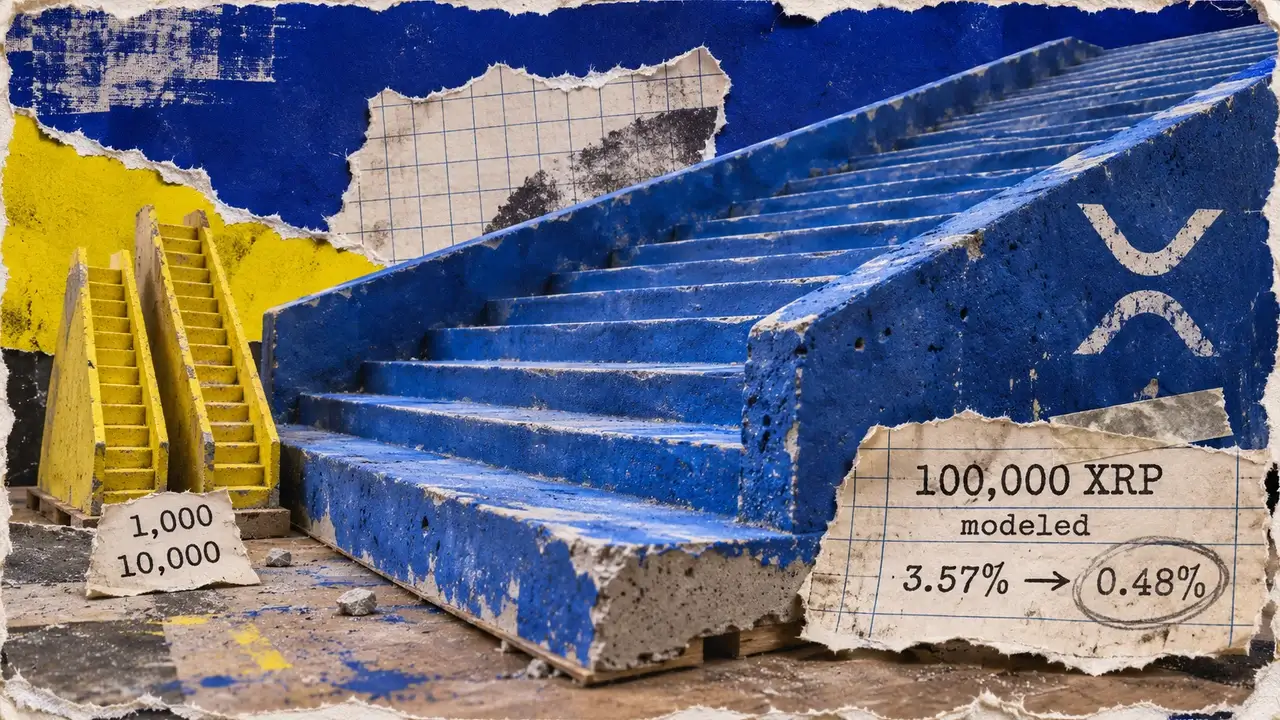
When you see a 99% increase in volume, the gut reaction is to expect tighter spreads and better fills. In a perfectly efficient market, more participants mean more competition for orders, which should benefit the person selling 1,000 tokens just as much as the person selling 1,000,000. However, the data coming out of the XRP ecosystem shows a divergence. While the shortfall for massive 100,000 XRP trades actually narrowed slightly, smaller retail-sized sales saw their returns diminish.
This suggests that the liquidity being injected into the system is highly specialized. It is institutional-grade liquidity designed to facilitate large-scale swaps, likely between XRP and the upcoming RLUSD stablecoin. For the small builder or the casual holder, the market is actually becoming more expensive to exit. You are paying a premium for the lack of retail-focused market makers.
The RLUSD Factor
Ripple is clearly pivoting toward a dual-token ecosystem. The introduction of RLUSD is a strategic move to capture the massive demand for dollar-pegged assets, but it creates a new friction point for XRP. In the current testing phase, all tested trade sizes returned fewer RLUSD than anticipated. This tells us that the bridge between the native asset and the stablecoin isn't quite optimized yet.
For developers building on the XRP Ledger (XRPL), this is the most critical takeaway. If the core pair for the ecosystem’s new stablecoin is showing these kinds of inefficiencies during a high-volume period, it means the plumbing is still being laid. We are seeing a shift from a speculative asset to a utility-driven bridge asset, but that transition is messy. Small sellers are essentially subsidizing the testing phase through increased slippage.
Why Smaller Sellers Are Losing Out
In most financial markets, the "little guy" gets the leftover liquidity. When volatility or volume spikes due to institutional rebalancing, the automated market makers and order books prioritize the largest blocks to prevent massive price swings at the top end. This leaves the smaller orders to be filled at sub-optimal prices.
Specifically, the data shows that smaller sales worsened in terms of their RLUSD return. If you are a founder building a dApp that relies on small-ticket micro-transactions, this should be a red flag. High volume doesn't mean cheap transactions. It often means the big players are crowding out the small ones. If the cost of moving in and out of the ecosystem’s primary stablecoin is rising for small users, the barrier to entry for consumer-facing applications rises along with it.
A Founder’s Perspective on Liquidity
I have always argued that builders should look at the "quality" of volume rather than just the number. A $62 million day driven by retail utility is very different from a $62 million day driven by institutional testing. The latter creates a predatory environment for smaller participants. The fact that the 100,000-XRP shortfall narrowed while smaller trades suffered suggests that market makers are tightening their belts around large institutional blocks to ensure the RLUSD launch looks successful on paper.
This is a classic "top-down" liquidity strategy. Ripple needs RLUSD to work for banks and payment providers first. If the institutional swaps are efficient, the product is viable for their primary customers. The retail holder, unfortunately, is not the primary customer in this specific roadmap. They are the ones providing the exit liquidity for the system to find its new equilibrium.
What This Means for the XRP Ledger
The XRPL has always been marketed as a fast, low-cost alternative to Ethereum for payments. However, as the ecosystem matures and introduces more complex instruments like a regulated stablecoin, the "low cost" part of that promise is being tested. Transaction fees might stay low, but the cost of the trade—the slippage and the spread—is where the real expense lies.
Builders need to be aware that the liquidity landscape is shifting. If you are building a product that requires users to swap XRP for RLUSD, you cannot assume a 1:1 value transfer. The current market conditions suggest that the "tax" on these transactions is increasing for the very people we want to bring into the fold: the everyday users.
The Takeaway for Builders
Don't be blinded by the 99% volume surge. It is a signal of institutional activity, not retail health. If you are building on XRPL, you need to account for the fact that smaller users are currently facing a disadvantage in the market. The infrastructure is being tuned for large-scale movement, and until the RLUSD ecosystem is fully public and saturated with diverse market makers, the small participant will continue to lose out.
The metric that matters isn't how much money is moving; it is who the movement is serving. Right now, it isn't serving the small builder.
We need to stop celebrating volume spikes as a universal win. In this case, the surge is simply a byproduct of a system being stress-tested by its biggest players, leaving the smaller ones to pay the price for the lack of retail-centric liquidity.
Read the original at CryptoSlate →