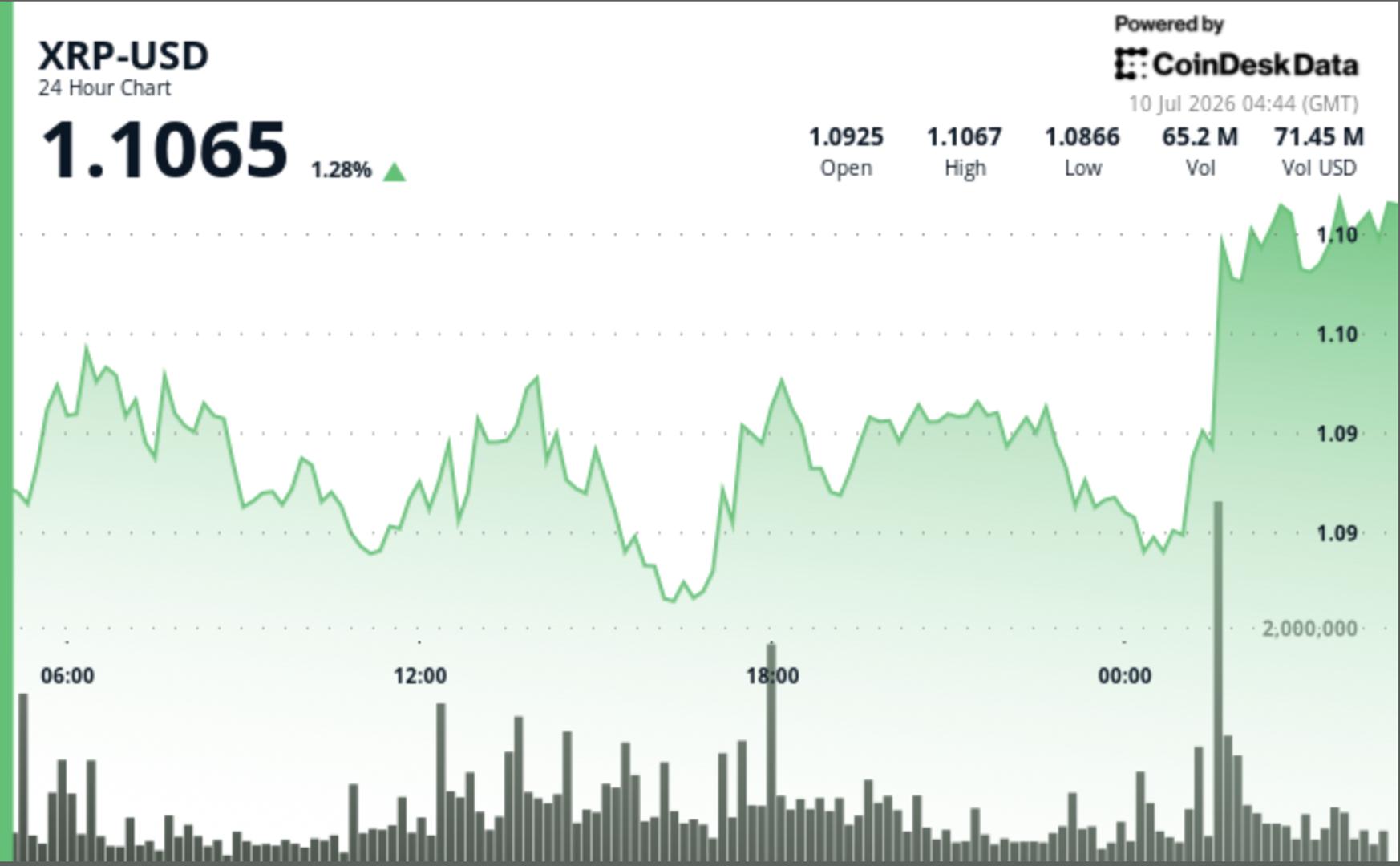
We have all seen this movie before. The markets get quiet, a few liquidations hit the tape, and suddenly XRP starts moving against the grain. This week, we saw a modest 2% push that nudged the price through the $1.10 resistance level. On paper, it is a win for the chart-watchers. In reality, it is a signal for builders to start paying attention to what is happening under the hood of the XRP Ledger.
When a token sits under a resistance level for a long time, it creates a psychological barrier. Traders call it a ceiling. Founders should call it a bottleneck. For those of us building in this space, price action is usually noise, but volume is data. The late-session surge that pushed XRP over that $1.10 mark suggests that the hands holding the asset are changing. We aren't just seeing retail hype; we are seeing consistent accumulation that suggests a floor is being established.
Understanding the $1.10 Ceiling
Resistance levels are essentially areas where sell orders outweigh buy orders. For months, the $1.10 mark has been a wall. Every time the price approached it, the market pushed back. Crossing it is significant not because the number is special, but because it indicates that the supply of sellers at that price point has finally been exhausted.
For a builder, this matters for liquidity. If you are building a payment gateway or a cross-border settlement tool on the XRPL, you need tight spreads and deep pools. Volatility is the enemy of utility. When an asset breaks a major resistance level and starts to treat that level as support, it creates a more predictable environment for financial applications. High-velocity assets are easier to hedge, and if XRP can hold this line, it makes the cost of doing business on the chain slightly more stable.
Why the Volume Matters More Than the Price
The 2% gain is a distraction. The real takeaway from the recent activity is the volume surge that accompanied the move. If a price moves up on low volume, it is usually a trap. It means one or two large players moved the needle and the rest of the market didn't follow. This move was different. The volume followed the price, which tells us there is broad participation.
As founders, we have to look at where that volume is coming from. It isn't just speculative gambling on centralized exchanges. Much of it is driven by the growing ecosystem of sidechains and the integration of the XRPL into institutional pipelines. We are seeing a slow transition from XRP as a purely speculative asset to XRP as a functional piece of infrastructure. The market is starting to price in the utility that builders have been working on for the last decade.
The Builder Perspective: Utility vs. Speculation
I have sat in enough rooms with founders to know the general consensus on XRP. It is often seen as the "old guard" or the "banker's coin." While that reputation persists, we cannot ignore the resilience of the network. While newer Layer 1s are blowing up or suffering from outages, the XRPL keeps churning out blocks. This reliability is why we are seeing this renewed interest.
If you are developing a product today, you have to ask yourself where the users are going to be in two years. Speculators follow the green candles, but businesses follow the stability. The break above $1.10 suggests that the market is finally comfortable with the regulatory clarity surrounding Ripple and its associated ecosystem. That clarity is a massive competitive advantage that many newer, more "exciting" projects simply do not have yet.
The market can stay irrational longer than you can stay solvent, but utility can outlast the market's irrationality entirely.
We need to focus on what happens if $1.10 holds as support. In the past, XRP has been prone to "fake outs" where it touches a level and immediately retraces. If it stays above this line for a week or more, it invites a different class of institutional buyers who have been waiting for a confirmed trend. For builders, this means more eyes on your dApps and more potential for integration into traditional finance stacks.
The Skeptic's Corner
Let's keep it real: $1.10 is not the moon. It is barely a milestone when you look at the all-time highs of years past. We should be cautious about getting swept up in the narrative of a "breakout." Every time XRP moves, the hype machine goes into overdrive. My advice is to ignore the influencers and look at the developer metrics.
- Are the number of active wallets increasing along with the price?
- Is the TVL in XRPL-based DeFi protocols growing?
- How many new validators are coming online?
If these numbers aren't moving alongside the price, then we are just looking at a speculative bubble. However, the current data suggests a more measured growth. It feels structured, not manic. That is a good sign for those of us who want a sustainable industry rather than a series of pump-and-dump cycles.
What This Means for the Next Six Months
We are entering a phase where the market is rewarding projects that have survived the legal and technical gauntlets. XRP is the poster child for survival. Moving through resistance levels is a technical signal that the "risk-off" sentiment is fading. For a founder, this is the time to start scaling. If the infrastructure you rely on is gaining value and volume, your cost of capital and your reach are improving.
Don't get distracted by the 2% gain. Focus on the fact that the wall at $1.10 was finally pushed down. It shows a shift in sentiment that has been years in the making. The liquidity is there, the regulatory air is clearing, and the network is holding steady. Now the pressure is on the builders to create something that justifies the price.
Takeaway
XRP breaking the $1.10 resistance is a proof-of-concept for the asset's market resilience. It is a sign that the floor is rising, providing a more stable foundation for developers building real-world financial tools. Watch the volume, ignore the hype, and keep your head down. The real value is created in the work, not the chart.
Read the original at CoinDesk →