The Illusion of Privacy in a Wrapped World
For a long time, the crypto community has tried to bridge the gap between privacy-centric assets and the high-speed utility of modern decentralized finance. It is a noble goal. We want the features of Monero—anonymity, fungibility, and resistance to surveillance—packaged in a way that allows us to use them as collateral or trade them on lightning-fast chains. But the recent collapse of a wrapped Monero token serves as a cold shower for anyone who thinks wrapping is a magic bullet.
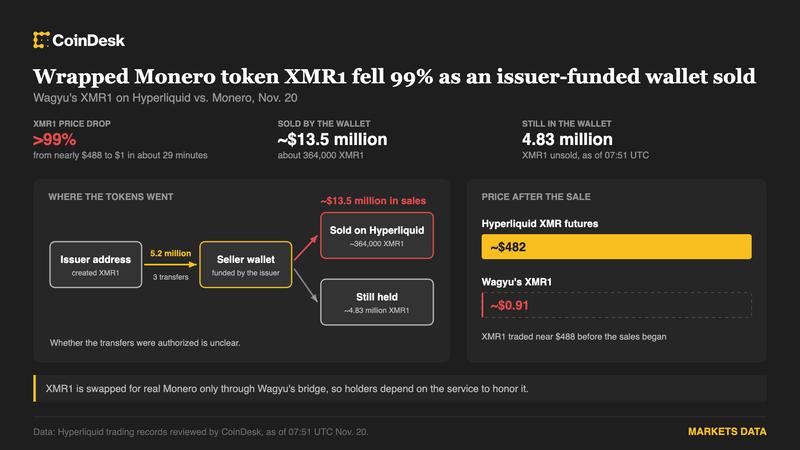
A specific wrapped Monero asset, known as XMR1, effectively went to zero this week. The catalyst wasn't a market crash or a sudden change in privacy laws. It was a liquidity event triggered by the very entity responsible for maintaining the asset's value. A wallet directly linked to the issuer offloaded roughly $13.5 million worth of tokens into the market, causing a 99% plunge in price almost instantly.
As a founder, you have to look past the ticker symbol. This wasn't a failure of Monero itself. It was a failure of the bridge architecture and the trust placed in a centralized issuer. When you wrap an asset, you are trading the security of the underlying protocol for the convenience of the new environment. In this case, that trade-off proved fatal for investors.
The Mechanics of the Dump
The technical details are as familiar as they are frustrating. On-chain analysis tracked a significant movement of funds originating from a wallet associated with the project's developers. When $13.5 million hits a liquidity pool for a relatively niche wrapped asset, the slippage is astronomical. The order books were cleared, the automated market makers were drained, and the price flatlined.
This sell-off specifically targeted the XMR1 token issued by Wagyu. It is important to distinguish this from the actual Monero (XMR) coin and even from other derivative products like the futures markets on Hyperliquid. Those remained stable because they rely on different settlement mechanisms. XMR1, however, relied on the promise that the issuer held the underlying assets and would act in the best interest of the token holders. That promise was broken.
For those of us building in this space, this is a textbook example of a single point of failure. If one wallet can destroy the market cap of a project in a single afternoon, you aren't looking at a decentralized financial instrument. You are looking at a centralized promissory note with a flashy name.
Why Builders Should Care
If you are building a protocol that relies on wrapped assets, you need to be sweating right now. Every time a bridge or a wrapped token fails, the entire industry takes a step back in terms of user trust. We talk a big game about "trustless" systems, but most wrapped assets are the exact opposite. They are systems built on top of high-stakes trust.
The problem for builders is that users often don't distinguish between the "wrapped" version and the "real" version when things go wrong. They just see that their Monero-adjacent portfolio is down 99%. This creates a reputation risk for any platform that lists these assets. If your DEX or lending protocol allows users to interact with poorly collateralized or centrally controlled wrapped tokens, you are essentially importing their risk into your ecosystem.
- Audit the Bridge: Don't just look at the code; look at the governance. Who holds the keys to the mint?
- Liquidity Depth: If a single $13 million sell order can kill the project, the asset is too fragile for most retail use cases.
- Transparency: If the issuer isn't providing real-time proof of reserves, you're flying blind.
The Myth of Anonymous Utility
There is a fundamental irony here. Monero is the gold standard for privacy. Yet, the moment you wrap it to use it on a transparent ledger like a modern L1 or L2, you lose the very thing that makes Monero valuable. You gain utility, but you lose the shield. XMR1 promised a way to have both, but it delivered neither.
I have always been skeptical of projects that try to bridge privacy coins into public DeFi environments without robust, decentralized bridging technology. The technical hurdles are massive. Most of these projects take shortcuts. They use a multisig or a single centralized custodian to hold the native XMR while minting the wrapped version. That is a honey pot for hackers and a temptation for issuers who might want an exit strategy.
We are seeing a trend where the "bridge" is becoming the most dangerous part of the stack. It doesn't matter how secure the destination chain is if the bridge itself is a back door for the issuer to dump on their own community.
A Founder's Perspective on Risk
If I were building a product that required a privacy-focused wrapper today, I would be looking for solutions that don't rely on a single entity's wallet. We need to move toward atomic swaps or more advanced zero-knowledge proofs that don't require a middleman to hold the keys to the kingdom. XMR1's collapse isn't an isolated incident; it’s a symptom of a broader structural flaw in how we think about interoperability.
As a founder, your job is to protect your users from this kind of systemic risk. That means being honest about what is truly decentralized and what is just a centralized service wearing a crypto hat. When a wallet linked to the issuer sells $13.5 million, it’s not a "market adjustment." It’s a liquidation of trust.
For the builders who survived this cycle, the lesson is clear: convenience is never worth the cost of a centralized kill switch. If you can't verify the reserves without asking the issuer for permission, you aren't building DeFi. You're just building a faster version of the old system, complete with all the same vulnerabilities.
The most expensive lesson in crypto is learning that a wrapped token is only as strong as the person holding the wrapper.
We need to stop rewarding projects that prioritize speed over security. The collapse of XMR1 is a tragedy for the people who lost money, but for the rest of us, it’s an urgent warning. It is time to get serious about how we bridge assets, or we will continue to see these multi-million dollar disappearances every time an issuer decides they've had enough.
Read the original at CoinDesk →