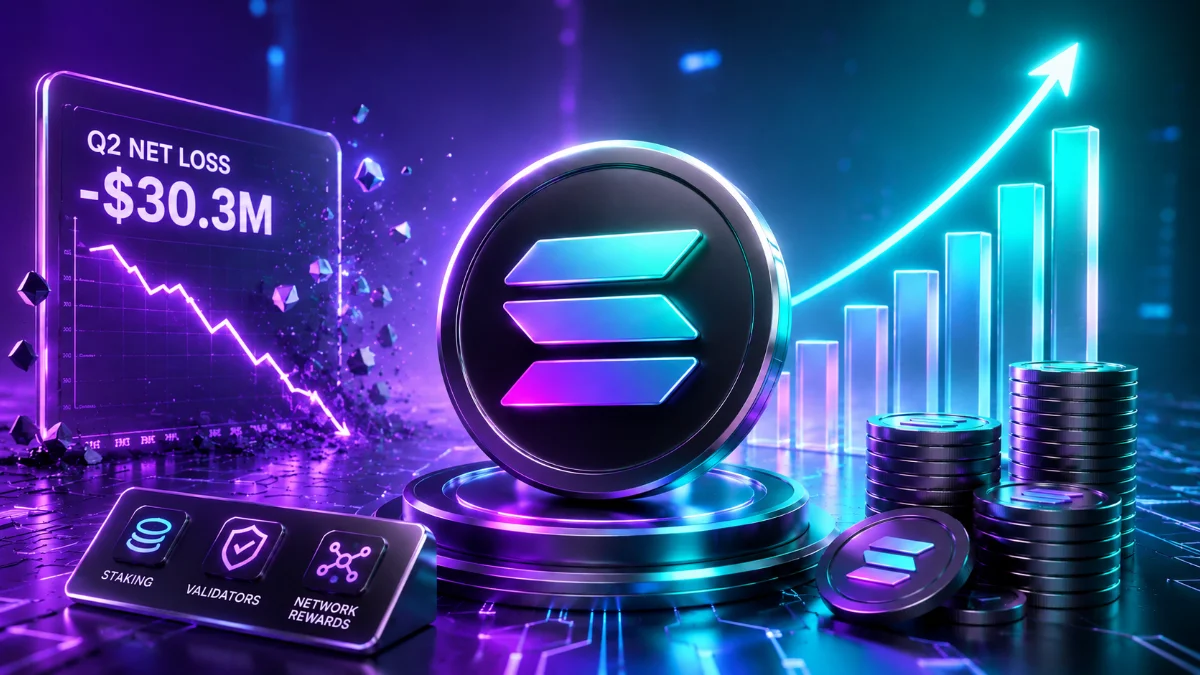
Every quarter, a handful of public companies quietly run an experiment most of crypto ignores: Can a corporate balance sheet built on a volatile token actually function like a business?
Nasdaq-listed Solana Company (HSDT) just published its second data point, and the results are messier and more instructive than the loss figure suggests.
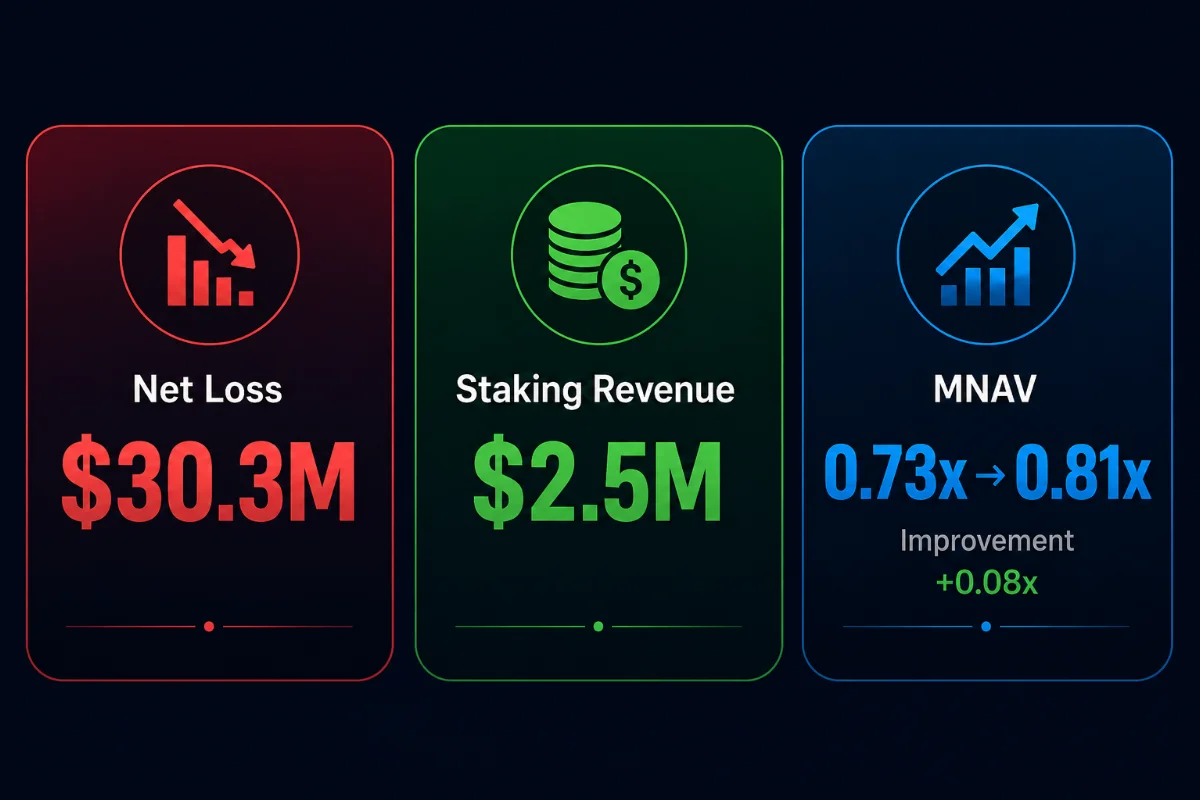
The company reported a net loss of $30.3 million for Q2, or $0.38 per share, alongside $2.5 million in staking revenue on its Solana (SOL) treasury.
Taken in isolation, that reads as a company hemorrhaging capital. Read as a full quarter, it's closer to a live test of whether treating SOL as productive collateral, not just a speculative bet, actually holds up when the underlying asset is down.
The Numbers on the Table
According to the company's Q2 2026 earnings call and investor presentation, the quarter broke down as follows:
• Net loss: $30.3 million, driven mostly by non-cash fair value adjustments on SOL holdings, not operating costs.
• Staking revenue: $2.5 million from 31,200 SOL staked at a 6.14% net yield reported—46 basis points above the Solana network average.
• SOL holdings: Down roughly 12% for the quarter, following a steeper 33% drop in Q1, tracking price weakness rather than forced selling.
• MNAV: Improved from 0.73x to 0.81x, meaning the stock is trading closer to—but still below—the value of the SOL it holds.
• Buybacks: 1.3 million shares repurchased for about $2.3 million, a direct bet that the stock was undervalued relative to its treasury.
The buyback is the real tell, not the loss number.
The company also stood up its first institutional validator cluster in Tokyo, securing a modest $500,000 third-party staking commitment—a small number, but the first sign of a second revenue line beyond simply holding SOL.
The Critical Lens
None of this should be read as a clean win. A $30.3 million loss is real money on paper, even if it's non-cash, and mark-to-market accounting on a volatile asset means that number swings hard in both directions every quarter.
The six-month picture is rougher still: Combined with a steeper Q1 loss during SOL's sharpest decline, first-half losses reportedly topped $130 million against roughly $6.1 million in revenue.
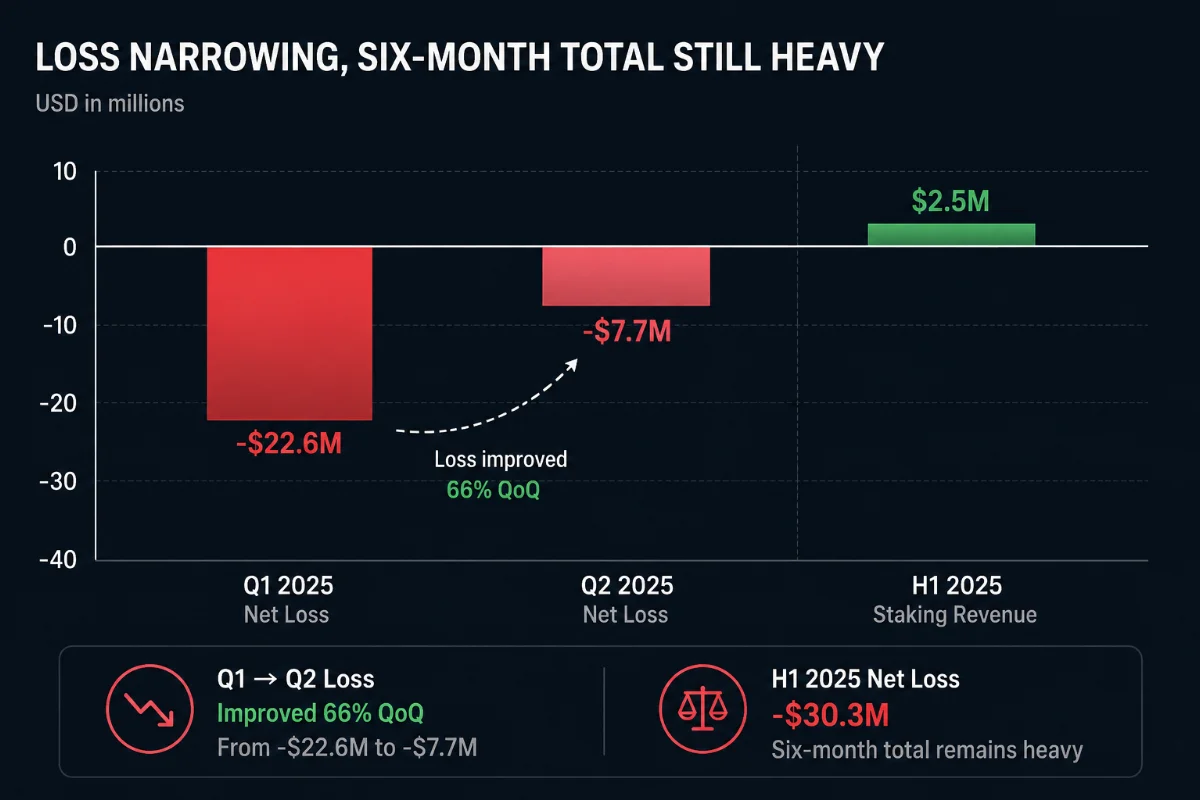
Staking income is genuine, but it remains a rounding error next to swings in the underlying asset. There's also an open structural question: Is this a treasury company, a validator business, or both?
Right now it's mostly the former, with the Tokyo cluster still a proof of concept rather than a revenue driver.
My Interpretation
Strip out the accounting noise and the quarter tells a simpler story: The treasury strategy is working roughly as designed, and non-cash losses are making it look worse than it is. The company generated real staking income, improved its MNAV, bought back shares it believed were mispriced, and stood up its first piece of validator infrastructure—all while SOL itself was under pressure.
That's execution through a rough patch, not a strategy losing control. The buyback is the real tell. Spending $2.3 million to retire shares while reporting a $30.3 million loss only makes sense if management genuinely believes the market is undervaluing the SOL on its balance sheet. An MNAV still below 1x suggests they might be right.
Investors' Next Move
The quarters ahead will say more than this one did. Whether MNAV crosses 1x will show whether the market stops discounting the stock against its treasury and starts pricing it fairly. Whether validator revenue scales beyond Tokyo's single small commitment will determine if this becomes a genuine second business line or stays a footnote. And whether that 6.14% yield holds above the network average for another two or three quarters will separate a real edge from a one-off.
SOL is being used, not just traded, and this is proof.
None of this is investment advice—it's simply a framework for reading what comes next, not a prediction of where the stock goes.
What's genuinely useful here, beyond one company's earnings, is what it signals about the category forming around it: Treasury strategy and staking infrastructure are becoming their own lane inside the Solana ecosystem, separate from the memecoin activity still dominating headlines. Utility-focused platforms built on Solana, including staking and coordination projects like Skill Stacker $STKR, sit inside that same shift toward SOL being used, not just traded.
Solana Company's Q2 didn't prove the treasury model works. It proved the model is being tested in real time, with real numbers, in a market that isn't making it easy.