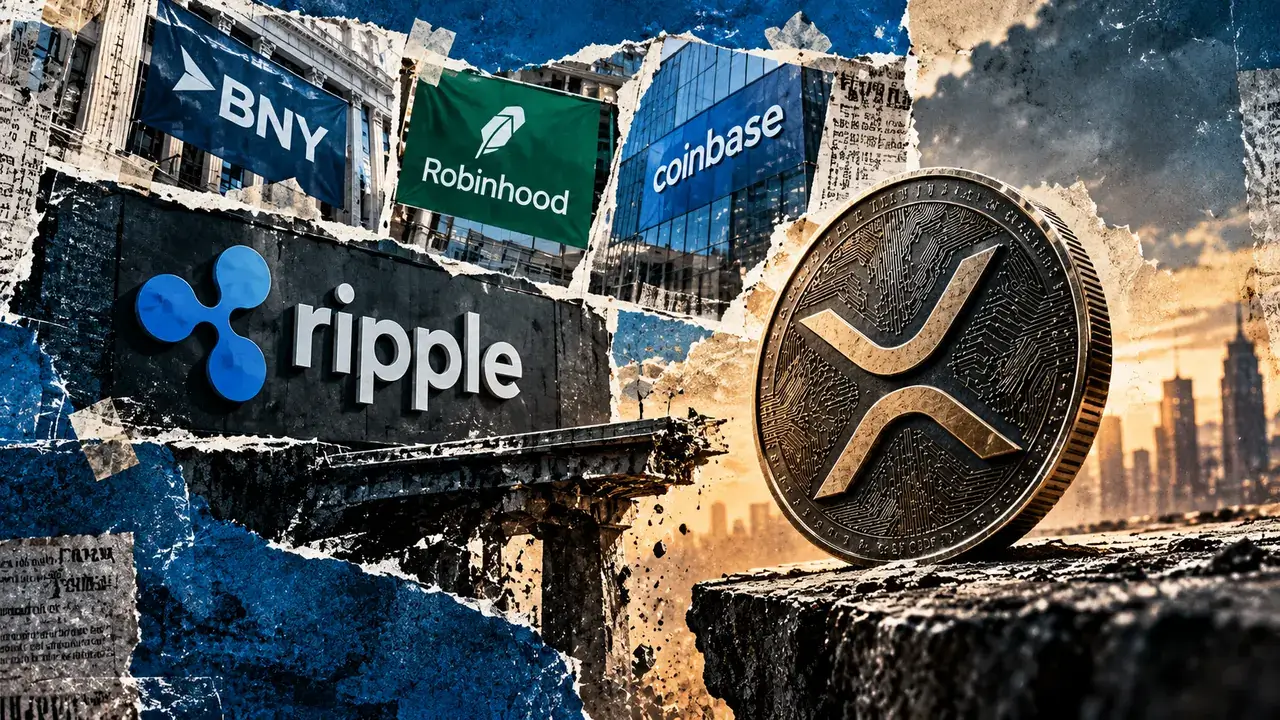
The Great Decoupling
If you have been watching the headlines lately, Ripple looks like a world-beater. They are processing trillions in payment volume, signing deals with central banks, and expanding their infrastructure into every corner of the legacy financial world. By any traditional metric, the business is humming. Yet, if you look at the XRP price chart, you see a completely different story. The token is stuck in a range that feels allergic to the company’s actual success.
As a builder, this is the most important lesson you can learn about the current state of blockchain. Success for a protocol’s founding company does not automatically translate to value for the protocol’s native token. In Ripple’s case, we are seeing a massive structural disconnect that many retail investors refuse to acknowledge. You can own a piece of the network’s utility without owning a piece of the company’s equity, and that distinction is currently worth about 16 trillion dollars in missed expectations.
Equity Versus Utility
The core of the problem is simple: XRP is not a stock. When Ripple signs a deal with a major bank in South America or a payment processor in Europe, those entities are often using Ripple’s software, not necessarily the XRP ledger for liquidity. Ripple has spent years building a suite of products, like RippleNet, that allow banks to communicate and settle without ever touching a volatile cryptocurrency. To a bank, XRP is a risk. To Ripple, the software is the product.
This creates a scenario where Ripple the company can become a generational giant in fintech while the XRP token remains a legacy asset from a previous era of speculation. Token holders have no legal claim on Ripple’s profits. They don’t get dividends, they don’t have voting rights in the boardroom, and they don’t benefit when Ripple sells its enterprise software for millions of dollars. The company’s bank account is growing, but the token’s utility remains largely theoretical for the average holder.
The Illusion of Correlation
Many people bought into XRP because they believed it would become the global reserve currency for banks. It’s a compelling narrative, especially when you see the 16 trillion dollar figure floating around. But the reality of enterprise adoption is much more boring. Banks want efficiency and regulatory compliance; they don't want to hold a digital asset that could drop 10% while they are waiting for a wire transfer to clear. Ripple knows this, which is why they’ve built paths for their partners to use the network without the price exposure.
For builders, this is a cautionary tale about tokenomics. If you are building a platform, you have to decide early on if your token is a friction point or a value driver. If the success of your business can happen regardless of the token’s price, then the token is essentially a meme with a high-tech whitepaper. Ripple has successfully pivoted into a software-as-a-service company that happens to have a large treasury of tokens they can sell to fund operations. That is great for their runway, but it’s a constant weight on the market price for everyone else.
The Supply Overhang
We also have to talk about the elephant in the room: the escrow. Ripple still holds a massive amount of XRP that they release into the market periodically. While they claim this is to provide liquidity and support the ecosystem, it functions as a perpetual sell wall. Every time the price shows a hint of life, there is more supply waiting to be absorbed. This isn't a conspiracy; it's a documented part of their business model. They use the token as a decentralized piggy bank to fund their very centralized corporate expansion.
This creates a conflict of interest that is rarely discussed in polite crypto circles. Ripple needs the token to have some value so they can continue to fund their operations, but they don't necessarily need it to moon. A stable, low-volatility token is actually much better for a payment settlement use case than a speculative asset that doubles and halves every other month. The company’s incentives and the moon-shot dreams of the XRP army are fundamentally at odds.
What Builders Should Take Away
If you are in the middle of designing a project, look at the Ripple model as a masterclass in corporate survival and a warning sign for token design. You can build a fantastic business that solves real problems for real people, but if your token doesn't have a direct, non-discretionary link to that value creation, you are setting your community up for disappointment.
- Software is not the token: Just because your code is being used doesn't mean your coin is being bought.
- Enterprise is risk-averse: Big companies will always choose the path that avoids price volatility.
- Equity is king: Founders will always prioritize the valuation of their company over the price of a secondary asset.
The bridge between Ripple’s corporate wins and XRP’s price is currently out of service. Until there is a regulatory or technical reason that forces these trillion-dollar volumes to settle exclusively through the token—without an off-ramp—the price will likely continue to drift. Ripple is winning the fintech war, but they are doing it by playing a game that doesn't require the XRP token to be expensive.
The Honest Bottom Line
I don't hate Ripple. From a founder’s perspective, what they have achieved is incredible. They survived an SEC onslaught that would have killed 99% of other projects. They have stayed relevant for over a decade. But we have to stop pretending that every partnership announcement is a pump signal. The 16 trillion dollar volume is a testament to Ripple’s sales team and their engineering, not the token’s necessity.
Stop looking for a correlation that doesn't exist. If you want to bet on Ripple, you’re about a decade late to the private equity rounds. If you’re holding the token, you’re betting on a future where banks eventually get brave enough to handle the asset directly. Given the current global regulatory climate, that is a very long-dated bet with no guarantee of a payout.
Read the original at CryptoSlate →