You open your favorite aggregator, maybe Jupiter or 1inch. You type in the amount of SOL you want to swap for USDC, wait a millisecond for the price to refresh, and click the button. From your perspective, the decentralized dream is working. You didn't ask a bank for permission, and you didn't wait for a wire transfer to clear. But if you look under the hood, the reality is a lot less revolutionary than the marketing suggests.
We like to think of these platforms as the venues where the trades happen. In reality, they are search engines. And more often than not, the results they are finding for you aren't coming from a pool of community-provided liquidity. They are coming from the same sophisticated, high-frequency trading firms that dominate the New York Stock Exchange. The plumbing has changed, but the water is being supplied by the same old incumbents.
The Illusion of the Automated Market Maker
In the early days of DeFi, we had the Automated Market Maker (AMM). It was simple, elegant, and totally transparent. If you wanted to trade, you traded against a pool of tokens sitting in a smart contract. The price was determined by a mathematical formula. It was slow and often inefficient, but it was genuinely peer-to-peer. You were trading against other DeFi users who were earning yield for providing that liquidity.
Fast forward to today, and the AMM is increasingly becoming a backup plan rather than the main event. Professional market makers have realized that they can provide better prices than a static formula. They use off-chain engines to calculate the perfect price and then submit that quote to the aggregator. When you click swap, you aren't interacting with a pool; you're interacting with a private firm's balance sheet via a Just-In-Time (JIT) quote.
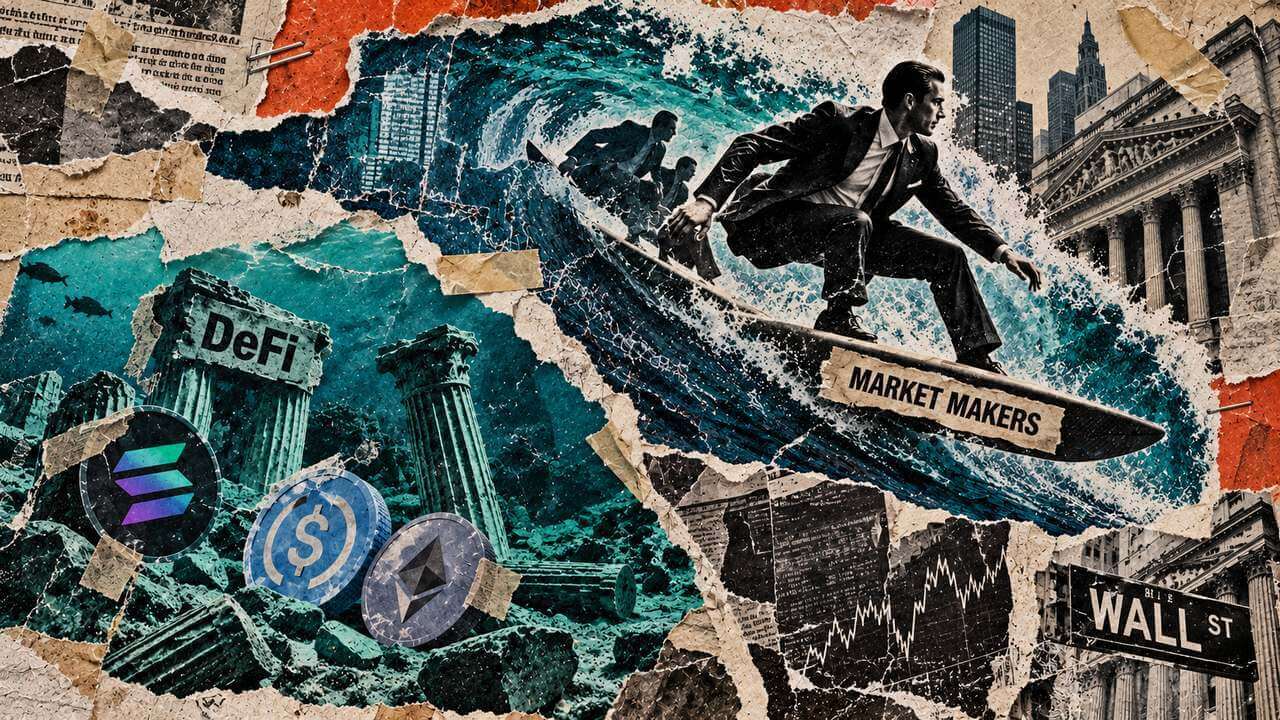
Reports indicate that roughly 90% of significant DeFi volume is now being routed through these private channels. We've built a massive decentralized infrastructure only to use it as a frontend for Wall Street market makers like Jane Street, Jump, or Wintermute. If you're a founder building in this space, you have to ask yourself: did we actually decentralize finance, or did we just build a better API for the incumbents?
Why Efficiency is a Double-Edged Sword
As a builder, it’s easy to justify this. The goal of any exchange is to provide the best execution for the user. If a professional firm can give a user $100 more on a swap than a Uniswap V2 pool can, the aggregator is going to choose the firm every single time. Users don't care about the philosophy of decentralization when they're losing money on slippage. They care about the bottom line.
This drive for efficiency has created a feedback loop. Because the professional firms get the bulk of the trade flow, they have more data and more profit to refine their algorithms. This makes them even more efficient, which further starves the traditional on-chain liquidity pools. Eventually, the passive liquidity provider—the retail user who just wanted to earn 5% on their ETH—gets pushed out of the market entirely. They can't compete with the speed and precision of a multi-billion dollar firm.
The decentralized dream wasn't just about the technology; it was about who owned the infrastructure. If the ownership is being consolidated back into the hands of a few major players, the 'D' in DeFi starts to feel like a marketing gimmick.
The Risk of Hidden Centralization
The problem isn't necessarily that these firms are malicious. The problem is systemic risk. We moved to blockchain to avoid the fragility of the 2008 banking system. We wanted a system where if one giant firm went down, the rest of the market wouldn't care because the liquidity was distributed across thousands of independent actors.
When 90% of the volume is routed to a handful of market makers, we are re-introducing the same counterparty risks we tried to escape. If one of these firms hits a technical glitch or a regulatory wall, liquidity on decentralized aggregators could evaporate in seconds. The 'DEX' wouldn't actually be able to facilitate your trade because the engines behind the curtain have all stopped running. We’ve traded resilience for a slightly better price on a SOL swap.
What This Means for Builders
If you are building in the DeFi space today, you have to decide what side of the fence you are on. Are you building tools that empower individual users to provide liquidity, or are you building more efficient pipes for institutional capital? There is a lot of money to be made in the latter, but it’s a crowded, cutthroat game where the house usually wins.
For those interested in true decentralization, the challenge is finding ways to make on-chain, passive liquidity competitive again. Whether that's through new hooks in Uniswap V4, privacy-preserving order books, or better MEV (Maximum Extractable Value) protection for retail LPs, the goal should be to lower the barrier to entry for providing liquidity, not just for consuming it.
The Takeaway
We need to be honest about the state of the industry. We haven't replaced Wall Street yet; we've just invited them to play on our servers. The convenience of modern aggregators is great for the average user, but it comes at the cost of the original vision. If we continue down this path, the blockchain becomes nothing more than a settlement layer for the same people who have always controlled the money.
Builders should focus on creating incentives that keep liquidity distributed. If we don't, we’ll wake up one day and realize that the only thing 'decentralized' about our financial system is the wallet software we use to check our balances at the same three firms.
Read the original at CryptoSlate →