We have a habit in this industry of slapping new labels on old business models to justify higher multiples. Right now, every company with a foundation model is an AI company. But if you look at how the money moves, the massive capital expenditure required, and the way they deliver services, these entities are starting to look a lot more like specialized utilities.
The Cloud Comparison
Lately, the conversation around Anthropic has shifted from their research breakthroughs to their valuation. To understand if the numbers make sense, you have to stop comparing them to software startups and start comparing them to cloud giants. If we treat Anthropic as a cloud provider, the math gets interesting and a bit concerning.
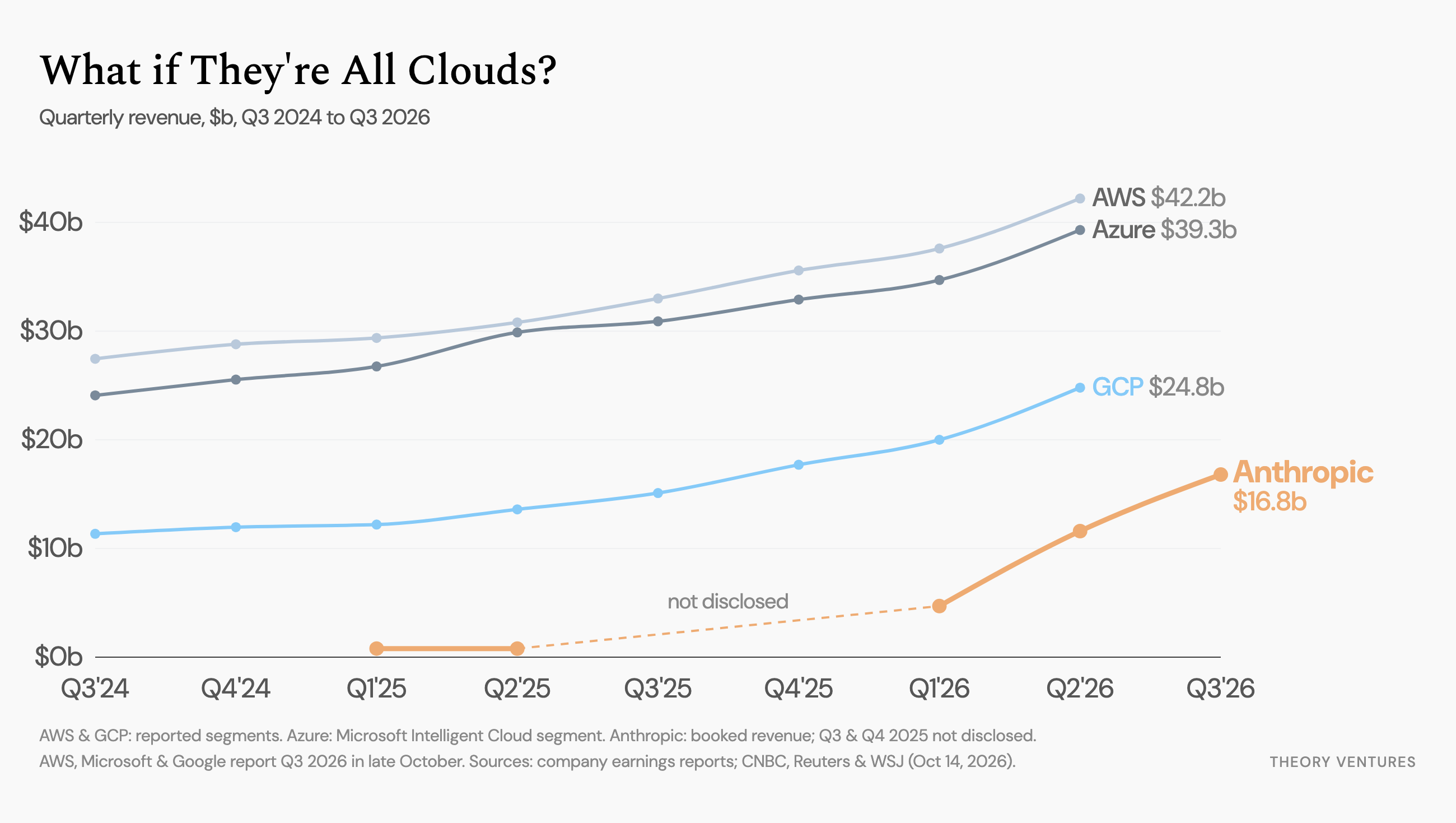
Current market whispers and internal projections suggest Anthropic could be reaching for a valuation in the $1.5 trillion to $2 trillion range in a hypothetical public scenario or peak-private exit. For context, that is roughly what analysts think Google Cloud Platform would be worth if it were spun off today. The problem? Google Cloud generates significantly more revenue than Anthropic does.
If Anthropic is valued at the same level as a standalone GCP, they are doing so on roughly two-thirds of the revenue. That is a massive premium for a company that effectively acts as a middleman for compute power.
The Margin Problem
In the early days of SaaS, we loved high margins. You wrote the code once and sold it a million times. Cloud providers like AWS or GCP have lower margins because they have to pay for the physical hardware, the electricity, and the data centers. Anthropic has an even tougher road.
They aren't just paying for servers; they are paying for the most expensive chips ever made, often rented from the very companies they are competing with. When you look at the unit economics of a foundation model provider, it feels less like a scalable software business and more like a heavy industrial operation. Every time a user asks Claude a question, there is a tangible cost in compute that doesn't exist for a traditional software platform.
Why Builders Should Care
If you are building on top of these models, you need to understand that your foundation is a cloud provider that hasn't found its footing yet. We are seeing a race to the bottom on pricing for tokens, while the cost to train the next generation of models is skyrocketing. This creates a squeeze.
For a founder, this means the platform risk is real. If the market eventually decides these companies are clouds and not magical AI unicorns, their access to cheap capital will dry up. They will be forced to raise prices or cut costs, which usually means less support for the developer ecosystem and more focus on their own enterprise high-ticket items.
The Infrastructure Trap
The trap for Anthropic and its peers is that they are trapped in a cycle of perpetual upgrading. In a traditional cloud business, you build a data center and you depreciate those assets over several years. In the AI world, your hardware is arguably obsolete the moment you finish a training run. The pace of innovation is actually a financial liability.
We are watching a high-stakes game of chicken where these companies are betting that scale will eventually lead to a monopoly that allows them to fix the margins. But history shows us that cloud infrastructure eventually becomes a commodity. Once the models plateau in quality, the only differentiator left is price. And in a price war, the company with the highest capital costs loses.
A Reality Check on Multiples
Wall Street is currently giving AI companies a pass on traditional metrics because they represent the future. But the future eventually has to be audited. If Anthropic wants to be valued like a cloud, it needs to show the stability and scale of a cloud. If it wants to be valued like a software company, it needs to show software-like margins.
Right now, it has neither. It has the capital requirements of a utility and the volatility of a startup. That is a dangerous combination for long-term valuation sustainability.
What Happens Next?
We are likely to see a shift in how these companies are pitched to investors. The narrative will move away from raw intelligence and toward reliability, uptime, and vertical integration. The companies that survive will be the ones that own the most of their stack, reducing the amount of money they have to hand back to Nvidia or Amazon.
For the rest of us, it means we should stop treating these models as partners and start treating them as vendors. Use them while the subsidies last, but have a plan for when the cloud bill finally comes due.
The Takeaway
Anthropic is being priced as a mature cloud giant despite having a fraction of the revenue and none of the infrastructure ownership. Builders should enjoy the cheap compute while it lasts, but build with the expectation that the AI margin squeeze is coming.
Read the original at Tomasz Tunguz →