We have been staring at the sky for decades, but the universe keeps finding new ways to throw noise at us. Since 2007, astronomers have been tracking Fast Radio Bursts, or FRBs. These are millisecond-long pulses of energy that hit our sensors and then vanish. Most of the time, they are one-offs. They don't repeat, they don't leave a return address, and they don't give us enough data to build a reliable model of what actually causes them.
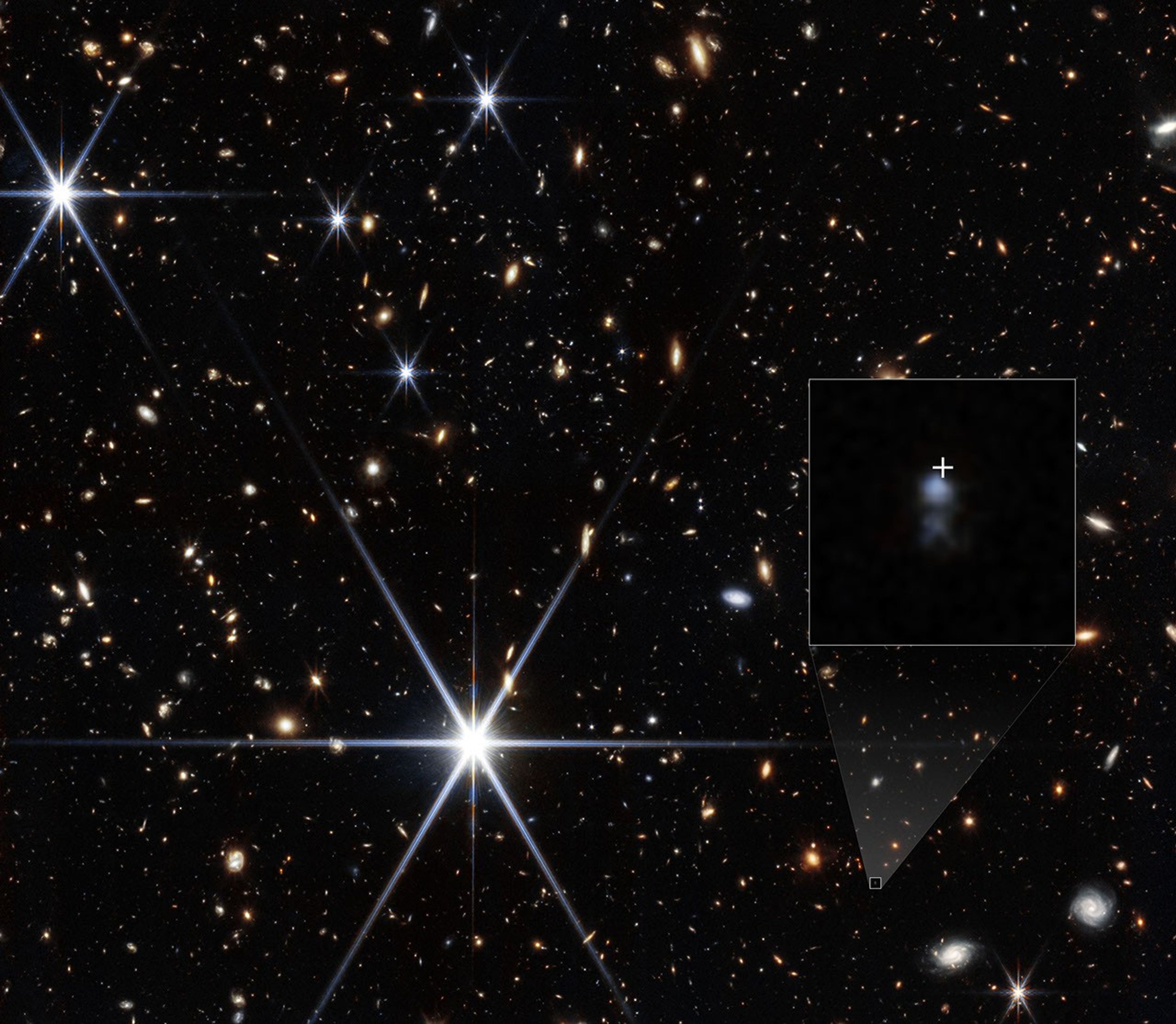
Recently, NASA used the James Webb Space Telescope to get a better look at one specific signal: FRB 20220610A. This isn't just another blip on the radar. This is the most distant burst we have ever recorded. And what Webb found is shaking up the standard theories about how these things form. Instead of a single, lonely galaxy, Webb found a complex cluster of at least seven galaxies that appear to be interacting. This tells us that the environment where these bursts happen might be more chaotic than we originally thought.
The Logistics of Deep Space Data
For founders in the AI and data space, this is a masterclass in signal processing. The burst in question traveled for eight billion years to reach us. When it was first detected by the Australian Square Kilometre Array Pathfinder, we knew it was powerful, but we didn't know the context. Without context, data is just noise. Webb provided the context by acting as a high-resolution lens for the deep past.
Early theories suggested FRBs came from isolated events, maybe a dying star or a collision in a quiet neighborhood. But the discovery of this galactic pile-up suggests that extreme environments—where galaxies are merging and stars are being born at a frantic pace—are the real breeding grounds. For builders, this is a reminder that the environment surrounding a data point is often as important as the data point itself. You can't understand the output if you don't understand the infrastructure that produced it.
Why This Matters for Technical Founders
If you are building in the crypto or AI space, you might wonder why a radio burst from eight billion years ago matters to your roadmap. It matters because it represents the ultimate edge case. We are talking about signals that are so brief and so distant that our current compute models struggle to categorize them. The researchers had to use Webb's infrared sensitivity to peel back the layers of dust and see what was actually happening at the source.
We see this in high-frequency trading and decentralized networks all the time. You have a spike in activity—a flash crash or a sudden surge in gas fees—and you have to trace it back to a specific set of conditions. Usually, it isn't one single factor. It is a cluster of interacting variables, much like the seven galaxies Webb just identified. Complexity is the default state of the universe, and our systems need to be built to handle that reality.
- Scale: The distance involved here is hard to wrap your head around. We are looking at light that started its journey when the universe was less than half its current age.
- Resolution: Ground-based telescopes couldn't see the individual galaxies. They just saw a smudge. Webb’s resolution allowed for a granular breakdown.
- Validation: This discovery validates the idea that extreme cosmic events are tied to high-density environments.
The Skeptical Take on Cosmic Origins
I’m always a bit skeptical when people start claiming we’ve found the 'origin' of a mystery. We haven't found the specific object that fired off the FRB. We’ve found the neighborhood. It’s like tracing a hack back to a specific data center in Singapore. You know where it happened, but you don't necessarily know who was sitting at the keyboard or what software they were running.
The prevailing theory is that these bursts come from magnetars—highly magnetized neutron stars. But the fact that this specific burst came from such a crowded area suggests that we might be looking at a different mechanism, or at least a very rare version of a magnetar born from a galactic merger. As builders, we should be wary of 'solved' problems. Every time we get better tools, like Webb, the 'solved' problems suddenly look a lot more complicated.
The more we look, the more we realize that the universe doesn't like to repeat itself in simple ways. The outliers are where the real discovery happens.
We see this same pattern in AI development. You train a model on a massive dataset and it works 99% of the time. But it's that 1%—the hallucinations, the edge cases, the weird artifacts—that actually tells you how the model is functioning under the hood. Astronomers are doing the same thing. They are chasing the outliers to understand the fundamental laws of physics.
What Builders Can Learn
The takeaway here isn't just about space. It’s about the value of high-fidelity sensors and the courage to question established models. When the data doesn't fit the theory, most people try to squeeze the data until it fits. The best founders, and the best scientists, throw out the theory and start building a new one based on what they actually see.
If your startup is hitting a wall, or if your network is throwing errors you can't explain, you probably need better resolution. You are likely looking at a 'smudge' when you should be looking at the 'cluster.' Stop looking for a single point of failure and start looking at how your systems are interacting with each other.
Building for the Long Haul
Finally, there is a lesson in persistence. These bursts were discovered nearly twenty years ago. It took billions of dollars in hardware and two decades of observation to finally get a clear look at where one of them came from. In a world of 24-hour news cycles and quarterly earnings, that kind of long-term commitment to a problem is rare. But it’s the only way to solve the big mysteries.
Whether you are building a new protocol or trying to map the stars, the principle is the same: stay skeptical, get better data, and don't be afraid of the complexity. The universe is messy, and your tech stack probably is too. That’s not a bug; it’s a feature of operating at the edge of what’s possible.
Read the original at NASA Breaking News →