The Era of Delegation
For the last decade, the retail world has been obsessed with friction. Every click removed between a user seeing a product and seeing a delivery notification is worth billions. But as we transition from the mobile era into the AI era, the goalpost is moving. It is no longer about making it easier for a human to shop; it is about teaching an AI how to shop on a human's behalf.
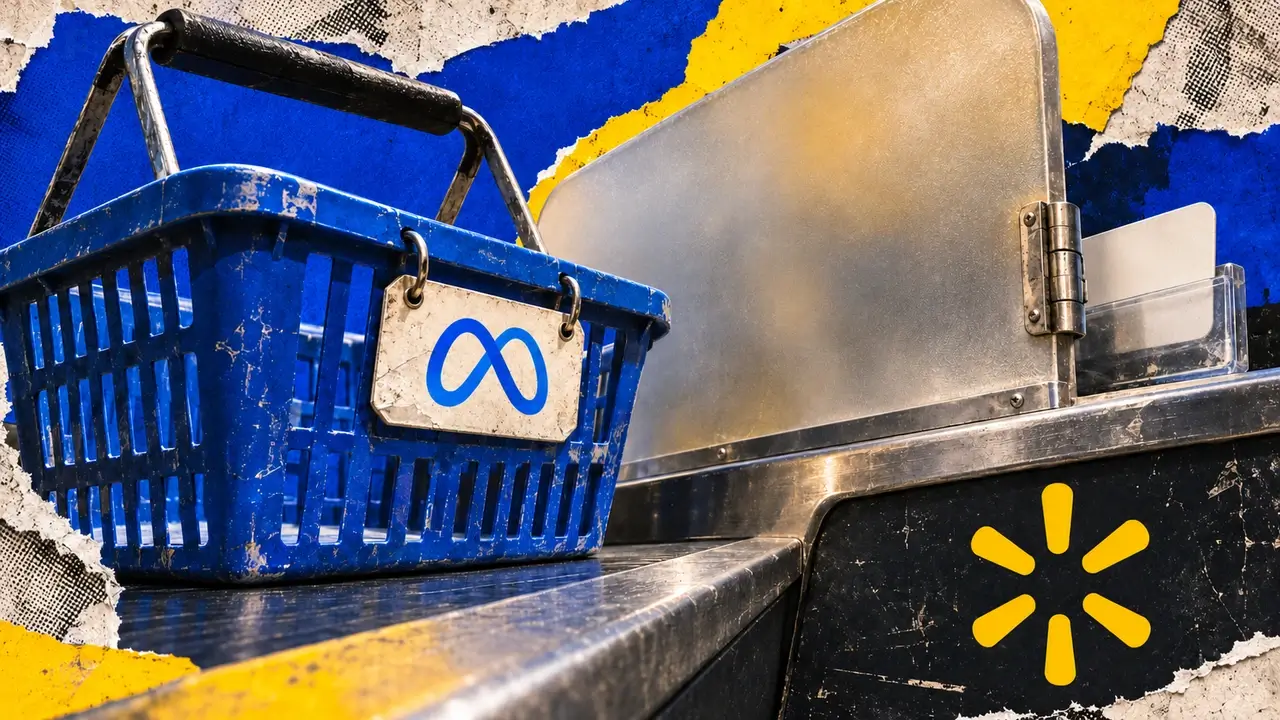
Walmart’s recent rollout during the Black Friday rush, specifically their integration with Meta’s Muse AI, is a significant marker for those of us building in the space. They aren't just selling toasters; they are stress-testing a new model of financial delegation. The core of this development is simple: a shopper can interact with an AI agent in a chat interface, pick out items, and check out using a saved card on their Walmart account. Crucially, the agent never actually touches the money.
The Custody Problem
In the crypto and web3 circles, we have spent a lot of time talking about "self-custody." The dream has always been to have an AI agent with its own wallet, roaming the internet and executing smart contracts to buy assets or services. The problem is that most people are terrified of that. Giving a bot full control over your private keys is a recipe for a drained bank account due to a hallucination or a clever prompt injection attack.
Walmart’s approach sidesteps this by creating a permissioned bridge. You aren't giving the AI your wallet; you are giving it a specific spending limit within a pre-existing trust relationship. It is a middle-ground solution that builders should pay close attention to. If you want mass adoption for AI agents, you have to solve for safety before you solve for autonomy.
How the Workflow Actually Functions
The technical implementation here is less about breakthrough AI and more about clever API design. By linking a Walmart account to the Meta environment, the user sets a threshold. The AI acts as a concierge, not a treasurer. It suggests products, handles the search, and bundles the cart. When it comes time to pay, it triggers a checkout process that relies on the established credentials of the user’s Walmart account.
This is what I call the "Allowance Model." Just like you might give a teenager a debit card with a $50 limit, we are now giving AI agents a leash. This allows the AI to be useful without being dangerous. For founders building in the AI-commerce space, this is a clear signal: don't build a new wallet if you can leverage an existing merchant's vault. The friction of trust is much harder to overcome than the friction of technology.
What This Means for Founders
If you are building an AI agent startup right now, your biggest hurdle isn't the LLM—it’s the checkout button. The traditional web is built for humans with eyeballs and fingers. It is built for CAPTCHAs and 2FA. AI agents break all of that. Walmart is showing that the solution is to move the "permissioning" layer back to the merchant or the platform, rather than the browser.
For builders, there are three main takeaways from this rollout:
- Focus on Intent, Not Just Execution: The AI’s value isn't just in clicking "Buy." It’s in the filtering process that leads to the purchase. Walmart is using Muse to narrow down the noise of Black Friday.
- The Spending Limit is the Feature: Security isn't a secondary concern; it’s the product. Users will not adopt autonomous shopping until they know exactly how much they can lose in a worst-case scenario.
- Platform Moats are Expanding: By integrating with Meta, Walmart is meeting users where they live. If you are building a standalone shopping agent, you are fighting an uphill battle against these integrated ecosystems.
The Skeptic’s Corner
I have to be honest: this isn't perfect. We are still looking at a very centralized, closed-loop system. Walmart controls the inventory, Meta controls the interface, and the user is essentially just the source of capital. It lacks the interoperability that we talk about in the crypto world. An agent that only works at Walmart isn't truly an autonomous assistant; it’s just a high-tech sales rep.
However, we have to start somewhere. The transition from "searching for things" to "having things found for us" is inevitable. The skepticism comes in when we look at data privacy. Meta knowing what you want to buy and Walmart knowing how you pay creates a massive data profile that most users won't fully understand until it's too late. As builders, we should be thinking about how to replicate this "allowance" model using decentralized identity and verifiable credentials to protect the user.
Final Takeaway for the Builder
The Walmart-Meta collaboration proves that AI commerce is moving away from the "wallet" and toward the "permissioned account." If you want to build the future of agentic shopping, don't focus on giving the bot a credit card. Focus on giving the user a way to cap the bot's influence. The first companies to make AI shopping feel safe, rather than just fast, will be the ones that win the market.
We are moving toward a world where the primary interface for the internet is a conversation, not a grid of products. Walmart just fired a major shot in that transition. Watch the spending limits—that is where the real innovation is happening.
Read the original at CryptoSlate →