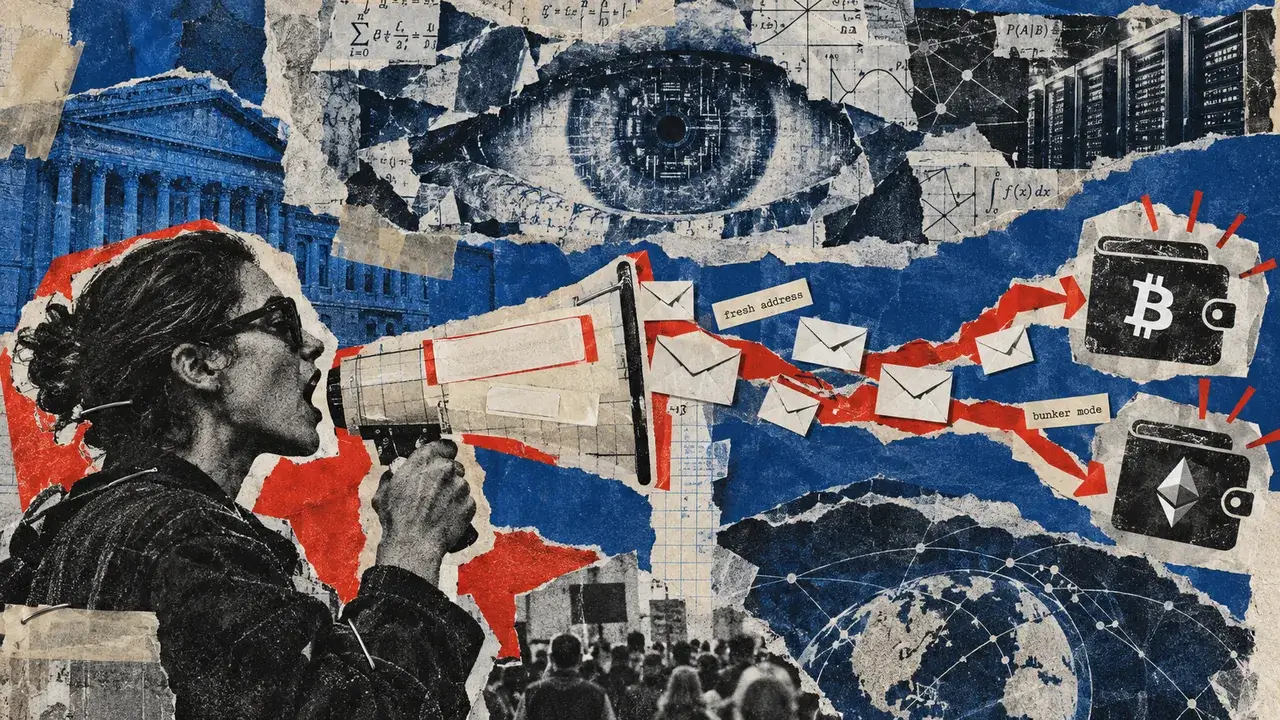
We have spent years talking about the quantum apocalypse in the abstract. It was always a problem for tomorrow, something that researchers and academics debated while the rest of us built applications and traded tokens. But the conversation is shifting. The catalyst isn't just better hardware; it is the rapid acceleration of artificial intelligence. When Vitalik Buterin speaks, the market usually listens to the technical nuances, and his recent push for calm regarding AI-driven threats to cryptography deserves a deep look from a founder's perspective.
The Core Anxiety
The fear is straightforward: if AI can speed up the development of quantum computing, it could theoretically break the Elliptic Curve Digital Signature Algorithm (ECDSA) that currently secures Bitcoin and Ethereum. If that happens, your private keys aren't private anymore. A sufficiently powerful machine could derive a private key from a public key, essentially emptying every wallet on the chain.
Vitalik is signaling that we should be cautious, but not hysterical. The narrative that AI will suddenly grant hackers the ability to crack 256-bit encryption overnight is a stretch. However, the intersection of machine learning and quantum research does shorten the timeline. For builders, this means the grace period for ignoring post-quantum cryptography is ending sooner than we planned.
Wallet Hygiene as a First Line of Defense
One of the most practical takeaways from Vitalik's recent commentary involves the simple act of address reuse. In the early days of Bitcoin, the standard advice was to never use an address twice. Every time you received a payment, you generated a new public key. This wasn't just for privacy; it was a security buffer.
When you send a transaction, you reveal your public key. Until that moment, only the hash of your public key is visible on the blockchain. Hashing algorithms are significantly more resistant to quantum attacks than the signature schemes themselves. If you have a wallet that has received funds but has never sent a transaction, even a quantum computer would have a hard time stealing your assets because it wouldn't have the public key to work backward from.
For founders building wallet infrastructure or DeFi protocols, this is a reminder to prioritize 'one-time-use' architecture. The industry has become lazy with account abstraction and persistent identities. While that helps user experience, it creates a larger surface area for future cryptographic vulnerabilities. We need to find a way to balance the seamless 'one-click' experience with the reality that exposing a public key repeatedly makes it a target.
The AI X-Factor
Why is AI the variable that has everyone nervous? It’s not that ChatGPT is going to write a script to hack Ethereum. It’s that AI-driven materials science and error correction are accelerating the development of the hardware needed for quantum calculations. Quantum computers are notoriously unstable; qubits flip and lose their state due to environmental noise. AI is proving to be exceptionally good at managing that noise.
Vitalik’s stance is that while AI might weaken some of the cryptography designed to resist quantum attacks, the transition to 'post-quantum' standards is already in motion. The Ethereum roadmap has long included plans for Vericle Trees and other structures that are harder to crack. The message to builders is: the protocol will adapt, but you need to be mindful of how you handle user data and keys in the interim.
Practical Steps for Builders
If you are building in the space right now, you shouldn't be tearing up your roadmap. But you should be auditing your assumptions. Here is how to think about it:
- Minimize Public Key Exposure: If your protocol requires users to sign messages constantly, you are increasing their exposure. Explore ways to batch signatures or use zero-knowledge proofs where the actual key isn't part of the repeated interaction.
- Migration Paths: Think about how you would migrate your users to a new signature scheme. If a hard fork or a mandatory upgrade were required to move to quantum-resistant addresses, how much friction would your users face?
- Avoid Hype-Driven Security: Don't buy into 'AI-proof' or 'Quantum-proof' marketing fluff. Real security comes from tested, peer-reviewed mathematical standards, not buzzwords. Vitalik's call for calm is specifically a call to rely on rigorous math rather than panic-buying into unproven solutions.
The Founder's Reality Check
I have seen a lot of cycles where a new technology is framed as the 'crypto killer.' First, it was regulation, then it was central bank digital currencies, and now it is the AI-Quantum combo. The reality is that cryptography is a moving target. It is an arms race that has been going on since long before Bitcoin existed.
The current threat isn't a reason to stop building. It is a reason to build better. We have become accustomed to the 'move fast and break things' mentality, but in cryptography, 'move fast' usually leads to getting rekt. Vitalik is advocating for a measured transition. He favors migration to unused addresses because it's an easy, low-cost way to hedge against uncertainty. It’s an insurance policy that costs almost nothing but provides a massive safety net if the quantum timeline accelerates faster than the protocol can evolve.
Looking Ahead
We are entering an era where the underlying assumptions of the internet—not just crypto—are being challenged by AI. Encryption is the bedrock of digital property. If that bedrock shifts, the entire industry has to shift with it. But as long as we have leaders like Buterin focusing on the technical debt and the migration paths, we are in a better position than most legacy financial systems.
The takeaway for the builder community is clear: stay focused on the fundamentals. Use fresh addresses. Don't over-expose your users. And most importantly, don't let the headlines distract you from the actual work of building useful tools. The 'AI threat' is just another engineering problem to be solved, and in this space, we are pretty good at solving engineering problems.
The goal is not to be perfectly secure against a god-like AI, but to be significantly more expensive to attack than the value of the prize.
If we keep our heads down and focus on these iterative security improvements, the 'apocalypse' will likely turn out to be just another routine software update.
Read the original at CryptoSlate →