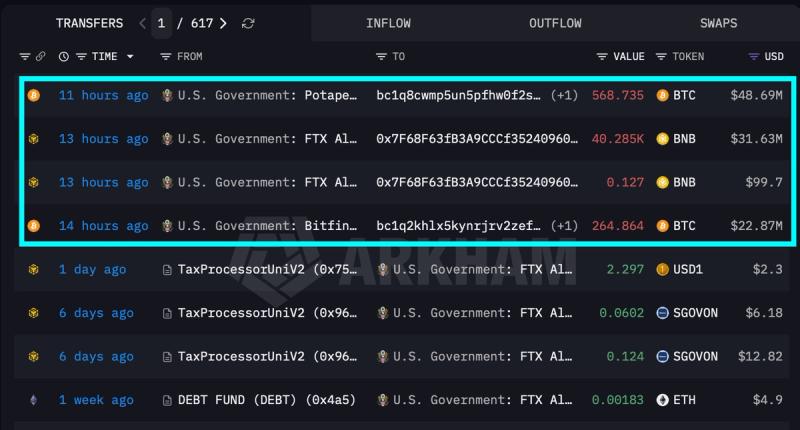
The U.S. government is once again acting like the world’s most unpredictable whale. On Tuesday, blockchain tracking tools flagged several significant movements originating from wallets controlled by federal authorities. We are talking about more than $100 million worth of Bitcoin and BNB shifting between digital addresses. As usual, the immediate reaction on social media was a mix of panic and speculation about an impending market dump.
The Logistics of Federal Custody
Before we jump to the conclusion that a massive sell-off is about to tank your portfolio, we have to look at how these entities actually operate. The government doesn't trade like a retail degen or even a sophisticated hedge fund. They have specific protocols for asset seizure, storage, and eventual liquidation. Moving funds out of a cold storage wallet isn't always a signal for a sale; often, it is just administrative maintenance or a shift between custodial partners.
Arkham Intelligence data shows these funds have been sitting dormant for quite a while. When these coins move, it usually means one of three things: they are preparing for a public auction, they are moving the assets to a private exchange for a controlled liquidation, or they are simply reorganizing their internal security structure. Historically, the U.S. Marshals Service has been the primary handler for these assets, and they tend to favor methods that minimize market disruption—even if the mere sight of their wallet addresses moving causes a temporary dip.
Why BNB Matters More Than Bitcoin Here
The inclusion of BNB in this transaction set is the real story for me. Bitcoin movements from the government are old news. We know they hold billions in BTC from the Silk Road and various hack recoveries. But seeing a significant chunk of BNB move suggests the government is working through assets seized from specific exchange-related enforcement actions. For builders in the Binance ecosystem, this is a reminder that regulatory overhang isn't just a headline; it is a literal balance sheet item that the government is now managing.
As a founder, I look at this and see a clear lack of infrastructure for institutional-grade sovereign custody. The government is essentially acting as a reluctant custodian for assets they don't particularly like but are legally obligated to hold. This creates a weird friction in the market where one of the largest holders of crypto is an entity that lacks a clear profit motive or a long-term investment strategy.
The Founder Perspective: Volatility as a Feature
If you are building a product in this space, you can't let $100 million movements rattle you. In the grand scheme of Bitcoin’s daily volume, $100 million is a rounding error. However, the psychological impact is outsized. We are still in a phase where the market reacts to the idea of government intervention more than the actual mechanics of it. This tells me the market is still fragile and lacks the depth to absorb news without emotional swings.
Builders should be focusing on creating tools that abstract away this noise. We need better data transparency that distinguishes between a "custodial shuffle" and an actual "market sell." Right now, every time an Arkham alert goes off, people rush to the exits. That is a failure of education and a failure of the current information stack we rely on. We need to build systems that provide context, not just raw data.
The Skeptic's View on Liquidation
Let’s be honest: the government is eventually going to sell these assets. They have no interest in being a long-term HODLer. The skeptics will tell you that the government wants to suppress the price of crypto to protect the dollar. I don't think it's that coordinated. I think it’s bureaucracy. They have a mandate to liquidate seized assets and return value to the Treasury. They will do it in the most efficient way possible for their own internal accounting, regardless of what it does to your long position.
The real risk isn't this $100 million. The risk is the lack of a clear, public schedule for these liquidations. In the traditional financial world, large asset sales are often telegraphed to prevent market chaos. In crypto, the government operates in the shadows until a blockchain explorer catches them. This lack of transparency is exactly what keeps institutional capital on the sidelines. If the government wants to treat crypto like a legitimate asset class, they need to start acting like a professional seller.
What This Means for the Roadmap
For those of us in the trenches, this news is just another Tuesday. But it should serve as a prompt to evaluate your project's sensitivity to macro liquidity events. If your startup's survival depends on Bitcoin staying above a certain price floor, and that floor can be shaken by a simple wallet transfer, you need to rethink your business model. You shouldn't be building on a foundation that can be moved by a federal clerk with a hardware wallet.
We need more focus on decentralized liquidity and automated market-making that can handle these shocks. The more we rely on centralized exchanges to handle government liquidations, the more vulnerable we are to these sudden spikes in volatility. The goal for the next generation of builders should be to create a market so deep and so decentralized that even a billion-dollar move by Uncle Sam barely registers on the chart.
The government is the ultimate reluctant whale. They don't want the assets, they just want the cash, and their lack of a playbook is our biggest source of volatility.
Stop watching the whale alerts and start building the infrastructure that makes them irrelevant. The government moving money is a distraction from the real work of scaling AI and blockchain integration. If you’re worried about $100 million, you aren’t thinking big enough about where this technology is going.
Read the original at CoinDesk →