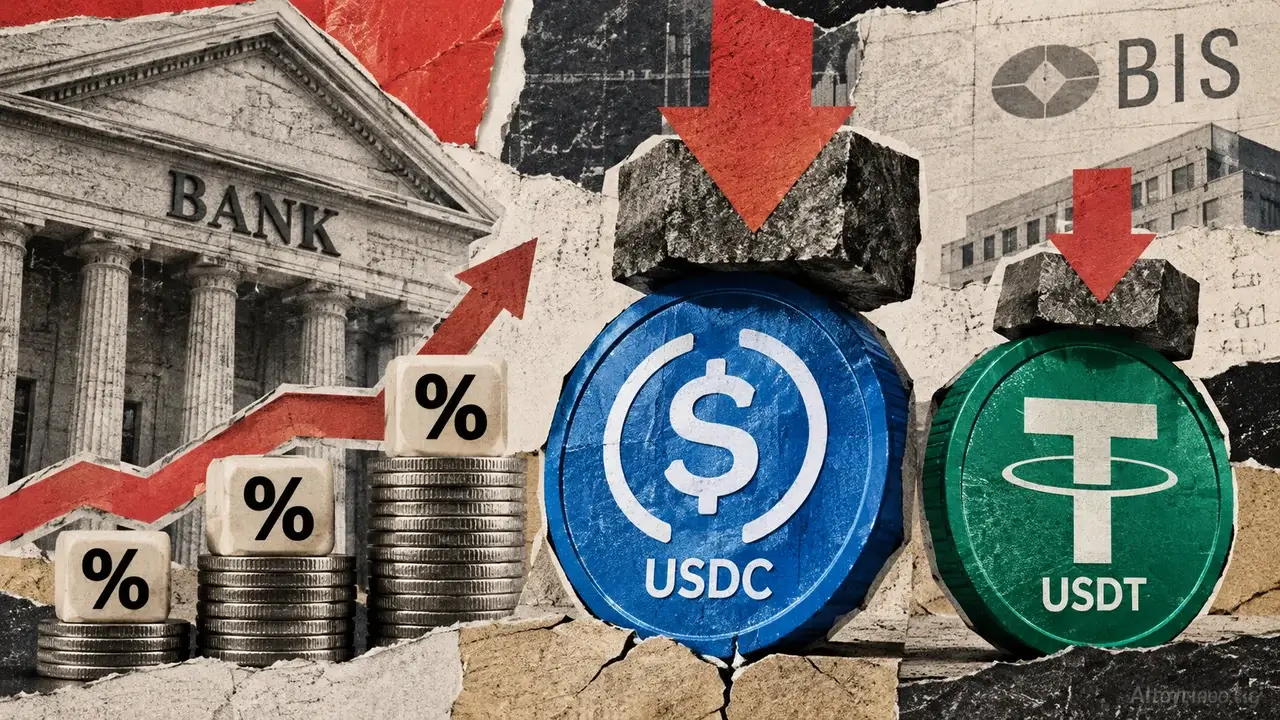
Stablecoin issuers like to talk about the future of money, but the reality is much more boring. It is a game of interest rates. For a long time, the narrative was that USDC would become the primary rail for global finance because it is faster and more transparent than the legacy banking system. However, a recent model from the Bank for International Settlements (BIS) suggests that the hurdle for adoption isn't technical proficiency—it is the yield on a standard U.S. savings account.
As an editor focusing on the builder perspective, I look at USDC as a tool. But tools have costs. When you hold USDC, you are essentially giving Circle a zero-interest loan so they can earn yield on Treasuries. When the Federal Reserve kept rates at near-zero, this was a fair trade for the utility of instant settlement. Now that deposit rates have climbed, the opportunity cost of holding a non-yielding stablecoin has become a choke point for growth.
The Yield Gap Problem
The BIS model confirms what many founders have felt in their balance sheets: USDC adoption is highly sensitive to the Federal Funds Rate. Historically, when the gap between what a bank pays you and what a stablecoin offers (usually nothing) widens, the circulating supply of USDC shrinks. This isn't just about retail investors moving money; it is about companies and institutional builders realizing their idle capital is rotting.
For a builder, this creates a friction point. If you are building an app that requires users to hold USDC, you are asking them to ignore the 4% or 5% they could be getting in a high-yield savings account. That is a massive tax on the user experience. The convenience of a blockchain transaction is rarely worth a 500-basis-point loss on capital for a treasury manager.
Why This Hits USDC Harder Than Tether
You might wonder why Tether (USDT) continues to grow while USDC struggles with these rate dynamics. The BIS research points toward the difference in use cases. USDC is heavily integrated into the U.S. financial ecosystem and regulated entities. It is the "compliant" stablecoin. Because it plays by the rules, it competes directly with other compliant instruments—like bank deposits.
Tether, on the other hand, often serves as the liquidity backbone for offshore trading and regions with limited access to dollars. If you are in a country with a collapsing local currency, you don't care about the 5% yield in a U.S. bank because you can't get a U.S. bank account. You just want the dollar. USDC's proximity to the U.S. banking system is its greatest strength, but in a high-interest-rate environment, it becomes a structural weakness.
The Exchange Reward Complication
The BIS report also highlights a variable that makes forecasting difficult: exchange rewards. Platforms like Coinbase have started sharing a portion of their yield with users who hold USDC. This is a desperate attempt to bridge the gap. By offering 4% or 5% on USDC holdings, they are trying to mimic the banking experience to prevent capital flight.
For developers, this is a double-edged sword. On one hand, it keeps liquidity in the ecosystem. On the other, it turns the stablecoin into something that looks and acts like a security or a managed investment product. This introduces a layer of regulatory risk that many builders aren't prepared to handle. If the only way to make your stablecoin viable is to pay users to hold it, you aren't building a new financial rail—you're just building a digital bank with more steps.
The Founder's Perspective: Is the Model Broken?
We need to be honest about the "stablecoins as a payment rail" thesis. If the growth of these assets is purely a function of interest rate arbitrage, then they aren't yet a transformational technology; they are a macro trade. Builders should be looking at the BIS data and asking if they are building on a foundation that only works when money is free.
- Capital Efficiency: If your dApp requires locked USDC, you are competing with the Fed.
- Regulatory Drift: Yield-bearing stables are coming, but they bring a heavy compliance burden.
- User Friction: Expecting users to take a haircut on yield for the sake of "decentralization" is a losing strategy in the long run.
The real test for USDC isn't whether it can survive high rates, but whether it can provide enough utility to justify the lost interest. So far, the data says it hasn't.
Moving Beyond the Interest Rate Trap
What does this mean for the next wave of development? It means the "convenience" of crypto needs to get a lot cheaper or a lot more useful. We can't rely on a zero-interest-rate policy (ZIRP) to subsidize the adoption of blockchain rails. If USDC supply only grows when bank rates are low, it remains a derivative of the legacy system, not an alternative to it.
The BIS model suggests that we are at a crossroads. Either stablecoin issuers find a way to pass yield directly to holders in a compliant way, or stablecoins will remain a niche tool for traders rather than the base layer for global commerce. For those of us building in this space, the goal should be to create applications where the velocity of money is so high that the 5% annual yield doesn't matter. But we aren't there yet.
The Bottom Line
The BIS research isn't just an academic exercise; it's a warning. USDC adoption is being choked by the very financial system it seeks to modernize. Until the utility of holding these assets outweighs the returns of a boring old bank account, the growth of regulated stablecoins will be capped by the Federal Reserve's whims. Don't build your product assuming stablecoin liquidity is infinite. It's expensive, and right now, the banks are winning the price war.
Read the original at CryptoSlate →