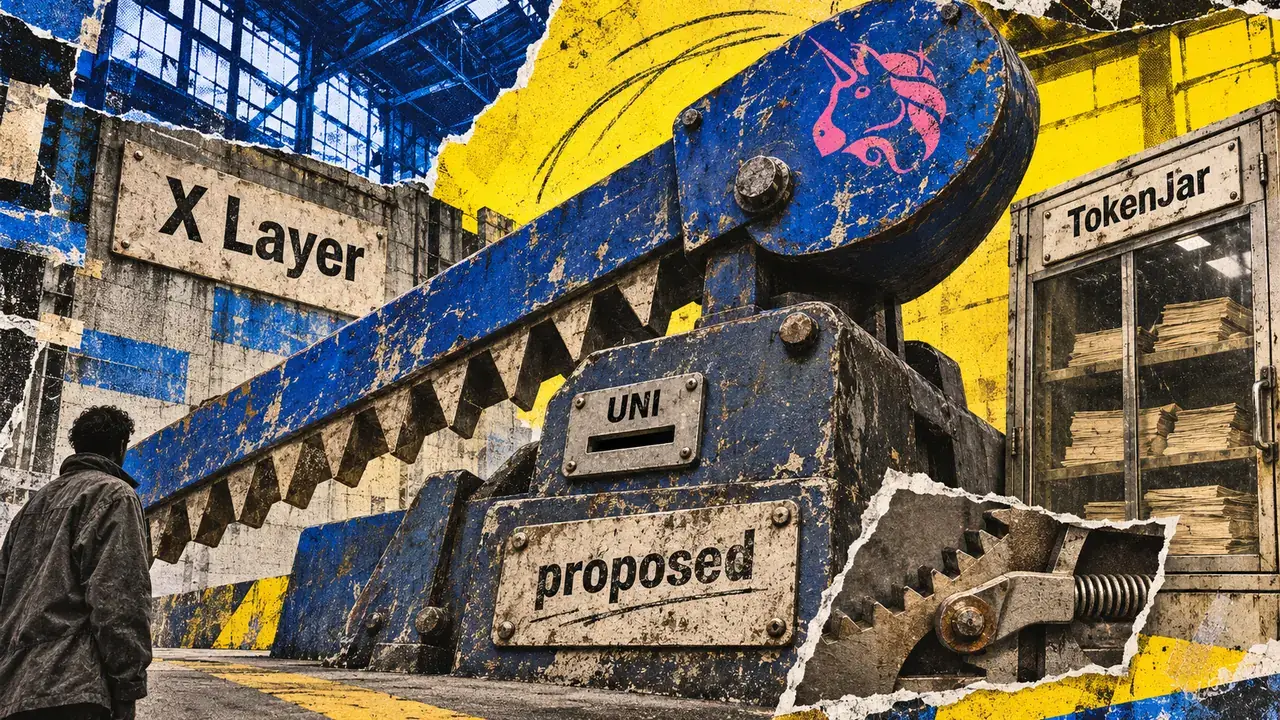
In the world of decentralized finance, code is supposedly law. But as any founder who has ever shipped a product knows, laws often have loopholes that only appear once you scale. Uniswap, the heavyweight champion of decentralized exchanges, is currently staring at a $300,000 problem that highlights the friction between automated smart contracts and the reality of gas prices.
The issue centers on a specific mechanism designed to handle fees and burn tokens. Right now, there is roughly $300,000 worth of fees sitting in a sort of limbo. These are assets collected by the protocol that are meant to be converted and processed, but the math simply isn't working anymore. The cost to trigger the process is higher than the reward, leaving a pile of capital stranded on the sidelines.
The Mechanics of Failure
To understand why this matters for builders, we have to look at how these fees are handled. In its current state, the protocol relies on a system where external participants are incentivized to trigger the conversion of these fees into UNI tokens for burning. It is a neat, decentralized way to manage protocol health without a central admin. You offer a small bounty, someone pays the gas, the protocol stays clean, and tokens get burned to provide value to the ecosystem.
However, the fee tiers on certain pools are so small that the bounty doesn't cover the transaction costs on Ethereum. We are seeing a classic economic dead zone. Because the gas costs to execute the burn outweigh the potential profit for the bot or user doing the work, the fees just sit there. It is the digital equivalent of a vending machine that only accepts pennies but costs a dollar in gas to drive to and collect.
Why Builders Should Care
For those of us building in the space, this is a cautionary tale about "automated" systems. Automation is never truly free; it relies on an underlying economic assumption. In Uniswap's case, the assumption was that gas would remain low enough or the fees large enough to make the cycle self-sustaining. When that assumption broke, the feature stalled.
This isn't just a technical glitch. It’s a design flaw in how we perceive protocol sustainability. If your protocol requires manual or incentivized triggers to function, you aren't really building a perpetual motion machine. You are building a machine that requires a constant supply of cheap energy to stay relevant. When that energy—in this case, block space—becomes expensive, the machine breaks.
The Proposed Auction Solution
The community is now looking at a proposal to change the parameters of these auctions. The goal is to raise the UNI payment required to claim these fees, essentially sweetening the pot to ensure someone actually performs the task. By adjusting the auction dynamics, Uniswap hopes to clear the backlog and get the burning mechanism back on track.
It’s a pragmatic fix, but it reveals a deeper truth: decentralized governance is often just reactive maintenance. We talk a lot about "set it and forget it" protocols, but the reality is that market conditions change faster than smart contracts can adapt. As a founder, you have to ask yourself if your protocol can survive a 10x spike in gas or a 50% drop in volume without requiring a governance vote to stay functional.
The Illusion of Deflation
There is also the matter of tokenomics. The fee-burn mechanism is a primary value driver for the UNI token. When $300,000 is stranded, the deflationary pressure stops. For investors, this looks like a broken promise. For builders, it’s a reminder that your token’s utility and its economic engine are only as strong as the code's ability to execute in adverse conditions.
We see a lot of hype around "burns" and "buybacks" in crypto marketing. But if the execution of those burns is gated by high friction, they are effectively meaningless. If you are building a system that relies on burning tokens to maintain price or supply, the mechanism needs to be gas-agnostic or at least robust enough to handle the inevitable volatility of the network it lives on.
A Founder’s Perspective on Technical Debt
What Uniswap is dealing with here is a form of technical debt. It’s not that the code is bad; it’s that the environment evolved beyond the code’s original scope. When V3 was launched, the landscape of Ethereum was different. Today, with the rise of L2s and fluctuating mainnet fees, those original parameters are showing their age.
- Scalability isn't just about speed: It is about economic resilience. If your core features fail because a transaction costs $50 instead of $5, you haven't scaled.
- Incentives must be dynamic: Static bounties are a recipe for failure. Any protocol that uses incentives to drive behavior needs those incentives to be linked to real-time market data.
- Simplicity wins: The more steps you have between "fee collected" and "value delivered," the more points of failure you introduce.
Complexity is the enemy of decentralization. The more moving parts your protocol has, the more likely one of them is to get stuck in the gears of the market.
The Path Forward
The fix being discussed—an auction adjustment—is a band-aid. It will clear the $300,000, and it will probably work for a while. But the real lesson here is for the next generation of builders. We need to move away from rigid, hard-coded economic parameters and toward systems that can autonomously adjust to the cost of their own existence.
Uniswap will be fine. They have the brand, the liquidity, and the community to vote through these changes. But smaller projects might not have that luxury. If you are building a DEX or a yield aggregator today, you should be looking at this situation and asking: "What happens to my protocol if gas stays high for six months?"
The $300,000 is a small price to pay for a very loud wake-up call. Decentralization doesn't mean a lack of management; it means building systems that are robust enough to manage themselves even when the math gets ugly. We are still learning how to build these machines, and Uniswap’s current struggle is just another chapter in that manual.
The Takeaway
Do not assume your automated processes will always be profitable for the participants who run them. Build with the expectation that the underlying network will become more expensive and more congested. If your protocol’s value flow relies on cheap gas, you haven't built a decentralized future—you've built a fair-weather tool that will break exactly when your users need it most.
Read the original at CryptoSlate →