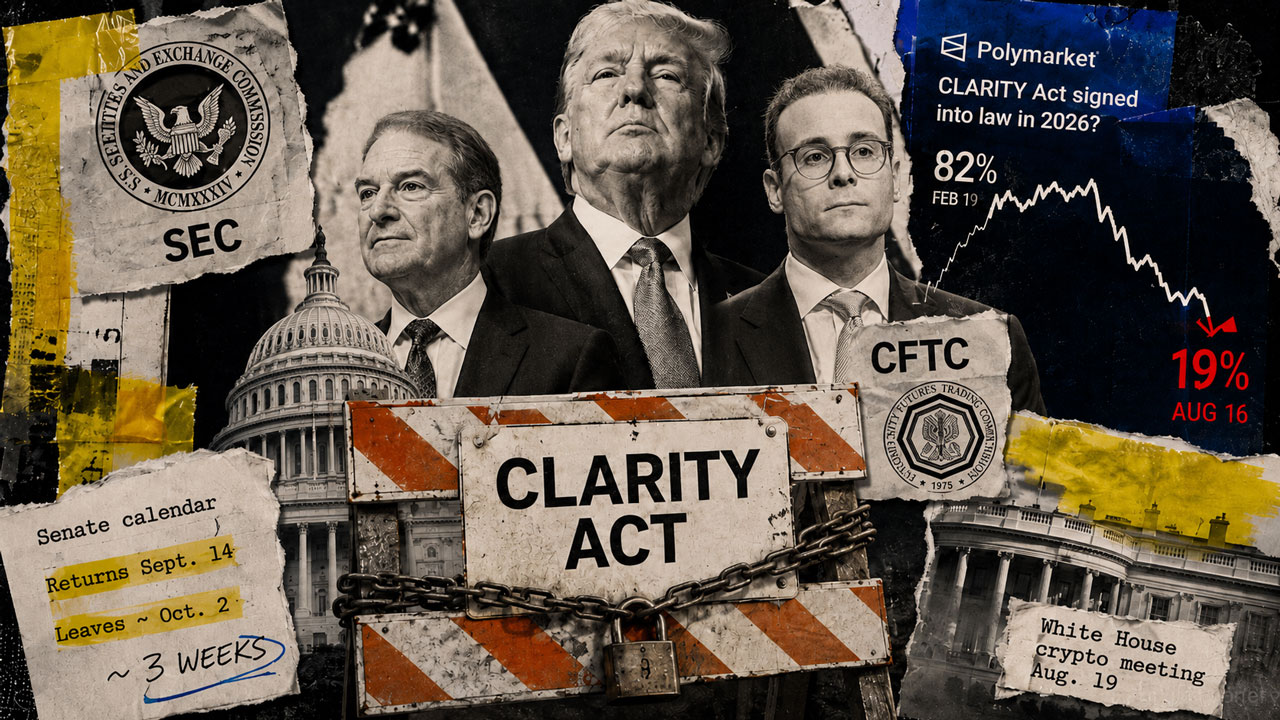
Donald Trump is summoning the crypto heavyweights to the White House next week. We are talking about the usual suspects: Coinbase, Ripple, Andreessen Horowitz, and a few prediction market founders. It is the kind of meeting that generates a thousand headlines but rarely produces a single line of working code.
For those of us actually building products, the timing is hard to ignore. This gathering is happening right as the CLARITY Act—the industry’s big hope for stablecoin regulation—is effectively dying on the vine. Current estimates put its chances of passing this year at a dismal 10%. When the legislative path hits a wall, the political theater usually ramps up. That is where we are right now.
The Policy Void
The CLARITY Act was supposed to be the adult in the room. It aimed to provide a federal framework for stablecoins, giving developers a clear set of rules for how to handle reserves and issuance without looking over their shoulders at the SEC every five minutes. It was the kind of boring, functional policy that helps founders scale without the constant threat of a Wells Notice.
But the odds of it passing have collapsed. Washington is distracted, the election cycle is in full swing, and the appetite for nuanced financial tech policy has vanished. In its place, we get high-profile meetings. Trump, along with heads of the SEC and CFTC, wants to sit down with the suits to discuss the future of digital assets. While it is better than being ignored, we have to ask what this actually does for the person writing a smart contract in their garage.
The Founder’s Dilemma
If you are building in crypto or AI, you have to look at these meetings with a healthy dose of skepticism. The executives attending—the Brian Armstrongs and Brad Garlinghouses of the world—are playing a different game than we are. They are playing the institutional survival game. They need a seat at the table to protect massive balance sheets and existing market share.
For the rest of us, the collapse of the CLARITY Act means the regulatory fog isn’t lifting anytime soon. We are still stuck in a world where "regulation by enforcement" is the standard operating procedure. A photo op at the White House doesn't change the fact that the underlying rules of the game are still being written by lawsuits rather than lawmakers.
Why Prediction Markets Are at the Table
Interestingly, prediction market executives are also on the guest list. This makes sense. Polymarket and its peers have become the breakout stars of this election cycle. They have provided more accurate data than most traditional polling outlets, and they have done it by using the exact technology the government has spent years trying to throttle. Including them in the meeting is a quiet admission that the tech works, even if the regulators don’t like how it’s being used.
What It Means for Your Roadmap
When policy odds drop to 10%, it should signal a shift in your development strategy. You cannot build a business model that relies on the government suddenly becoming rational. If your startup needs the CLARITY Act to exist, you are probably in trouble. The builders who survive this cycle are the ones who are architecting for resilience, not just compliance with laws that don't exist yet.
- Focus on utility over speculation: The more your tool looks like a functional piece of software and less like a financial instrument, the safer you are.
- Assume the status quo: Don't bet on a post-election miracle. Build as if the current regulatory environment is here to stay for the next four years.
- Watch the narrative, but follow the code: Politicians will say whatever helps them win the next news cycle. The only thing that matters is what actually gets signed into law.
"Policy is a lagging indicator of technological reality. By the time the government understands what we are building, the industry has usually already moved on to the next problem."
The reality is that these meetings are often more about fundraising and optics than they are about technical progress. Trump has pivoted toward a pro-crypto stance because he sees an energized, well-funded voter base. The crypto leaders are attending because they have to. None of this guarantees that the friction of building in the US will get any easier next month.
Looking Ahead
As we watch the updates from this meeting trickle out next week, look past the quotes about "innovation" and "leadership." Look for specific commitments regarding the SEC's jurisdictional reach or concrete timelines for legislative reintroductions. If those aren't there, it's just another networking event with better security.
The collapse of the CLARITY Act is a reminder that the path to a decentralized future is rarely linear. It is messy, political, and often incredibly slow. As builders, our job isn't to wait for the White House to give us permission. Our job is to build tools that are so useful that they eventually force the hand of the regulators.
Don’t let the headlines distract you from the terminal. The code you write today is more important than the meeting happening in D.C. next week. If the law won’t provide clarity, we have to provide it ourselves through transparency and better products.
Read the original at CryptoSlate →