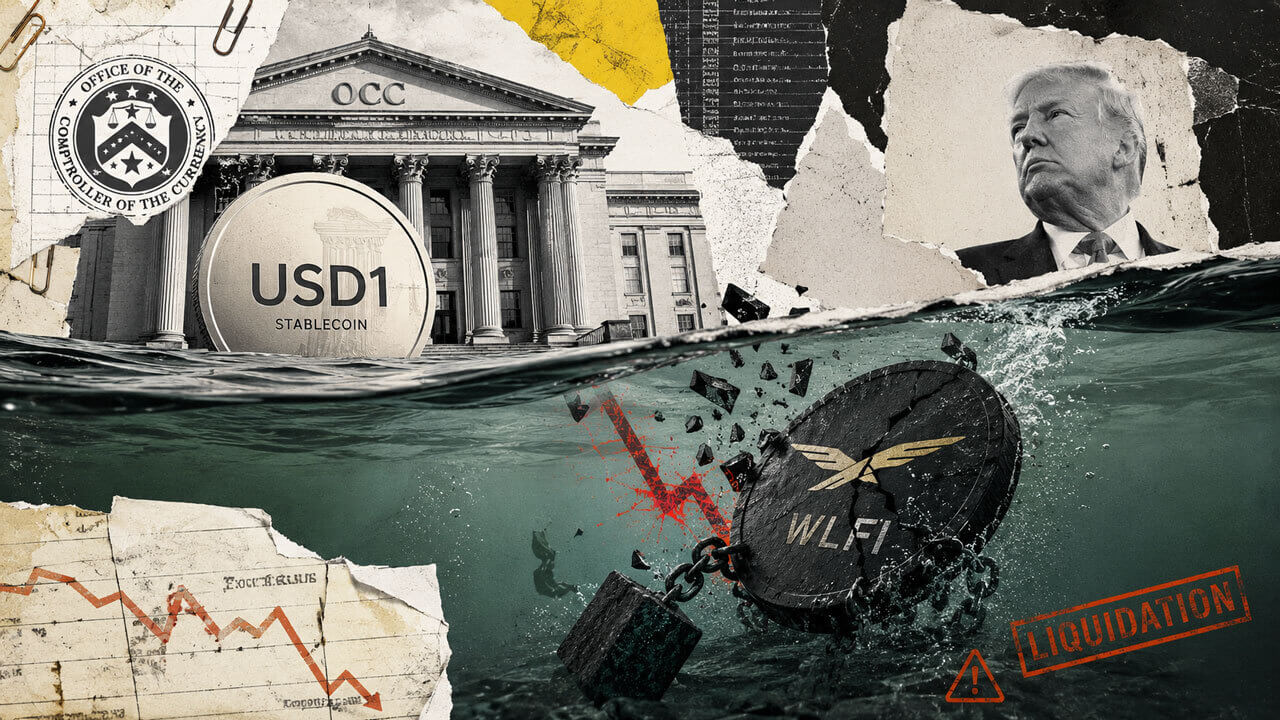
We are watching a surreal collision of old-world regulatory stamps and new-world liquidation risks. World Liberty Financial, the DeFi project tied to the Trump family, just secured preliminary conditional approval from the Office of the Comptroller of the Currency (OCC) to charter a national trust bank. This is a massive administrative win, yet the project is simultaneously nursing a $112 million debt position that is uncomfortably close to being wiped out by market volatility.
As a founder, you have to appreciate the irony. Most of us spend years begging for a meeting with the OCC. This team got a 'yes' while their primary on-chain activity looks like a high-stakes gamble. The move aims to turn World Liberty Trust into the primary engine for their USD1 stablecoin, bringing the issuance and the reserves under a federal umbrella. It is a play for legitimacy in a sector that is usually defined by its lack of it.
The Institutional Pivot
The OCC approval isn't just about optics; it is about infrastructure. By establishing World Liberty Trust Company, the project is attempting to bypass the traditional banking bottlenecks that kill most crypto startups. If you own the bank that holds the reserves for your stablecoin, you have effectively vertically integrated your financial stack. This eliminates the risk of a third-party bank suddenly deciding your business is 'high risk' and freezing your accounts.
For the broader crypto industry, this sets a confusing precedent. Usually, the OCC is a fortress. Getting a trust charter requires rigorous proof of solvency, compliance, and risk management. Seeing a project with a very public, very volatile debt position get the green light suggests that the regulatory climate is shifting faster than the code is being written. It signals that 'who' you are might be starting to matter as much as 'what' your smart contracts do.
The Liquidation Sword of Damocles
While the lawyers celebrate the OCC news, the developers and risk managers are likely sweating. The project has a massive position on Aave—around $112 million—backed by collateral that isn't exactly stable. In the DeFi world, your federal charter doesn't mean anything to a smart contract. If the price of the collateral drops below a certain threshold, the code executes a liquidation. It doesn't call a lawyer. It doesn't wait for a court order. It just takes the money.
This is the fundamental tension of World Liberty Financial. They are playing the institutional game and the degen game at the exact same time. It creates a strange situation where a federally recognized trust company could essentially be born out of a project that just suffered a massive on-chain margin call. For builders, this is a reminder that regulatory wins do not equal operational safety. You can have the blessing of the federal government and still get wrecked by a 20% price swing.
What This Means for Stablecoin Issuance
The goal for USD1 is to reach a $4 billion market cap. To get there, you need trust. The OCC charter is the ultimate trust signal for traditional investors who are terrified of USDT or USDC. By moving the reserves into a federally regulated trust, World Liberty is trying to position USD1 as the 'safe' alternative. They are betting that the market wants a stablecoin that feels more like a treasury bond and less like a Caribbean hedge fund.
However, the execution matters. If the reserves are managed with the same aggressive leverage seen in their current Aave positions, the 'safety' of the OCC charter is just a facade. A bank charter protects you from the SEC; it doesn't protect you from bad math. The bridge between federal oversight and decentralized liquidity is still being built, and this project is the primary test case.
The Founder's Perspective
If you are building in this space, do not look at this as a roadmap for your own project unless you have significant political capital. The path to an OCC charter is usually paved with years of audits and millions in legal fees. What we are seeing here is an outlier. But the underlying strategy—vertical integration—is something every founder should study.
The real takeaway is that the 'gray area' of crypto is shrinking. You are either going full permissionless and risking the wrath of regulators, or you are going full institutional and dealing with the OCC. Trying to do both, as World Liberty is doing, creates a bizarre hybrid. It is a project that wants the freedom of DeFi with the protection of a national bank. It is ambitious, but it is also fragile.
The Technical Risk
We often talk about 'regulatory risk' as the big bogeyman, but for World Liberty, the technical risk is currently higher. The $112 million position is a giant target. In DeFi, large positions are often hunted by bots looking to trigger liquidations. Having your name on a federal charter doesn't make your smart contracts any less vulnerable to market manipulation or flash crashes. If anything, the high profile of the project makes it a more attractive target for those looking to prove that DeFi is still the Wild West.
Takeaway for Builders
The lesson here is simple: Compliance is a tool, not a shield. You can win the regulatory battle and still lose the economic war. If you are building a protocol, your first priority is the robustness of your internal economics. A federal charter won't save a broken liquidity model. World Liberty Financial is trying to prove that you can bridge the gap between DC and DeFi, but until they stabilize that nine-figure debt, the bridge looks pretty shaky. Watch the liquidations, not just the headlines.
Read the original at CryptoSlate →