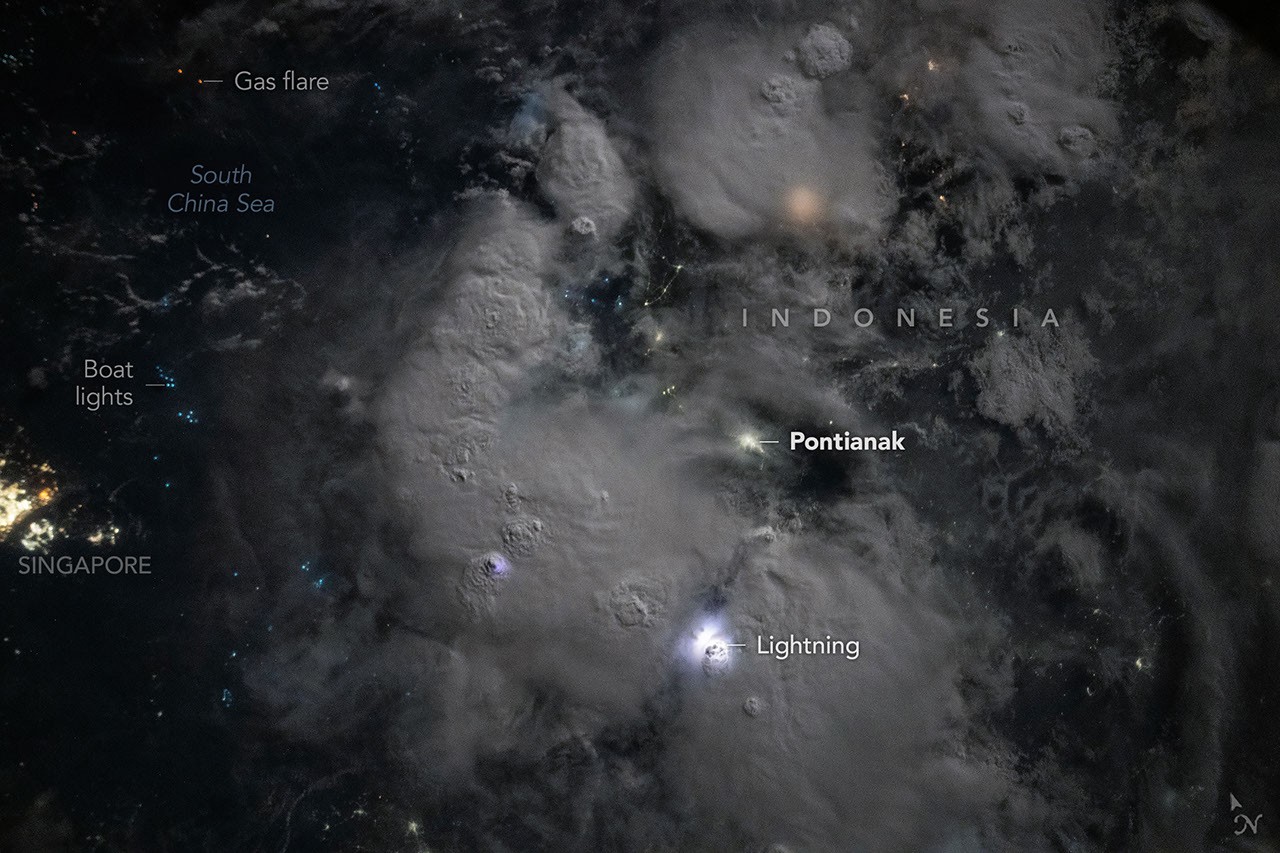
When you spend enough time looking at how systems interact, you start to notice that the view from the ground is usually wrong. Down here, lightning is a violent, vertical event. It hits a tree, it shakes a house, or it shorts out a power grid. But if you look at the recent data and photography coming off the International Space Station, you realize that the real action is horizontal. It is a massive, interconnected game of catch played between clouds.
The View from 250 Miles Up
NASA astronauts frequently talk about the internal fireworks display of the Earth's atmosphere. From the ISS, lightning isn't just a flash; it is a sprawling, rhythmic pulse that travels across the top of the cloud deck. For a founder or a builder, there is a lesson here about perspective. When you are inside the storm, everything feels like a localized crisis. When you zoom out, you see the energy transfer for what it actually is: a system seeking equilibrium.
We often treat technological breakthroughs like these vertical lightning strikes. We think a new LLM release or a sudden market pump is an isolated event that hits the ground and changes everything. In reality, the most significant movements are the ones happening cloud-to-cloud. It is the silent transfer of data, capital, and energy between adjacent systems that builds the real storm. By the time it hits the ground, the story is already over.
Why Builders Should Care About Atmospheric Data
You might wonder why a crypto and AI analyst is talking about NASA weather observations. It is because the way we monitor these electrical discharges is becoming a blueprint for how we handle high-frequency data in decentralized networks. Monitoring lightning from space requires sensors that can filter out the noise of the sun's reflection while capturing events that last only milliseconds. That is a hardware and software challenge that parallels the work being done in edge computing and real-time AI inference.
When we look at the Earth's electrical system, we are looking at a massive, unmanaged network. It has no central controller, yet it maintains a global balance. For those building decentralized infrastructure, this is the ultimate reference architecture. The energy doesn't just disappear; it moves. If a cloud gets too saturated, it offloads to the neighbor. If the neighbor can't take it, it finds the path of least resistance to the ground.
The Skeptic's Take on Space Observations
I am naturally skeptical of the 'wonder and awe' narrative often pushed by government agencies. It is easy to get lost in the beauty of a photo taken from the ISS and forget the massive tax burden required to put that camera there. However, the utility here isn't in the aesthetics. It is in the mapping of energy patterns. Understanding where these discharges happen helps us predict turbulence, protect power grids, and improve the reliability of satellite communications.
In the tech world, we have a habit of ignoring the 'atmosphere' of our industry. We focus on the apps (the ground) and the protocols (the clouds), but we rarely look at the discharge events that happen between them. When a major protocol fails and liquidity moves to a competitor, that is a cloud-to-cloud discharge. If you aren't looking at the sensors, you just see a flash and wonder where the money went.
Infrastructure is the Only Real Story
Every time NASA releases a new set of observations about atmospheric phenomena, I look at the sensors first. The Geostationary Lightning Mapper (GLM) and the instruments on the ISS are masterpieces of signal processing. They have to differentiate between a flickering city light and a massive electrical discharge through a layer of thick water vapor.
As builders, our job is to create sensors for our own ecosystems. If you are building an AI startup, your sensor is your data pipeline. If you are building in DeFi, your sensor is your mempool monitor. If your sensors aren't sharp enough to see the 'fireworks' before they hit the ground, you are operating at a disadvantage. You are reacting to the thunder rather than tracking the light.
- Perspective: The higher you go, the more the chaos looks like a pattern.
- Energy Transfer: Nothing stays localized for long; energy always seeks a neighboring node.
- Noise Filtration: Success is defined by your ability to ignore the sun and see the spark.
The Founder's Takeaway
Don't get distracted by the noise on the ground. The big moves—the ones that actually shift the landscape—are usually happening at a level that most people aren't even watching. NASA's view of lightning reminds us that the most impressive displays of power are often those that never even touch the earth. They stay in the system, moving between clouds, building the potential for the next big shift.
Build your systems to handle the discharge. Whether you are managing server load or capital flow, expect the energy to move horizontally. If you only prepare for the vertical strike, you will be blinded by the flash you never saw coming from the side.
The sky isn't falling; it is just communicating. Our job is to learn how to read the signals before the storm clears.
Read the original at NASA Breaking News →