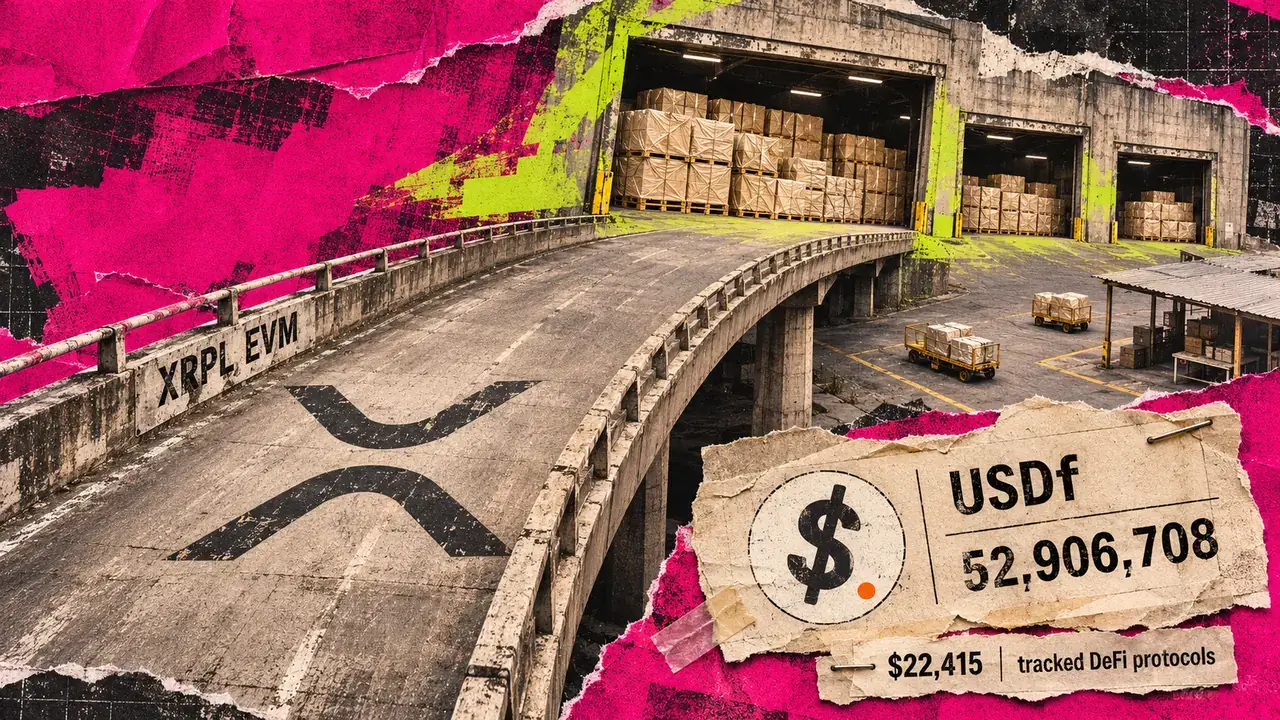
We talk a lot about liquidity in this industry, but we rarely talk about the quality of that liquidity. On paper, a project can look like a unicorn. On-chain, it can look like an abandoned parking lot. The latest data coming off the XRP Ledger’s EVM-compatible sidechain is a textbook example of why builders shouldn't trust top-line metrics without looking at the distribution.
The Ghost in the Machine
Recent snapshots of the XRP sidechain reveal a staggering concentration of wealth. Specifically, about $52.7 million worth of USDf—a wrapped stablecoin—is currently sitting in just three individual wallets. That represents the vast majority of the asset's supply on this particular chain. If this were a vibrant ecosystem, you would expect to see that capital flowing through decentralized exchanges, lending protocols, or even minting native assets. Instead, it is just sitting there.
When you look at the Total Value Locked (TVL) in the chain's actual DeFi protocols, the numbers fall off a cliff. We are talking about roughly $22,415 in tracked TVL. To put that in perspective, there are individual hobbyist developers on Solana or Base with more liquidity in their test projects than this entire institutional-leaning sidechain has in its active DeFi layer.
The Reality of Incentivized Liquidity
For founders, this is a cautionary tale about "phantom growth." It is easy to bridge assets to a new chain to claim a stake or participate in a snapshot. It is much harder to convince people to actually use those assets. When 99% of the capital on a chain is static, you don't have an ecosystem; you have a storage facility.
The lack of trading volume is the real red flag. If people were bullish on the utility of the XRP sidechain, we would see XRP buying demand or at least some basic arbitrage between the mainnet and the EVM layer. We aren't seeing that. The demand for the native token to fuel transactions is negligible because, frankly, there aren't enough transactions to matter.
Why Builders Should Care
If you are a developer looking for a place to deploy, you have to ask yourself: who am I building for? If the wealth on a chain is concentrated in three wallets, you are essentially building a product for three customers. Unless you have a direct line to those whales and a guarantee they will use your protocol, you are shouting into a void.
We see this cycle constantly. A legacy chain launches an EVM-compatible layer to attract the Ethereum developer crowd. They provide some bridging infrastructure and maybe some grants. The numbers spike initially as insiders or large holders move funds over to mark their territory. But if there isn't a unique value proposition—something you can do here that you can't do on a dozen other L2s—the capital stays parked in a wallet, waiting for an exit or a reward that may never come.
The Liquidity Trap
Concentrated inventory is a double-edged sword. On one hand, it looks good in a press release. On the other, it creates a massive liquidity trap. If one of those three wallets decides to exit, the slippage would be catastrophic because there is no retail or mid-tier liquidity to absorb the move. This is why professional market makers are hesitant to touch these environments. Without a distribution of holders, the risk-to-reward ratio for providing liquidity is broken.
The discrepancy between the $52 million in sitting capital and the $22,000 in active DeFi usage is one of the widest gaps I have seen this year. It suggests a total lack of organic interest from the broader crypto community.
A Founder's Perspective
My advice to anyone looking at these numbers is to ignore the $52 million and focus on the $22,000. That small number represents the actual size of the market on that chain right now. That is the pool of capital that is willing to take a risk, try a new dApp, or provide liquidity to a pool.
Building on a chain with high concentration and low velocity is like opening a gourmet restaurant in a vault. Sure, the vault is full of gold, but the people who own the gold aren't coming in to eat. They are just there to watch their assets.
What Comes Next
For the XRP sidechain to become a viable destination for builders, it needs to solve its distribution problem. It needs a reason for the other 99.9% of the crypto world to bridge over. Until we see that $22,000 TVL start to climb and the wallet concentration start to diffuse, this remains a laboratory experiment rather than a market.
We need to stop celebrating "money on the sidelines" and start valuing "money in the game." In the world of blockchain, if the money isn't moving, it might as well not exist. For now, the XRP sidechain is a quiet place. Too quiet.
Read the original at CryptoSlate →