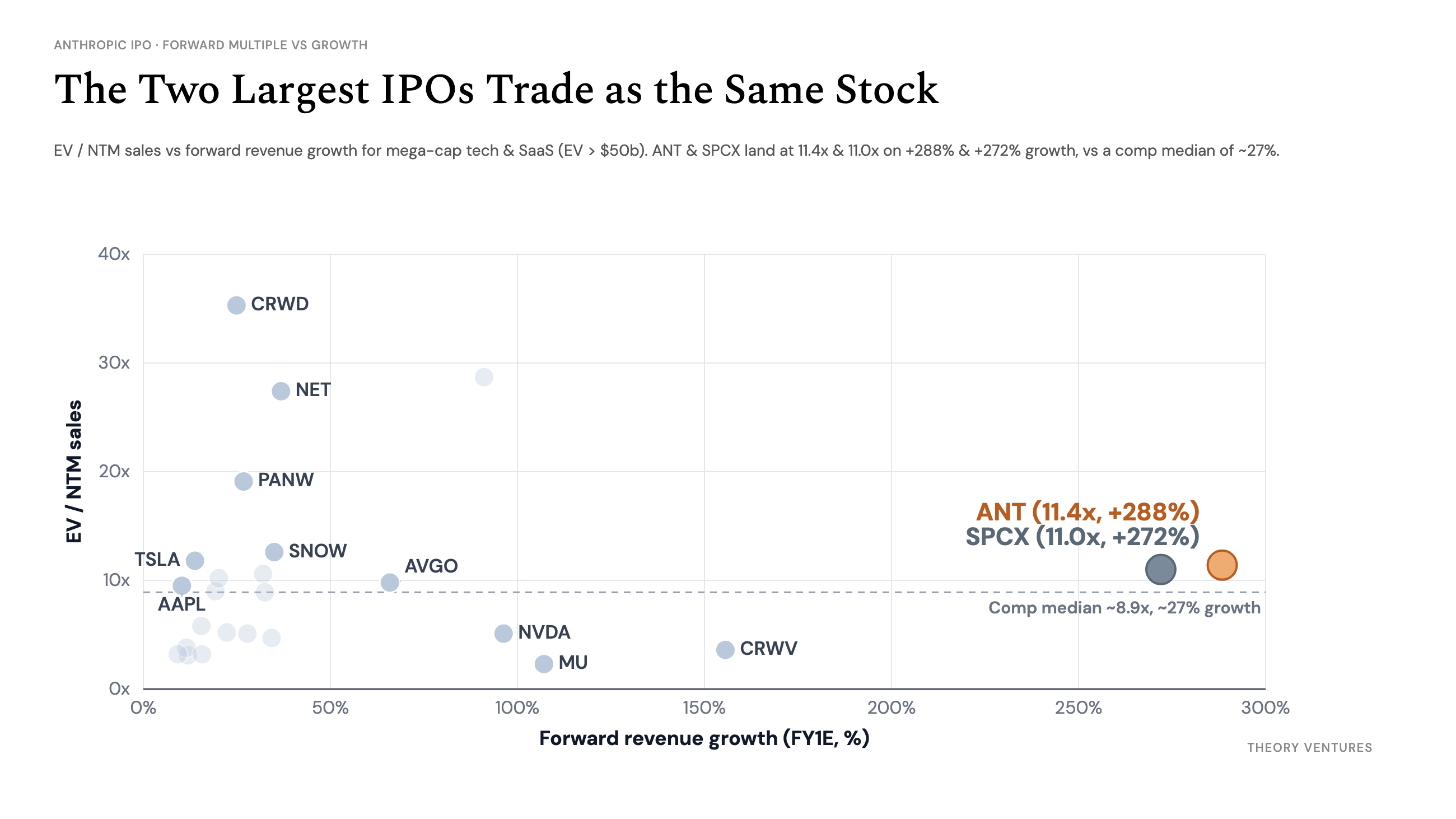
There is a specific kind of gravity that hits founders once they stop being startups and start becoming institutions. We talk a lot about the blitzscaling phase where growth is the only metric that matters, but there is a wall at the end of that hallway. It is the trillion-dollar wall, and recent data suggests it is harder to climb over than we thought.
The Math of the Giants
Look at Anthropic and SpaceX. On paper, these are two of the most exciting companies on the planet. One is building the cognitive infrastructure of the future; the other is making us a multi-planetary species. Their growth rates are staggering. We are looking at projected growth of 288% and 466% respectively. In the early stages of a venture, those numbers would command a valuation multiple that defies logic.
But right now, both are trading at roughly 9.5x their estimated 2027 revenue. If you are a builder in the trenches, this should make you pause. Why is the market treating a rocket company and an AI lab with nearly identical valuation benchmarks despite their wild growth trajectories? The answer is that once you reach a certain scale, the market stops betting on your potential and starts weighing your actual output.
The Multi-Trillion Dollar Ceiling
When a company’s enterprise value crosses that trillion-dollar threshold, public markets change the scorecard. They stop paying for top-line growth. Instead, they anchor to a very tight band of earnings multiples—usually between 20x and 26x. It does not matter if you are inventing AGI or colonizing Mars; if you are that big, the market wants to see the cash.
This is a sobering reality for AI founders who believe that scale alone will keep their valuations soaring. We have been living in a bubble of "growth at all costs" for so long that we forgot the endgame of the public markets is always utility and profit. The 10x revenue wall is real, and it is the point where the narrative meets the balance sheet.
What This Means for Crypto and AI Builders
If you are building in the crypto or AI space right now, you are likely chasing that exponential curve. But the lesson from the Anthropic/SpaceX comparison is about the transition from a growth story to a margin story. Most AI startups today are burning massive amounts of capital on compute, hoping that the sheer velocity of their user acquisition will eventually justify their burn.
The "10x Wall" suggests that there is a limit to how much the market will subsidize that burn. Even if you become the next Nvidia or Microsoft, you eventually hit a point where 300% growth doesn't move the needle on your valuation multiple anymore. At that stage, you are judged by your efficiency.
- Efficiency is the new growth: Founders need to stop obsessing over the next round's valuation and start looking at their long-term unit economics.
- Capital intensity matters: SpaceX has massive hardware costs; Anthropic has massive compute costs. The market is pricing them similarly because it views both as capital-intensive utilities.
- The Narrative ends at $1T: You can tell a story to get to $10 billion. You need a cash machine to stay at $1 trillion.
The Skeptical Founder’s Perspective
I have seen plenty of projects in the Web3 space try to bypass this reality by using tokenomics to manufacture growth. It works for a while. You can pump your FDV (Fully Diluted Valuation) to billions with low float and high incentives. But the public market—the real market where the big institutional money lives—is not fooled by these mechanics forever.
The convergence of Anthropic and SpaceX at the same revenue multiple is a signal that the market is becoming more disciplined. It is saying that at a certain size, you are just a business. You are no longer a miracle. If you are building a protocol or an AI agent platform, you should be asking: "How do I survive when the market stops caring about my growth rate?"
The market eventually stops paying for what you might do and starts paying for what you actually kept.
The Infrastructure Trap
Both companies mentioned are infrastructure plays. One provides the lift; the other provides the logic. There is a tendency for builders to think that being the "base layer" gives them a permanent pass on valuation metrics. But infrastructure is notoriously expensive to maintain.
As AI models become a commodity and space flight becomes more routine, the margins will compress. The market knows this. That is why the multiples are anchoring. They are factoring in the eventual decline in growth and the increase in competition. For those of us building tools on top of these giants, this is actually good news. It means the foundational layers are stabilizing, but for the giants themselves, it means the honeymoon is over.
Takeaway for the Next Cohort
Don't be blinded by the massive numbers you see in the headlines. A $100 billion valuation sounds invincible, but if it is built on a 50x multiple that is destined to revert to 20x, you are actually sitting on a shrinking asset. The goal for the modern builder should be to build a business that is comfortable at a 20x earnings multiple. If you can’t make the math work there, you aren't building a company; you're building a bubble.
The 10x Wall is not a sign of failure; it is a sign of maturity. It’s the market’s way of telling the visionaries that it’s time to grow up and show the money.
Read the original at Tomasz Tunguz →