We have spent years obsessing over throughput. If you have been in the crypto space for more than a minute, you have seen the marketing wars. One chain claims ten thousand transactions per second, another claims a hundred thousand, and then a third claims they have solved the trilemma entirely. Usually, these numbers are generated in a laboratory setting with no actual users and no real-world friction. They are vanity metrics for VCs.
But the conversation is changing because the users are changing. We aren't just talking about humans clicking buttons on a wallet anymore. We are talking about AI agents. And AI agents do not think, move, or transact like people do. They require a level of frequency and volume that would break most current blockchain architectures. This is the context we need to look at Sui’s recent stress test, where they clocked a massive 40.6 million transactions per second.
The Shift to Off-Chain Tunnels
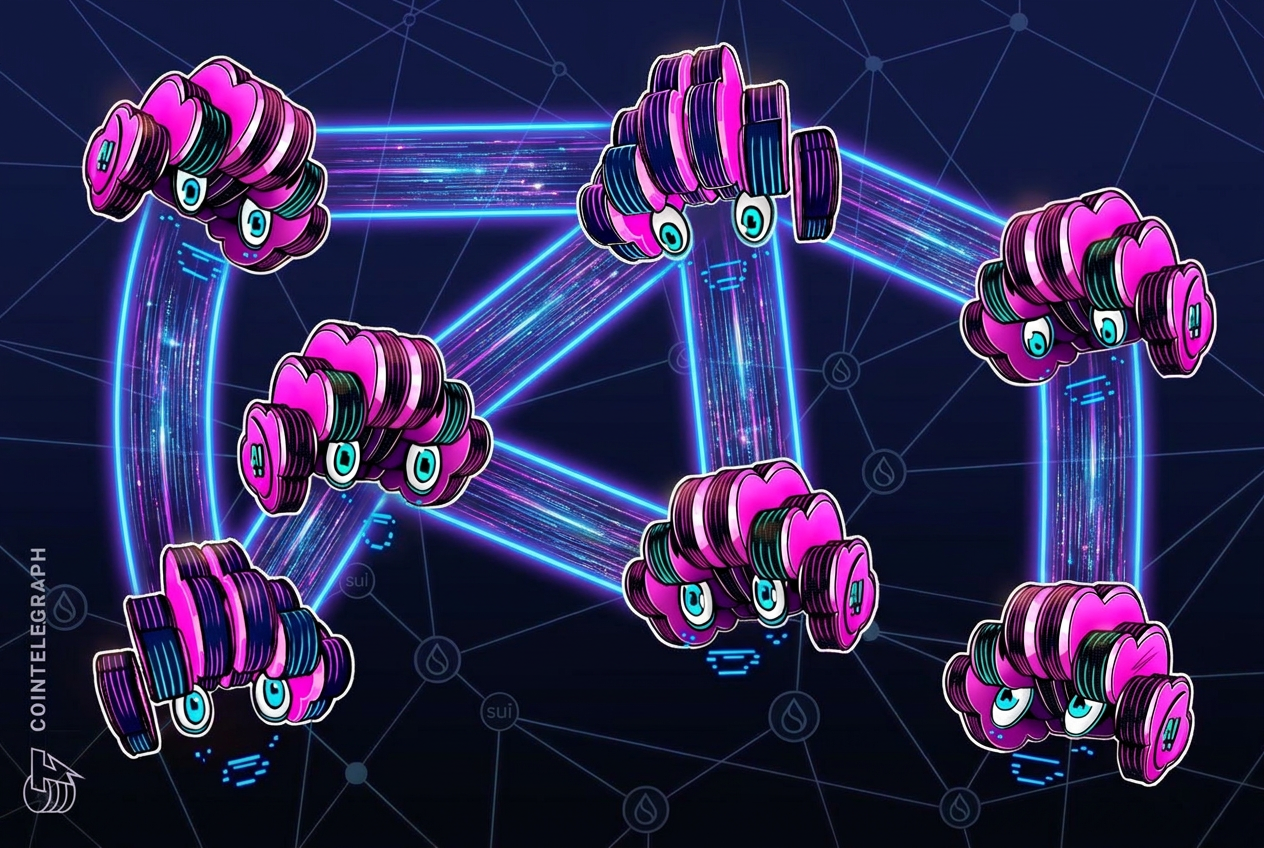
The headline number is 40 million, which sounds like total science fiction. However, the mechanism here is what actually matters for builders. This wasn't 40 million transactions hitting the global ledger at once. That would be a nightmare for state bloat and synchronization. Instead, Sui is utilizing what they call programmable off-chain tunnels.
Think of these tunnels as a private, high-speed lane. If two AI agents need to exchange data or micro-payments a thousand times a second to complete a task, they don't necessarily need to tell the whole world about every single one of those micro-steps in real time. They need a secure environment where they can operate at the speed of compute, not the speed of global consensus.
For a founder, this is a pragmatic admission. We have finally realized that not everything needs to be on-chain forever, but everything needs to be verifiable. These tunnels allow for that high-frequency interaction while maintaining the security guarantees of the underlying Layer 1. It is a hybrid approach that feels much more like how modern web infrastructure actually works.
Why AI Needs This Speed
Why do we even need 40 million TPS? If you are building a DeFi protocol for humans, you don't. Humans are slow. Even the most aggressive high-frequency traders are limited by the physical realities of order books and liquidity. But AI agents are different. An AI agent might be querying a model, verifying a data source, and executing a micro-transaction all in the span of a few milliseconds.
If you are building an autonomous agent economy, the bottleneck is latency. If an agent has to wait three seconds for a block to confirm before it can take the next step in its logic chain, the agent becomes useless for real-time applications. The goal of these tunnels is to remove the friction of the "wait state." By moving these interactions into a programmable off-chain environment, Sui is trying to create a sandbox where AI can actually behave like software rather than a slow-motion accountant.
The Reality of the Stress Test
It is important to stay grounded here. A stress test is a controlled environment. The 40.6 million TPS milestone was achieved during a specific simulation designed to test these tunnels. It does not mean the Sui mainnet is currently processing that volume, nor does it mean it could handle that volume if it were all directed at a single liquidity pool.
What it does prove is that the pipe is big enough. For developers, the concern is usually: "Will I outgrow this platform?" If you are building an AI-driven mesh network or a massive multi-agent system, you need to know that the infrastructure won't be the thing that kills your product. This test is a signal to builders that the ceiling is much higher than we previously thought.
Infrastructure for the Agentic Web
I have talked before about the "Agentic Web." This is the idea that the next phase of the internet isn't just websites we visit, but a series of autonomous services that negotiate with each other on our behalf. In that world, the currency isn't just money; it is also compute and data. If an AI agent needs to buy a fraction of a cent worth of GPU time from another agent, the transaction cost and time must be near zero.
Sui’s approach suggests they are positioning themselves as the settlement layer for these interactions. By using their object-centric model, they can keep these off-chain tunnels organized. Because Sui treats data as objects rather than just accounts with balances, it is easier to track the state of an AI agent as it moves through these tunnels.
A Skeptical Take on the Numbers
As much as I like the technical direction, we have to be careful with these massive numbers. The industry has a bad habit of using TPS as a proxy for quality. 40 million TPS is irrelevant if the developer experience is poor or if the cost of maintaining those tunnels is prohibitive for startups. The real test isn't the peak speed; it is the sustained reliability under chaotic, real-world conditions.
We also have to ask about decentralization. When you move things into off-chain tunnels to gain speed, you are often making a trade-off. Who validates the tunnel? How easy is it to challenge a fraudulent transaction within that tunnel? Sui claims these are programmable and secure, but the devil will be in the implementation details as these tools move from internal testing to public availability.
What This Means for Builders
If you are a founder, don't get distracted by the 40 million number. Instead, look at the capability. The ability to create high-speed, off-chain communication channels that eventually settle to a secure L1 is a powerful tool. It means you can build apps that feel as fast as a centralized server but have the auditability of a blockchain.
My takeaway is this: the infrastructure is finally catching up to the vision. For a long time, we talked about AI and crypto as a dream, but the math didn't work. You couldn't run an AI on a chain that did 15 transactions per second. Now, the math is starting to work. Whether it is Sui or another high-throughput chain, the path forward is clear. We are moving toward a tiered architecture where high-speed work happens in these side-channels, and the main chain acts as the ultimate source of truth.
Stop worrying about the marketing hype and start looking at how you can use these tunnels to let your agents run wild. The bottleneck is no longer the speed of the chain; it is now the imagination of the people building on top of it.
Read the original at Cointelegraph →