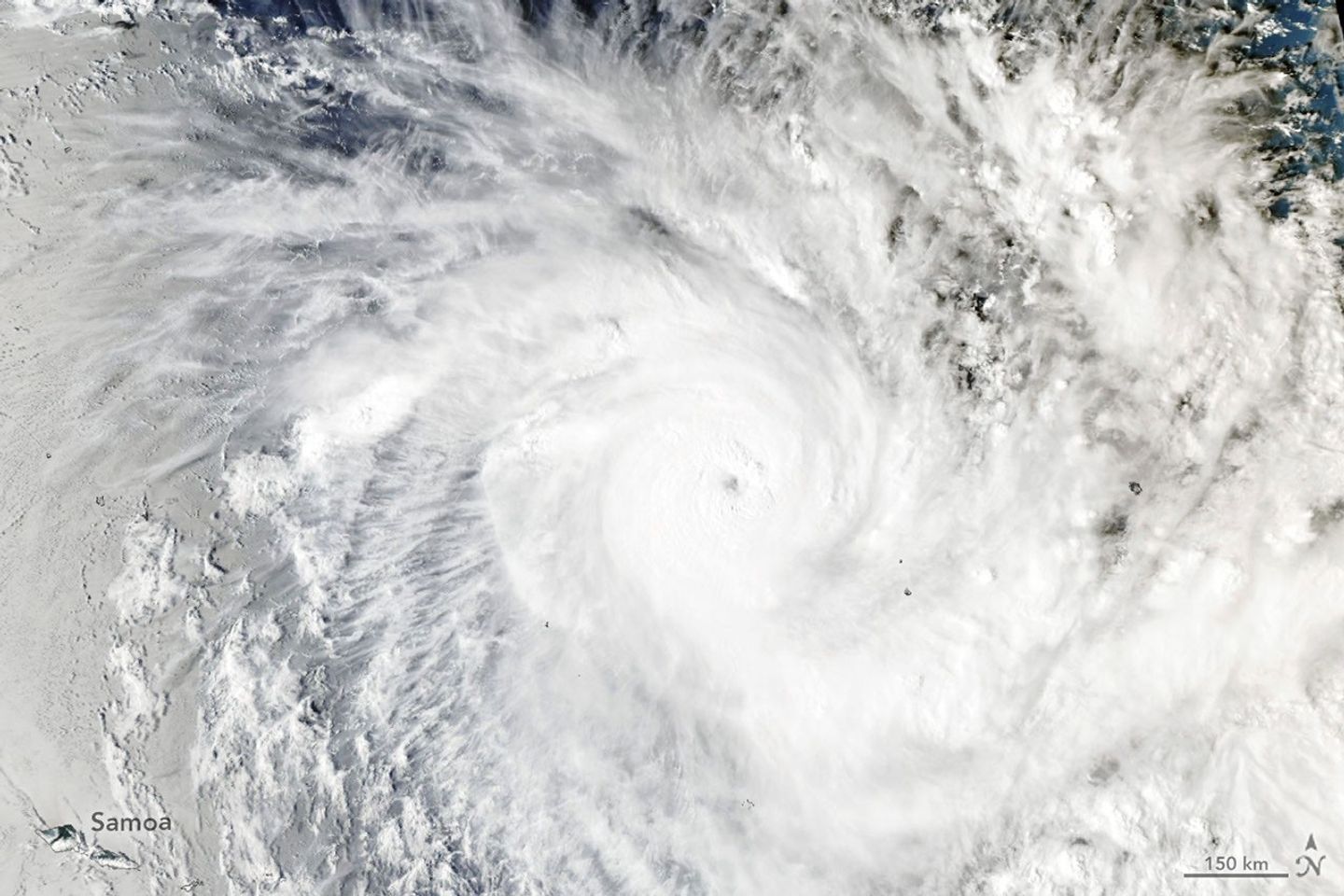
We talk a lot about infrastructure in the digital sense, but nature has a way of reminding us that the physical world is the ultimate hard-coded environment. Tropical Cyclone Xavier just ripped through the Southwest Pacific, officially opening a storm season that looks increasingly volatile. For builders in the geospatial and climate tech sectors, this isn't just a news cycle; it is a stress test for the data pipelines we rely on to understand planetary shifts.
The Anatomy of Xavier
Xavier did not just appear out of thin air. It formed in a pocket of the Southwest Pacific that has become a recurring laboratory for atmospheric instability. When we look at the satellite imagery, we see more than just clouds and wind. We see a massive transfer of energy that current modeling struggles to keep up with. The storm reached intensity quickly, fueled by sea surface temperatures that are consistently hovering above historical norms.
From a technical perspective, the formation of Xavier highlights a major gap in real-time data processing. Most of our predictive models are based on historical datasets that are becoming less relevant as outliers become the new baseline. If you are building tools for logistics, agriculture, or insurance, you know that the delta between "predicted path" and "actual impact" is where the risk lives. Xavier widened that gap.
Why Builders Should Care About the Southwest Pacific
The Southwest Pacific is often overlooked in global tech conversations, but it is one of the most critical zones for testing environmental resilience. The geographic fragmentation of the islands combined with extreme weather makes it a high-stakes environment for decentralized communication networks and off-grid power solutions.
- Data Latency: During events like Xavier, localized sensors often fail or go dark. This creates a data vacuum exactly when clarity is needed most.
- Predictive Accuracy: The rapid intensification of these storms suggests that we need to shift from static models to dynamic, AI-driven analysis that incorporates real-time thermal anomalies.
- Supply Chain Fragility: Storms in this basin disrupt shipping lanes that are vital for global hardware components. One cyclone can create a ripple effect that hits a fulfillment center three months later.
The Limits of Observation
We have incredible satellites, like those operated by NASA, that give us stunning visual proof of these storms. But there is a difference between observation and actionable intelligence. As a founder, I look at the imagery of Xavier and see a massive amount of unstructured data. We are very good at taking pictures of the disaster; we are still mediocre at parsing that data into something a local government can use to save lives in a twelve-hour window.
The challenge for the next generation of builders is not just building better sensors, but building better synthesis. We are drowning in telemetry but starving for context. When Xavier hit, the primary concern was not just the wind speed, but the storm surge and the resulting impact on localized infrastructure. If your stack can't translate "high wind" into "likely power outage for Sector 7," you aren't solving the problem yet.
The Hardware Problem
We often ignore the physical hardware required to monitor these events. Buoys, land-based weather stations, and drone arrays are the front lines of climate data. However, these tools are often destroyed by the very events they are meant to measure. This creates a massive opportunity for ruggedized, low-power IoT devices that can survive a Category 3 storm and continue to broadcast over low-earth orbit (LEO) satellite links.
The most reliable network is the one that doesn't rely on a single point of failure. In the middle of a cyclone, your fiber optic cable doesn't matter. Your local cell tower doesn't matter. Only the mesh matters.
A Skeptical Look at 'Climate Intelligence'
There is a lot of noise in the VC space right now regarding "Climate Intelligence" startups. Many of them are just wrappers for existing government APIs. They take the same NASA data that everyone else has, put a fresh UI on it, and call it a proprietary insight. Xavier proves that this approach is insufficient. If your startup is just a dashboard for NOAA data, you are not a climate tech company; you are a data visualizer.
True innovation in this space will come from those who are deploying proprietary sensor networks or developing novel machine learning architectures that can predict intensification before the traditional barometric pressure drops. We need builders who are willing to get their hands dirty in the physical world, not just the cloud.
Takeaway for the Founder Community
The kickoff of the Southwest Pacific storm season is a reminder that the environment is the ultimate arbiter of our systems. If you are building in crypto, you should be looking at how decentralized physical infrastructure networks (DePIN) can provide more resilient weather reporting. If you are building in AI, you should be looking at how to minimize the compute cost of running complex fluid dynamics models so they can be processed closer to the edge.
Xavier was a warning shot. The basin is warming, the storms are getting more erratic, and our current systems are barely holding on. Don't just watch the satellite feed. Look at the gaps in the data that Xavier exposed, and build something that fills them. The most successful companies of the next decade will be the ones that help us navigate a world where the weather is no longer a predictable variable, but a constant, volatile force.
Read the original at NASA Breaking News →