Jensen Huang is playing a high-stakes game of musical chairs with the world’s compute. On one side of the room, you have the Hyperscalers—Amazon, Google, and Microsoft—who are currently NVIDIA’s biggest customers but are secretly building the very tools to kill their dependence on the GPU giant. On the other side, you have the Neoclouds and frontier labs, the scrappy upstarts that need NVIDIA chips to survive but lack the cash to buy them outright.
The Two Halves of the Machine
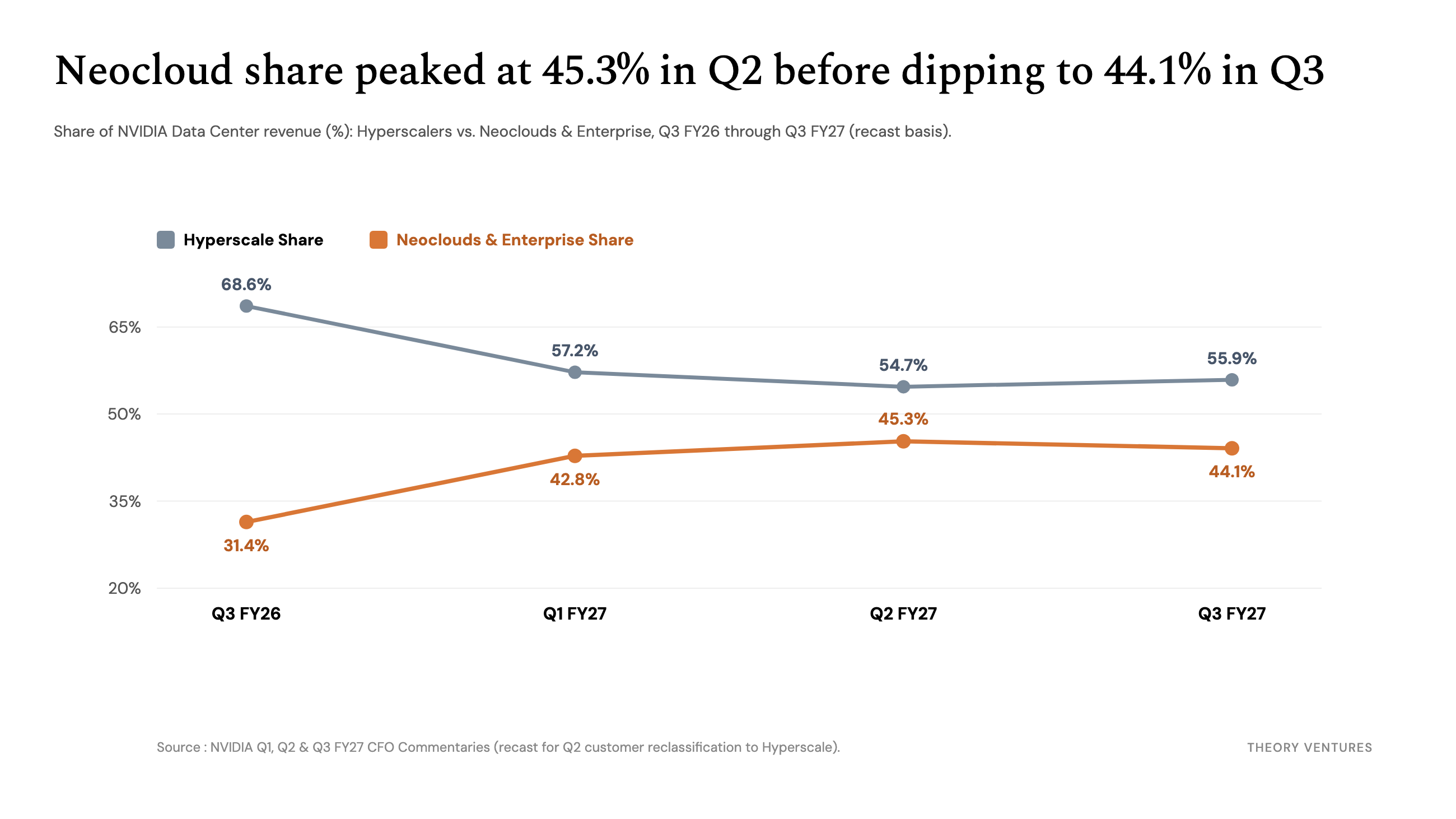
NVIDIA recently reported a staggering $107.6 billion in its Data Center business for the third quarter. To the average observer, it looks like a monopoly at the height of its powers. But if you look at the architecture of that revenue, you see a business divided against itself. Roughly $60.1 billion of that pie comes from the Hyperscalers. These are the giants. The problem? Every dollar they spend on an H100 is a dollar they are desperately trying to move toward their own custom ASICs. They don't want to be NVIDIA customers; they want to be NVIDIA's replacement.
Then you have the other $47.5 billion. This is the non-hyperscaler half, composed of sovereign clouds, frontier AI labs, and the so-called Neoclouds like CoreWeave and Lambda Labs. Unlike the Big Three, these companies aren't building their own silicon. They are pure-play NVIDIA shops. They are the most loyal customers NVIDIA has because they have no Plan B. But loyalty doesn't pay the bills when the bill is $100 billion, and these companies are increasingly relying on NVIDIA’s own balance sheet to keep the lights on.
The Neocloud Squeeze
In the second quarter, this non-hyperscaler segment reached a peak of 45.3% of NVIDIA’s data center revenue. It looked like the dawn of a new era where specialized clouds would decentralize the power of AWS. But by the third quarter, that share dipped to 44.1%. On the surface, a one-percent drop seems like noise. In reality, it signals a strategic tightening of the screws.
NVIDIA has started demanding more aggressive financing terms. When you are the only game in town, you can set the rules, and NVIDIA is currently acting as both the supplier and the bank. They are realizing that while the Neoclouds are their most dedicated partners, they are also the most financially fragile. If a Neocloud can't secure the capital to buy the next generation of Blackwell chips, NVIDIA’s growth hits a wall.
Why Builders Should Care
If you are building an AI startup or a decentralized compute protocol, this shift matters. We are entering a period of forced consolidation. The Hyperscalers are moving toward a vertical stack where they own the chip, the cloud, and the model. This is the ultimate moat. If you are an engineer, you have to ask yourself: am I building for an ecosystem that wants to commoditize my compute, or one that is struggling to stay solvent?
The Neoclouds were supposed to be the great hope for a more open, competitive AI market. They offered better pricing and more availability than the legacy giants. But as NVIDIA tightens the leash on financing, these Neoclouds are being forced to prove they can generate actual cash flow, not just burn through venture capital to stockpile GPUs.
The ASIC Threat is Real
We need to talk about the custom chips coming out of Seattle and Mountain View. Google has the TPU. Amazon has Trainium and Inferentia. Microsoft has Maia. These aren't hobby projects. They are a direct response to the "NVIDIA Tax." Every time a Hyperscaler successfully migrates a workload from a GPU to their own ASIC, NVIDIA loses a piece of its most stable revenue stream.
This puts NVIDIA in a precarious spot. They have to keep the Hyperscalers happy enough to keep buying, while simultaneously propping up the Neoclouds to ensure they have a fallback market. It is a balancing act that requires NVIDIA to be more than a hardware company; they are becoming a financial institution that happens to sell silicon.
The Rivalry Returns
For the first time in years, we are seeing the gap between NVIDIA and its rivals start to close, not because the rivals got better overnight, but because NVIDIA is hitting the limits of its own market dominance. When you squeeze your smaller customers on financing, you drive them to look for alternatives. Whether that is AMD’s MI300X or a specialized ASIC, the market is desperate for a non-NVIDIA path.
As a founder, I look at this and see a massive opportunity for the "second tier" of compute. The era of just throwing money at H100s and hoping for the best is ending. We are moving into an era of efficiency. If you can build a model that runs on less-specialized hardware, or if you can build software that abstracts away the underlying chip, you are going to be the one who survives the next cycle.
The strategy for the next two years isn't just about getting more compute; it's about making sure you aren't collateral damage in the war between the chip makers and the cloud providers.
The Takeaway
NVIDIA is still the king, but the kingdom is fractured. The dip in Neocloud revenue share suggests that the "infinite growth" phase of the GPU land grab is cooling off. NVIDIA is becoming more selective about who they bet on, and they are demanding more skin in the game from their partners.
For builders, the message is clear: stop relying on the assumption that compute will always be cheap and abundant. The financing wars are beginning, and when the bank starts getting nervous, the interest rates go up for everyone. Diversify your hardware stack now, or prepare to pay the price later.
Read the original at Tomasz Tunguz →