The South Korean Reactionary Playbook
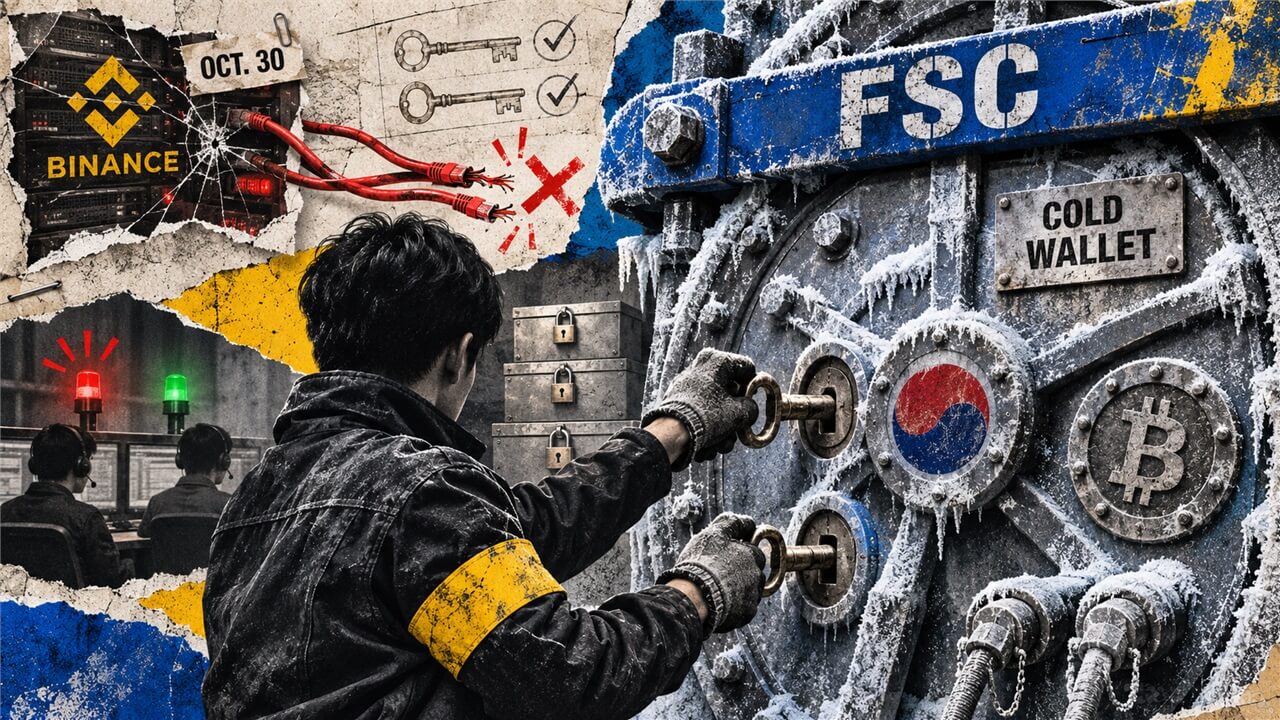
Whenever a major exchange takes a hit, regulators usually do one of two things: they either go quiet while they figure out how to tax the losses, or they panic and drop a hammer on the local industry. South Korea is currently leaning into the latter. Following the recent security breach at Binance, the Financial Services Commission (FSC) has issued a directive that essentially orders a massive lockdown of digital assets held by domestic exchanges.
The headline sounds like a disaster, but the reality is more about forced hygiene. The FSC is pushing for a transition where the vast majority of user funds are moved into cold storage. For those of us building in this space, this isn't exactly a new concept, but the scale and the urgency behind this specific order signal a shift in how governments view exchange risk. They no longer trust centralized platforms to manage their own 'hot' liquidity without adult supervision.
Cold Storage vs. Hot Reality
In simple terms, the FSC wants local exchanges to keep more money offline. Hot wallets—those connected to the internet—are necessary for fast trades and liquidity. They are also, as we saw with the Binance incident, the primary target for attackers. Cold storage is the digital equivalent of a vault buried under a mountain. It is safe, but it is slow.
For a founder, this creates a massive friction point. If you are building an application that relies on high-frequency movement or instant settlement, a government-mandated move to cold storage is a speed bump. The FSC is also demanding stronger transfer monitoring and increased staffing for security responses. On paper, this is great. In practice, it adds layers of bureaucracy to a technology that was supposed to remove it.
The Hidden Cost of Reserves
Part of this new mandate includes a requirement for exchanges to bolster their reserves. The logic is that if another hack happens, the exchange should have enough of its own capital to cover the user losses without going belly up. While this sounds like a win for consumer protection, it effectively raises the barrier to entry for any new South Korean exchange to a height that only the current giants can clear.
If you have to hold massive amounts of capital in reserve just to stay compliant, you aren't spending that money on product development or user experience. You are spending it on insurance for a worst-case scenario. This is where the founder's perspective gets skeptical: we are watching a regulatory environment evolve that favors the incumbents who can afford the compliance costs, while stifling the smaller, perhaps more innovative players who can't.
What Builders Need to Watch
The FSC hasn't been entirely clear on the specific custody thresholds yet. They’ve issued the 'what' but are still vague on the 'how.' This creates a period of uncertainty that is usually bad for business. If you are a developer building on top of these exchange APIs, you should expect latency. You should expect more 'maintenance windows' where withdrawals are halted. You should expect that the user experience of moving money from an exchange to a private wallet is about to get a lot more annoying.
There is also the matter of response staffing. The FSC is essentially telling exchanges they need more humans in the loop. In an industry that prides itself on automation and smart contracts, being forced to hire a small army of compliance officers feels like a step backward. However, from the perspective of a regulator who just watched millions of dollars vanish from one of the world's largest platforms, humans represent a kill-switch that code currently doesn't provide.
The regulatory response to the Binance hack isn't just about security; it's about control. By mandating cold storage, the state is effectively slowing down the velocity of money.
The Founder's Takeaway
We need to stop relying on centralized exchanges as the primary 'banks' of the crypto world. The FSC’s move is a blunt instrument, but it highlights a fundamental truth: if you don't hold the keys, you don't own the coins. This lockdown will likely cause a short-term dip in local trading volume as liquidity dries up, but for builders, it’s a clear signal to double down on self-custody solutions and decentralized infrastructure.
The more the government tightens its grip on centralized entities, the more valuable truly decentralized protocols become. If your business model depends on a South Korean exchange being able to move funds instantly, it's time to rethink your architecture. The era of 'fast and loose' exchange management in Asia is coming to a close, replaced by a rigid, reserve-heavy model that looks a lot more like the old banking system we were trying to improve.
The Long-Term Impact
South Korea is often a bellwether for crypto regulation in the rest of Asia. If these cold storage mandates and reserve requirements prove effective at stopping the bleeding from hacks, expect other regions to copy the homework. This will lead to a fragmented market where 'regulated' crypto feels very different from 'native' crypto.
For the skeptical builder, this is the time to watch the implementation details. If the FSC sets the cold storage threshold too high—say, 90% or more of all assets—we will see a significant shift in how liquidity is managed globally. We aren't just looking at a security upgrade; we are looking at the professionalization (and perhaps the sterilization) of the Korean crypto market.
Stay lean, watch your counterparty risk, and remember that every time a regulator 'protects' a user, they usually add a fee or a delay to the process. The Binance hack was the catalyst, but the FSC's reaction is the new reality we have to build around.
Read the original at CryptoSlate →