Solana is currently attempting something it hasn't really done before: a formal governance vote. For a network that has largely operated on the back of informal consensus and rapid-fire core developer updates, this is a significant milestone. But, in true crypto fashion, the rollout is hitting a snag that reveals exactly how messy the transition from code-driven execution to human-driven governance can be.
The Quorum Mismatch
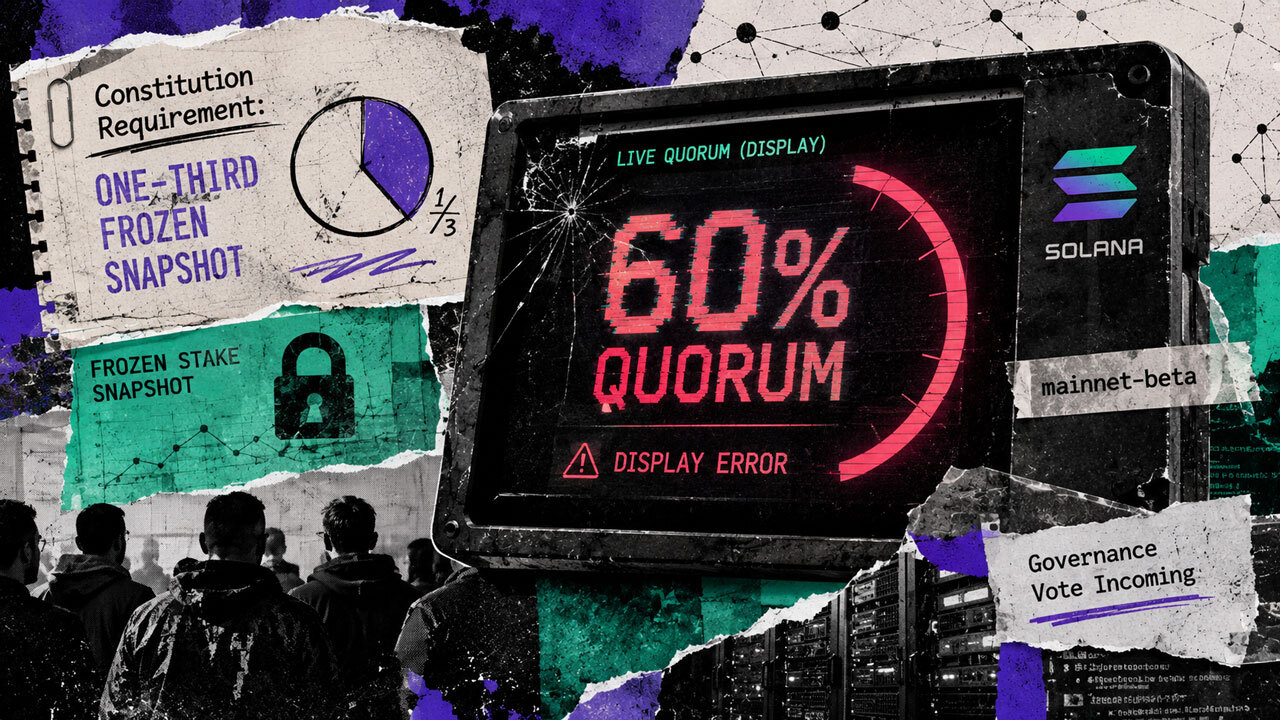
The issue at hand is essentially a math problem living in the user interface. Solana's newly established constitution requires a quorum of one-third of the total stake, based on a specific snapshot taken at a designated point in time. However, the frontend display currently tracking the vote is pulling live stake data, resulting in a displayed quorum requirement of roughly 60%. This isn't just a minor rounding error; it is a fundamental misalignment between the rules written in the governance documents and the software that validators and stakers are using to track progress.
For builders, this is a classic example of the 'frontend-backend' gap in decentralized systems. You can have the most robust, audited smart contract or protocol rulebook, but if the dashboard the community uses is wrong, the perception of the network's health and legitimacy suffers. In the lead-up to epoch 1021, developers are racing to merge a fix that replaces this live-stake calculation with the static snapshot data required by the constitution.
Why Snapshot Math Matters
In a proof-of-stake network, the 'total stake' is a moving target. People delegate, undelegate, and move tokens constantly. If your governance quorum is based on live data, the goalposts are always moving. A vote that looked like it was passing at 2:00 PM might suddenly fail at 2:05 PM because a whale moved their funds, even if the actual number of 'Yes' votes didn't change.
This is why snapshots are the industry standard. They freeze the distribution of power at a specific block height. It provides a level playing field where everyone knows exactly what the denominator is. The current friction on Solana suggests that while the governance rules were carefully thought out, the infrastructure to display those rules was an afterthought, or at least a victim of the network's high-velocity development cycle.
The Founder Perspective: Governance is UX
As a founder, I look at this and see a reminder that governance is, at its core, a user experience problem. If you make it difficult for people to understand if their vote counts or if a proposal is meeting its requirements, you lose the trust of the participants. Skepticism is the default state in crypto; when a dashboard shows a 60% requirement while the rules say 33%, the average user doesn't think 'oh, it's just a frontend bug.' They think the system is rigged or broken.
Solana has often been criticized for being overly centralized or 'developer-led.' This first vote is supposed to be the antidote to that narrative. It is meant to prove that the network can govern itself through a transparent, decentralized process. When the primary tool for that transparency is giving false readings, it plays right into the hands of the critics.
Infrastructure Debt
We often talk about technical debt in terms of messy code or outdated libraries. But there is also 'governance debt.' This occurs when you build a massive, high-performance machine but forget to build the control panel that tells the operators what is happening. Solana is the fastest machine in the room, but its control panel is currently blinking the wrong numbers.
The fix itself is relatively simple: an unmerged frontend update. But the fact that it needs to be rushed before a specific epoch highlights the fragility of these early-stage systems. Builders should take note: when you are designing a DAO or a governance module, your reporting tools are just as critical as your smart contracts. If the community can't see the truth, the truth doesn't matter.
What This Means for Builders
- Don't rely on live data for governance: Always anchor your quorum and voting power to a fixed snapshot. It prevents manipulation and provides clarity.
- UI is a consensus tool: The dashboard is where the community forms its collective opinion. If the UI is wrong, the consensus is fractured.
- Audit your displays: We spend millions on smart contract audits, but almost nothing on verifying that our frontends accurately reflect the state of those contracts.
Solana will likely fix this before epoch 1021, and the vote will proceed. But the lesson remains. Moving from a 'benevolent dictator' model to a community-governed model requires more than just a constitution; it requires a suite of tools that are as reliable as the blockchain itself. Right now, Solana's tools are still catching up to its ambitions.
Governance isn't just about the rules you write; it is about the data you show. If the data is wrong, the governance is a ghost.
We need to stop treating the 'governance page' of a project as a secondary feature. For any project aiming for true decentralization, the governance interface is the most important piece of software they will ever ship. It is the bridge between the code and the people who own it. When that bridge is shaky, the whole project feels unstable.
I’m watching to see how quickly the community reacts to this fix. In a truly decentralized ecosystem, the speed of the fix depends on the coordination of disparate developers, not just a command from the top. This bug is, ironically, a perfect test of the very governance system Solana is trying to implement.
Read the original at CryptoSlate →