Solana has always been the chain that moves fast and breaks things. It is the high-performance contender that prioritizes throughput above almost everything else. But as any founder knows, when you push the speed limit, you eventually hit a wall. For Solana, those walls have looked like network outages and congestion issues that have haunted the ecosystem for years.
The Alpenglow Experiment
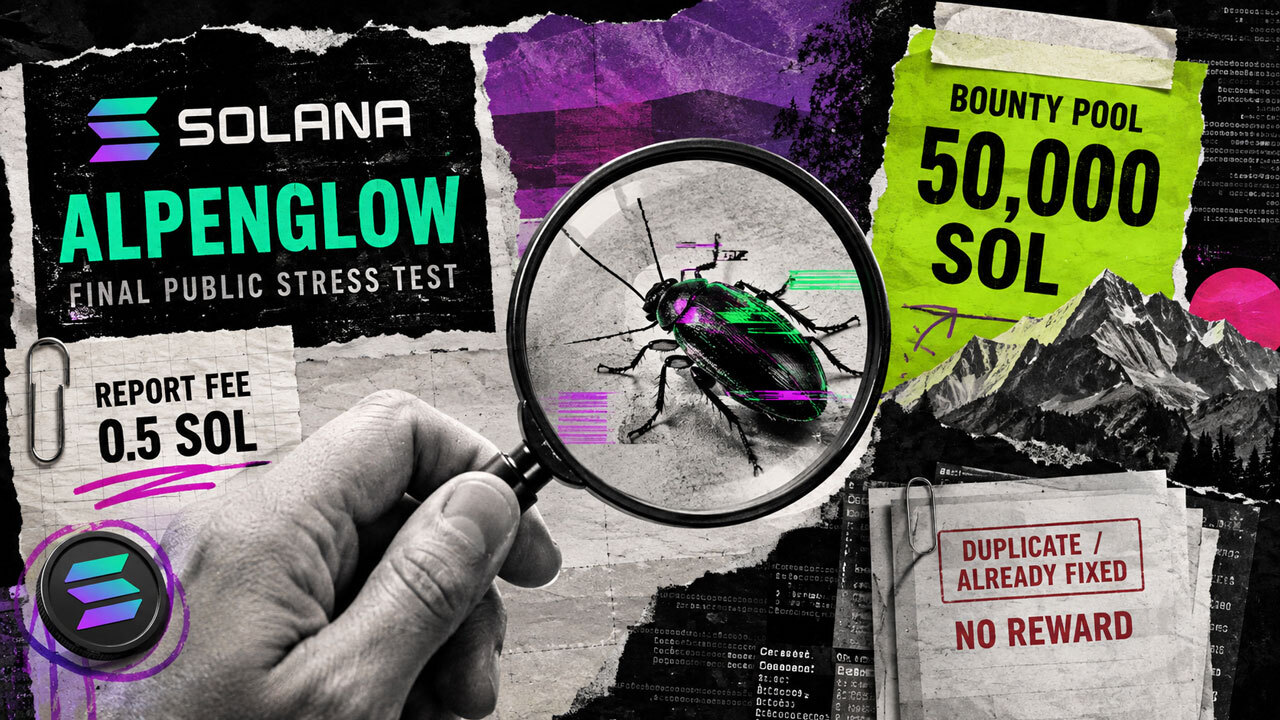
Anza, the developer shop spun out of Solana Labs to focus on the Agave validator client, recently announced Alpenglow. It is a bug bounty program designed to shore up the network's defenses. On the surface, the numbers look impressive. They are offering a ceiling of 50,000 SOL for the most critical vulnerabilities. At today's prices, that is a life-changing sum of money for a security researcher.
However, there is a catch that has the developer community talking: a 0.5 SOL filing fee. To even report a bug, a researcher has to pay about $70 to $100 depending on the market. If your report is deemed invalid or a duplicate, you lose that money. It is a pay-to-play model for security that feels distinctly different from the open-source ethos we usually see in crypto.
Filtering the Noise
I understand why Anza is doing this. If you run a high-profile project, your inbox is constantly flooded with low-effort garbage. You get people reporting that a button is off-center by two pixels and demanding a $5,000 reward. You get automated scanner results that have no bearing on actual security. It is exhausting, and it takes time away from real engineering work.
By charging a fee, Anza is effectively creating a proof-of-work mechanism for bug reports. They want to ensure that if someone is taking up their engineers' time, that person has enough skin in the game to be serious. It is an anti-spam measure. But as a builder, you have to ask if this friction is worth the potential loss of critical intel.
The Risk for Researchers
The math for a researcher is now fundamentally different. In a traditional bounty program, the only thing a researcher loses is time. With Alpenglow, they are risking actual capital. The program's rules around duplicate reports and eligibility are also somewhat fluid, which puts all the risk on the person trying to help the network.
If two researchers find the same critical flaw at the same time, the one who clicks submit a second later loses their 0.5 SOL and gets nothing. For a student or a developer in a developing economy, that fee isn't just a minor friction point; it is a barrier to entry. We might be locking out the very people who have the time and curiosity to find the deep, underlying flaws in the Agave client.
The Founder Perspective
If you are building an application on Solana, you want the underlying infrastructure to be as secure as possible. You want every white-hat hacker in the world looking at the code. Adding a toll booth at the entrance of the reporting process feels counter-intuitive to that goal. It assumes that the value of an engineer's time spent filtering spam is higher than the value of the one critical bug that might go unreported because a researcher didn't want to gamble 0.5 SOL.
We have seen this trend before in different ways. Whether it is paid API tiers or gated Discord communities, the industry is trying to solve the problem of noise. But security is the one area where you want the widest possible funnel. You want the noise because buried inside that noise is the signal that prevents a billion-dollar exploit.
Market Volatility and Incentives
Another factor to consider is the denomination of the fee and the reward. Both are in SOL. While this aligns incentives with the network's success, it adds a layer of price speculation to security research. If SOL moons, that filing fee becomes even more prohibitive. If SOL crashes, the 50,000 SOL reward might not be enough to keep a researcher from selling the exploit on the black market instead.
The black market for zero-days doesn't charge a filing fee. In fact, they pay upfront. When we create barriers for the good guys, we indirectly make the bad guys' offers look more attractive. It is a delicate balance that every protocol founder has to strike.
What This Means for Builders
- Higher Standards: If you are planning to report bugs to Anza, your documentation needs to be flawless. You are paying for their time, so make sure your proof-of-concept is undeniable.
- Resource Gating: This is a signal that the Solana ecosystem is moving toward a more professionalized, gated model of development. The days of 'cowboy coding' are being replaced by structured, albeit expensive, processes.
- Competitive Landscape: Watch how other validator clients handle this. If a competitor offers a zero-fee bounty program, we might see a shift in where the best security talent spends their time.
The Bottom Line
Anza is trying to solve a real problem—developer burnout from managing low-quality reports. But by putting a price tag on participation, they are running a social experiment as much as a technical one. They are betting that the serious researchers won't mind the fee and the jokers will be scared off. As a founder, I worry that this move prioritizes administrative convenience over radical transparency. Security shouldn't have a cover charge.
The goal of a bug bounty is to find bugs, not to balance the books on engineering hours. If one researcher decides not to report a critical flaw because of a 0.5 SOL fee, the cost to the Solana ecosystem will be far higher than the time saved by filtering spam.
We need to watch how this plays out. If the number of critical bugs discovered drops, Anza will have to pivot. If it stays the same and the noise disappears, every other major protocol will likely follow suit. For now, it is a bold, slightly cynical move that reflects the growing pains of a network trying to mature.
Read the original at CryptoSlate →