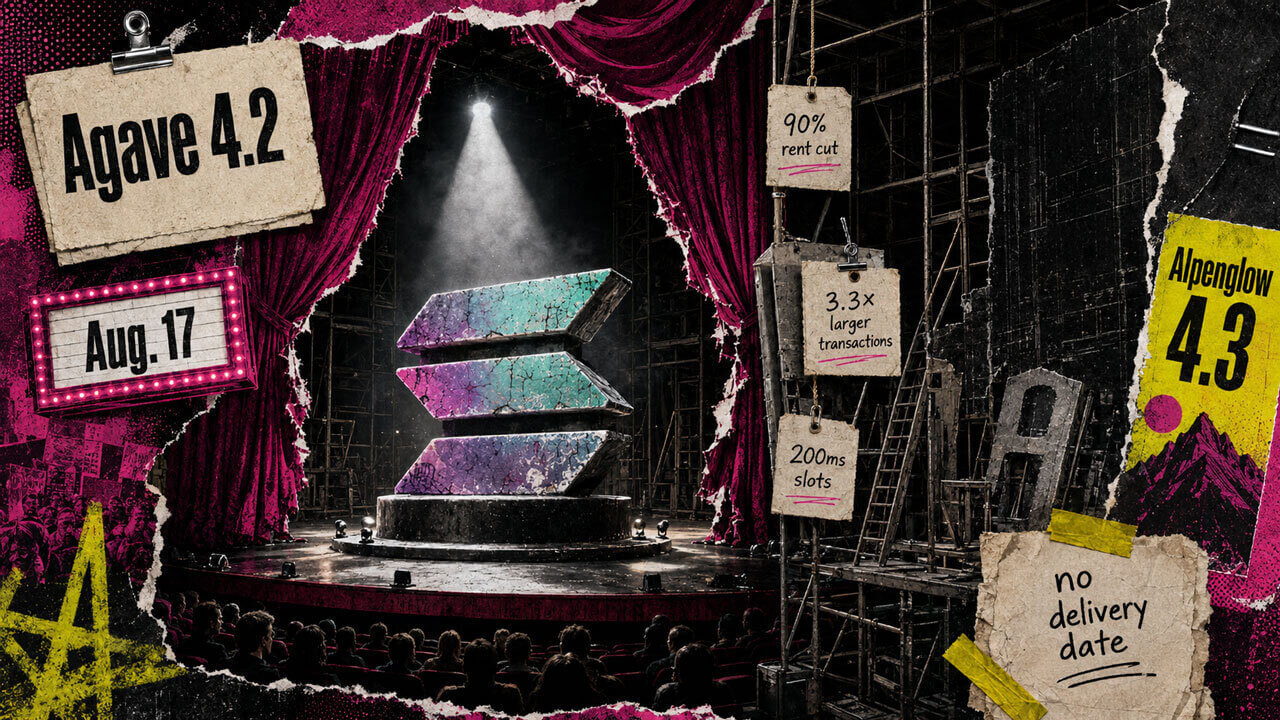
Solana is currently navigating one of its most critical periods of technical evolution. As the network attempts to scale beyond its initial architectural limits, the community has been looking toward the Agave 4.2 upgrade as a major milestone. However, the actual activation of this release has hit a bit of a snag. While the target dates have arrived, several of the most anticipated feature gates remain unconfirmed on mainnet.
For those of us building in this space, this isn't necessarily a cause for panic, but it is a reminder that moving fast and breaking things doesn't always work when you're managing billions in total value locked. The Agave 4.2 transition is supposed to be the moment Solana addresses some of its most persistent developer friction points. Instead, we are left watching the status monitors, waiting for the consensus mechanism to catch up with the roadmap.
The Bottleneck in the Gatekeeping Process
In the Solana ecosystem, a feature isn't just turned on by a flip of a switch. It goes through a process involving feature gates. This is a safety mechanism designed to ensure that new code doesn't cause a chain-splitting event or lead to massive state inconsistencies. The problem right now is that several of these gates—specifically those related to slot-time adjustments—are still pending.
When we talk about slot-time gates, we are talking about the very heartbeat of the network. If these aren't synchronized across validators, the network's clock gets out of whack. For builders, this matters because timing is everything in DeFi and high-frequency trading applications. The delay in these gates suggests that the transition to the new client isn't as seamless as the marketing materials might have suggested a few months ago.
The 90% Rent Cut: Why Builders Are Waiting
Perhaps the biggest disappointment in the current delay is the status of the 90% rent reduction. For years, the cost of opening new accounts on Solana has been a significant barrier to entry for smaller developers and projects trying to scale user bases. Rent is the fee paid to keep data stored on the blockchain, and it is currently high enough to make certain types of micro-transaction applications economically unfeasible.
The Agave 4.2 upgrade promised to slash these costs by nearly an order of magnitude. This would be a game-changer for consumer-facing apps that need to spin up thousands of accounts for new users. Right now, that feature lacks a confirmed start date. We are stuck in a holding pattern where the code exists, the intent is there, but the activation remains just out of reach. For a founder, this makes budgeting for user acquisition costs nearly impossible.
Expanding the Transaction Envelope
Another major pillar of this upgrade is the move to 4,096-byte transactions. If you’ve ever tried to build a complex smart contract on Solana, you know the frustration of hitting the current transaction size limits. You end up having to chain multiple transactions together, which increases complexity and introduces more points of failure.
Increasing the limit to 4,096 bytes would allow for much more sophisticated on-chain logic. It would essentially give developers more room to breathe. But like the rent reduction, this feature is currently stalled. The lack of a confirmed activation for larger transactions means we are still forced to optimize for a restricted environment that was supposed to be a thing of the past by now.
The Founder's Perspective on Network Maturity
I’ve seen plenty of projects rush updates only to regret it later. In that sense, a delay is better than a disaster. But there is a narrative risk here. Solana has fought hard to move past its reputation for downtime and instability. Part of that maturation process is hitting milestones when you say you will.
The Agave client is the successor to the original Solana Labs client, and its rollout is a test of the network's decentralized governance and technical coordination. If the network struggles to activate feature gates on schedule, it raises questions about how quickly Solana can actually iterate in a competitive landscape where Layer 2s and other high-throughput chains are nipping at its heels.
The tension here is between the need for speed and the requirement for stability. Developers want the new toys now, but the network cannot afford another high-profile outage.
What Should Builders Do Now?
If you are currently building on Solana, my advice is to keep your current optimizations in place. Do not start architecting your next release assuming the rent cut or the larger transaction sizes will be available next week. We have seen these "pending" statuses drag on longer than expected in the past.
- Audit your account structures: Assume the current rent prices will stick around for the next quarter. If your business model doesn't work at today's prices, you aren't ready for mainnet yet.
- Maintain transaction efficiency: Don't get lazy with your code. Even when the 4,096-byte limit arrives, the most efficient code will still win on performance.
- Monitor the validator logs: The best way to know when these gates will open isn't by reading Twitter; it's by watching the percentage of the network that has upgraded to the latest Agave version.
The Takeaway
Solana's Agave 4.2 upgrade is a necessary evolution, but the current delay in feature gate activation proves that the path to a truly scalable, low-cost blockchain is rarely a straight line. The rent cuts and transaction expansions are coming, but they aren't here yet. Builders should focus on what is possible today rather than banking on a future that is still stuck in the pending queue. The network is maturing, but that maturity comes with a slower, more deliberate pace of change that we all have to get used to.
Read the original at CryptoSlate →