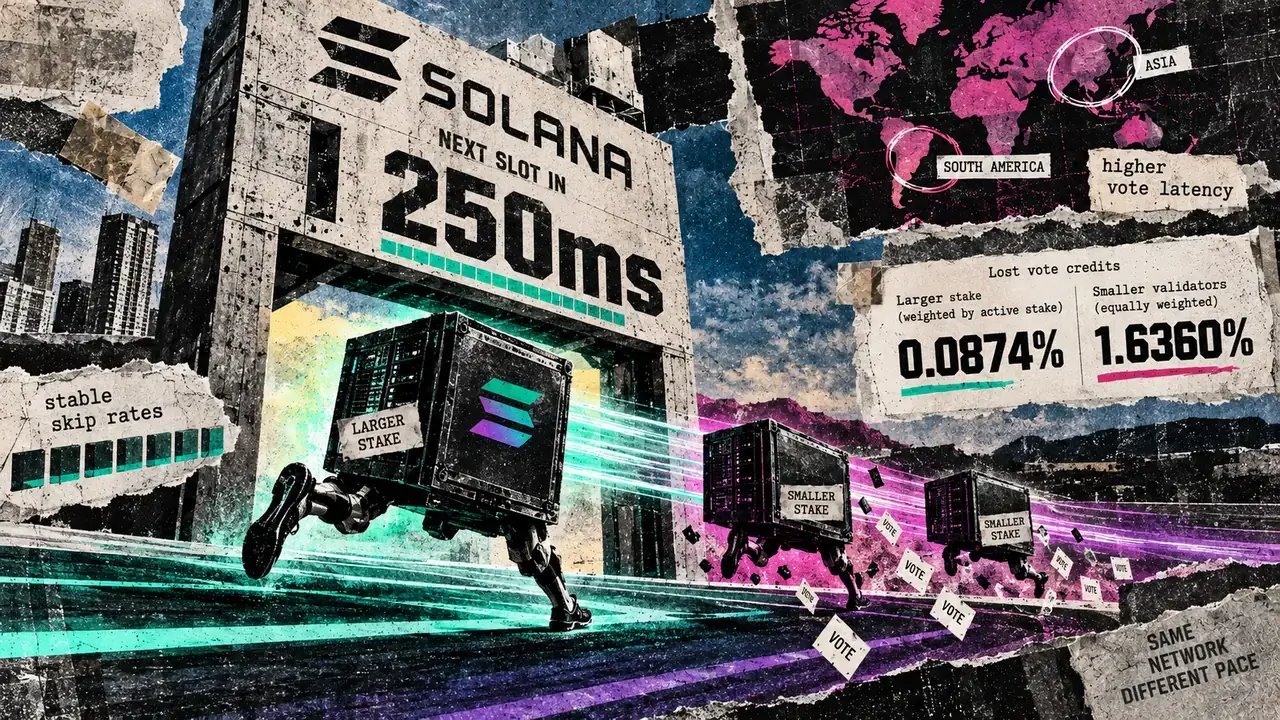
Solana has always been built on the promise of speed. The goal is to make the blockchain feel as instant as a centralized server. But as the network pushes toward a 250ms voting window, we are starting to see the physical limits of decentralized hardware. New data from the Solana Foundation suggests that while the network is getting faster, the cost of that speed is being paid by the smaller operators.
For those building on Solana, this isn't just a technical footnote. It goes to the heart of how decentralized the platform actually is. If the barriers to entry for running a validator keep rising, the network starts to look less like a global commons and more like a club for those with the best fiber connections and the deepest pockets for hardware upgrades.
The Math of a Vote Credit
To understand why this matters, you have to look at how validators get paid. In the Solana ecosystem, validators earn rewards by successfully voting on blocks. These are called vote credits. If your validator is too slow to communicate with the rest of the network, your vote doesn't get recorded in time. You miss out on the credit, and your yield drops.
Recent performance data during the shift toward 250ms windows shows a clear divergence. The heavy hitters—the validators with massive amounts of stake—are generally keeping their success rates high. But the smaller validators, those in the bottom tiers of stake weight, are seeing a significant spike in missed credits. This isn't a minor rounding error; it is a systemic disadvantage that compounds over time.
The Latency Tax
In the world of high-frequency trading, a millisecond is an eternity. Solana is essentially trying to bring that same level of urgency to a global decentralized network. When you tighten the window for voting, you are essentially increasing the "latency tax."
If you are a smaller validator running out of a secondary data center or a region with less-than-perfect peering, you are already at a disadvantage. When the network requirements were looser, you could compensate. At 250ms, the margin for error disappears. The data shows that these smaller players are losing a disproportionate share of their rewards simply because they can't shout loud enough or fast enough to be heard by the leaders.
Why This Matters for Founders
Founders often overlook the health of the validator set because they are focused on throughput and low fees. But a network that leans too heavily on a small group of elite validators is a fragile one. If the economics of being a small validator no longer make sense, these operators will simply turn off their machines. This leaves the network in the hands of a few large entities, which is exactly what crypto was supposed to move away from.
If you are building an application that requires true censorship resistance, you need a diverse and distributed set of validators. If the 250ms data is a sign of things to come, we might be heading toward a future where Solana is fast, but also more susceptible to the whims of a few large hosting providers and stake pools.
The 200ms Question
The Solana Foundation is already looking ahead to a 200ms window. If the current data shows smaller validators are already struggling at 250ms, a further reduction could be the breaking point. It raises a difficult question for the community: how much speed is worth the loss of decentralization?
There is a technical tension here that can't be solved with just a software patch. It is a limitation of physics and geography. As the voting window shrinks, the physical distance between validators becomes a deciding factor in their profitability. This creates a natural gravity that pulls validators toward the same data centers, creating a centralized point of failure.
The Incentive Gap
The current reward structure doesn't really account for this disparity. If the goal is to have a robust, global network, the incentive model might need to change. Currently, the system rewards efficiency above all else. But if efficiency leads to an oligarchy of high-speed nodes, the long-term value of the network might actually decline.
We have seen this play out in other industries. When you optimize for a single metric—in this case, speed—you often break the subtle mechanics that keep the system balanced. For Solana, the balance is between being a "world computer" and being a usable, high-performance platform for consumers.
A Reality Check for the Ecosystem
We need to stop pretending that hardware requirements don't matter. The narrative that anyone can participate in securing the network is getting harder to defend as the technical bar moves higher. For a founder, this means you need to be aware of the underlying infrastructure risks. You aren't just building on a protocol; you are building on a physical network of machines that are under increasing pressure.
If the data continues to show that smaller validators are being squeezed out, we may see a push for different reward tiers or subsidies for smaller nodes. But these are band-aid solutions for a fundamental architectural choice. Solana chose speed, and now the bill is coming due.
The move to 250ms isn't just a speed upgrade; it is a stress test for the social and economic fabric of the network. If we lose the small validators, we lose the spirit of the project.
Building for the Long Haul
As a builder, your job is to look past the hype of "faster blocks" and ask what it costs. A faster Solana is great for retail users and traders, but only if the network stays up and stays permissionless. The 250ms data is a warning light on the dashboard. It tells us that the current path favors the incumbents.
We should be watching the next few months closely. If the Foundation decides to push for 200ms without addressing the reward gap for smaller validators, it will be a clear signal that performance has officially won out over decentralization. For some, that's a trade-off they are willing to make. For others, it might be time to start thinking about what happens when the "people's chain" becomes a corporate playground.
The Takeaway
Speed is Solana's greatest strength, but it is also becoming its greatest centralizing force. The data on missed vote credits is a clear indicator that the network is becoming a playground for the well-connected. If you're building here, you need to account for a future where the validator set is smaller, faster, and much more concentrated than it is today.
Read the original at CryptoSlate →